The 1979 Iranian Revolution: What Actually Happened and Why It Still Matters
Introduction: The Revolution That Changed Everything
On February 11, 1979, the Iranian military declared itself “neutral” — refusing to defend the crumbling government of Shah Mohammad Reza Pahlavi. Within hours, armed revolutionaries seized government buildings, military installations, and television stations. The 2,500-year-old Persian monarchy was finished.
What replaced it changed the Middle East forever.
Within months, a 76-year-old cleric named Ayatollah Ruhollah Khomeini — who had spent 15 years in exile — consolidated power and established the Islamic Republic of Iran: the world’s first modern theocracy, governed by Shia Islamic law and the doctrine that a supreme religious jurist should rule the state.
Forty-seven years later, the revolution’s consequences are still unfolding: Iran’s proxy empire, its nuclear program, its confrontation with Israel, the persecution of its own people, and — in one of history’s great ironies — the explosive growth of Christianity within its borders.
To understand Iran today, you have to understand 1979. And to understand 1979, you have to go back further — to the last Shah, to American intelligence, and to a cleric’s cassette tapes.
The Shah: America’s Man in Tehran
Mohammad Reza Pahlavi
The Shah of Iran — Mohammad Reza Pahlavi — came to power in 1941 when the Allied powers forced his father to abdicate for sympathizing with Nazi Germany. He was 21 years old, insecure, and dependent on foreign support from the start.
In 1953, a pivotal event cemented the Shah’s dependence on the West. Iran’s democratically elected Prime Minister, Mohammad Mosaddegh, had nationalized Iran’s oil industry — threatening British Petroleum’s monopoly. The CIA and British MI6 organized Operation TPAJAX, a coup that overthrew Mosaddegh and restored the Shah to full power.
Declassified CIA documents confirm the operation. The Agency’s own internal history states that TPAJAX was “conceived and approved” at the highest levels of the U.S. and British governments, and that the coup involved bribing military officers, organizing street mobs, and spreading propaganda to destabilize Mosaddegh’s government.
The 1953 coup had two lasting consequences:
- It taught Iranians that their democracy could be overthrown by foreign powers — creating a deep distrust of the United States that persists to this day
- It gave the Shah unchecked power, which he used to build a security state backed by a feared secret police
SAVAK and Modernization
The Shah pursued aggressive modernization — building infrastructure, expanding education, promoting women’s rights, and transforming Iran into a regional power. He called it the “White Revolution.”
But modernization came with repression. The Shah’s secret police, SAVAK (Sāzmān-e Ettelā’āt va Amniyat-e Keshvar), was created in 1957 with CIA and Israeli Mossad assistance. SAVAK monitored, arrested, tortured, and killed political opponents — including leftists, Islamists, and intellectuals.
The Shah’s Iran was a contradiction: modern skyscrapers alongside medieval prisons. Women attending university while dissidents disappeared. A booming economy whose benefits flowed disproportionately to the connected elite.
By the late 1970s, the contradictions were unsustainable.
The Triggers: What Lit the Fuse
Economic Shock
Iran’s oil boom of the 1970s raised expectations — then dashed them. Oil revenues surged after the 1973 embargo, and the Shah launched massive spending programs. But the spending overheated the economy. Inflation rose sharply. Rural migrants flooded cities like Tehran, where housing and jobs couldn’t keep pace. The gap between rich and poor widened visibly.
Cultural Alienation
The Shah’s modernization program was perceived by religious conservatives as an assault on Iranian and Islamic identity. Western music, Western clothing, Western values — all flowing into Iran at a pace that left traditional communities disoriented and resentful.
The Shah’s lavish 1971 celebration at Persepolis — a party estimated to cost $200 million (equivalent to over $1.5 billion today) to honor 2,500 years of Persian monarchy — epitomized the disconnect. Iran’s clergy saw it as idolatrous excess. The poor saw it as obscene waste.
The Clergy’s Grievances
Ayatollah Khomeini had been exiled in 1964 after publicly opposing the Shah’s Status of Forces Agreement — which granted American military personnel in Iran immunity from Iranian law. Khomeini called it a surrender of sovereignty: “They have reduced the Iranian people to a level lower than that of an American dog.”
From exile — first in Iraq, then in Paris — Khomeini built a revolutionary movement using the most potent technology available: cassette tapes. His sermons were recorded, smuggled into Iran, copied by the thousands, and distributed through the vast network of mosques and bazaars that the Shah’s security apparatus couldn’t fully penetrate.
Khomeini’s message was simple and devastating: the Shah was an agent of America and Israel. His government was illegitimate. Islam demanded revolution.
The Revolution: 1978-1979
The Cascade
The revolution unfolded in stages:
January 1978: A government newspaper published an article insulting Khomeini. Seminary students in Qom protested. Security forces killed several students. The mourning period (40 days in Shia tradition) triggered new protests. More were killed. More mourning cycles began. Each cycle grew larger.
September 1978: Black Friday. On September 8, martial law was declared in Tehran. Troops opened fire on protesters in Jaleh Square, killing dozens — possibly hundreds. The event radicalized the movement. Compromise became impossible.
October-November 1978: Oil workers went on strike, crippling Iran’s primary revenue source. The bazaar merchants — Iran’s traditional commercial class — joined the strike. The economy ground to a halt.
December 1978: During the Shia holy month of Muharram, millions took to the streets in every major city. The demonstrations were the largest in Iranian history — an estimated 6-9 million people on December 10-11 alone, in a country of 35 million.
January 16, 1979: The Shah left Iran — officially for “medical treatment.” He would never return.
February 1, 1979: Khomeini flew from Paris to Tehran. An estimated 3-5 million people lined the route from the airport to the city center.
February 11, 1979: The military declared neutrality. The monarchy was over.
Khomeini’s Hijack: How an Islamic Republic Replaced a Revolution
The Coalition That Won — and Lost
The revolution was not a purely Islamic movement. It was a broad coalition:
– Islamic clerics (led by Khomeini)
– Leftist and Marxist groups (the Tudeh Party, Fedaiyan, Mujahedin-e Khalq)
– Liberal democrats (the National Front, led by figures like Mehdi Bazargan)
– Nationalist intellectuals
– Bazaar merchants
– Students
They agreed on one thing: the Shah must go. They agreed on almost nothing else.
Khomeini was brilliantly ambiguous during the revolution. From Paris, he told Western journalists he envisioned a democratic Iran where clerics would play an advisory, not governing, role. He said he personally had no interest in political power.
Every word of this was a lie.
The Consolidation
Once in power, Khomeini moved with ruthless efficiency:
March 1979: A national referendum — with a single option (“Islamic Republic: Yes or No?”) — passed with 98.2% approval. The question was designed to prevent any alternative.
April-June 1979: The Revolutionary Guards (IRGC) were established as a parallel military. Revolutionary courts began executing Shah-era officials, military officers, and political opponents. Hundreds were killed in the first months.
November 1979: Iranian students seized the U.S. Embassy in Tehran, taking 52 Americans hostage for 444 days. The hostage crisis eliminated moderate political figures (Prime Minister Bazargan resigned in protest) and rallied the population around Khomeini’s anti-American posture.
1980-1983: The leftist groups, liberal democrats, and nationalist intellectuals who had helped make the revolution were systematically suppressed. The Mujahedin-e Khalq were crushed. The Tudeh Party was banned. Thousands were imprisoned. Hundreds were executed.
By 1983, Khomeini had eliminated every alternative power center. The Islamic Republic was a one-ideology state.
Velayat-e Faqih: The Theological Innovation
Khomeini’s most consequential contribution was not political — it was theological. He developed the doctrine of Velayat-e Faqih (Guardianship of the Islamic Jurist): the idea that in the absence of the Hidden Imam (the Mahdi), a qualified Islamic jurist should have supreme authority over the state.
This was revolutionary within Shia Islam itself. Traditional Shia scholars — the “quietists” — taught that clerics should stay out of politics until the Mahdi returned. Khomeini argued the opposite: clerics were obligated to govern.
The result was the Supreme Leader — a position above the president, above the parliament, above the judiciary. The Supreme Leader commands the military, controls foreign policy, appoints the heads of the judiciary and state media, and has veto power over all legislation through the Guardian Council.
Iran’s Supreme Leader is not elected by the people. He is selected by the Assembly of Experts — a body of 88 clerics who are themselves vetted by the Guardian Council, whose members are appointed by the Supreme Leader.
The system is circular by design. Power flows from the top and returns to the top. The people vote, but only for candidates pre-approved by the clerical establishment.
The Iran-Iraq War (1980-1988)
Eight Years of Devastation
In September 1980, Iraqi President Saddam Hussein — encouraged by Iran’s revolutionary chaos — invaded. He expected a quick victory over a demoralized military.
He was catastrophically wrong.
The war lasted eight years. It killed an estimated 500,000-1,000,000 people on both sides. It featured trench warfare reminiscent of World War I, human wave attacks, child soldiers, and the use of chemical weapons by Iraq against both Iranian troops and Kurdish civilians.
Key facts:
- Iraq used chemical weapons extensively — including mustard gas and nerve agents — with the knowledge of Western governments. The U.S. provided Iraq with intelligence assistance even while aware of chemical weapons use.
- Iran sent teenage “Basij” volunteers to clear minefields, sometimes wearing plastic “keys to paradise” around their necks.
- Khomeini rejected ceasefire offers for years, extending the war long after Iran had pushed Iraqi forces back to the border. He wanted to overthrow Saddam and spread the revolution to Iraq.
- Khomeini finally accepted a ceasefire in July 1988, saying it was like “drinking poison.”
The war cemented the IRGC’s power, created a culture of martyrdom, and gave Iran the institutional memory of fighting alone against a world that either supported its enemy or stood by silently.
The Legacy: Why 1979 Still Defines the Middle East
What the Revolution Created
-
The first modern theocracy. The Islamic Republic proved that a religious government could seize and hold power in the modern era. It inspired Islamist movements worldwide.
-
The proxy empire. The IRGC, born from the revolution, built the network of Hezbollah, Hamas, Houthis, and Iraqi militias that defines Middle Eastern conflict today.
-
The nuclear question. Iran’s nuclear program — begun under the Shah with American assistance — was reoriented under the Islamic Republic toward potential weapons capability. The confrontation over Iran’s nuclear ambitions has shaped international diplomacy for two decades.
-
The Sunni-Shia cold war. The revolution triggered a regional rivalry between Iran (Shia) and Saudi Arabia (Sunni) that has fueled conflicts from Lebanon to Yemen.
-
The hostage crisis. 444 days of captivity permanently damaged U.S.-Iran relations and contributed to Ronald Reagan’s election. The two nations have not had diplomatic relations since 1980.
Biblical Perspective: God’s Sovereignty Over Revolution
The Pattern of Regime Change
Scripture consistently teaches that God is sovereign over the rise and fall of governments:
“He changes times and seasons; he removes kings and sets up kings.” (Daniel 2:21)
“The king’s heart is a stream of water in the hand of the LORD; he turns it wherever he will.” (Proverbs 21:1)
This does not mean God endorses every government that comes to power. It means no government comes to power outside His sovereign will — including governments that oppose Him.
The Irony of 1979
Here is the profound irony of the Iranian Revolution:
Khomeini established a government explicitly designed to promote Islam and suppress all alternatives — especially Christianity. He created a religious police, banned evangelism, and made apostasy from Islam punishable by death.
And under this government, more Iranians have come to faith in Jesus Christ than at any time in 1,400 years of Islamic rule.
The revolution that was supposed to purify Iran for Islam created the conditions — suffering, disillusionment, spiritual hunger — that opened Iranian hearts to the gospel. The underground church is the revolution’s unintended consequence. The regime built a theocracy; God used it as a greenhouse.
Cyrus and Khomeini
In Isaiah 45:1, God calls the Persian king Cyrus “my anointed” (māšîaḥ) — using him to accomplish divine purposes that Cyrus himself did not understand or intend.
The principle applies to all rulers, even those who oppose God. Khomeini did not intend to create the conditions for Christianity’s greatest advance in Iranian history. But God — who “declares the end from the beginning” (Isaiah 46:10) — was working through the revolution for purposes the Ayatollah never imagined.
Conclusion: The Revolution Isn’t Over
The 1979 revolution replaced one authoritarian system with another. It promised freedom and delivered theocracy. It promised justice and delivered the IRGC. It promised Islamic purity and delivered corruption, proxy wars, and economic ruin.
But the people of Iran are not finished.
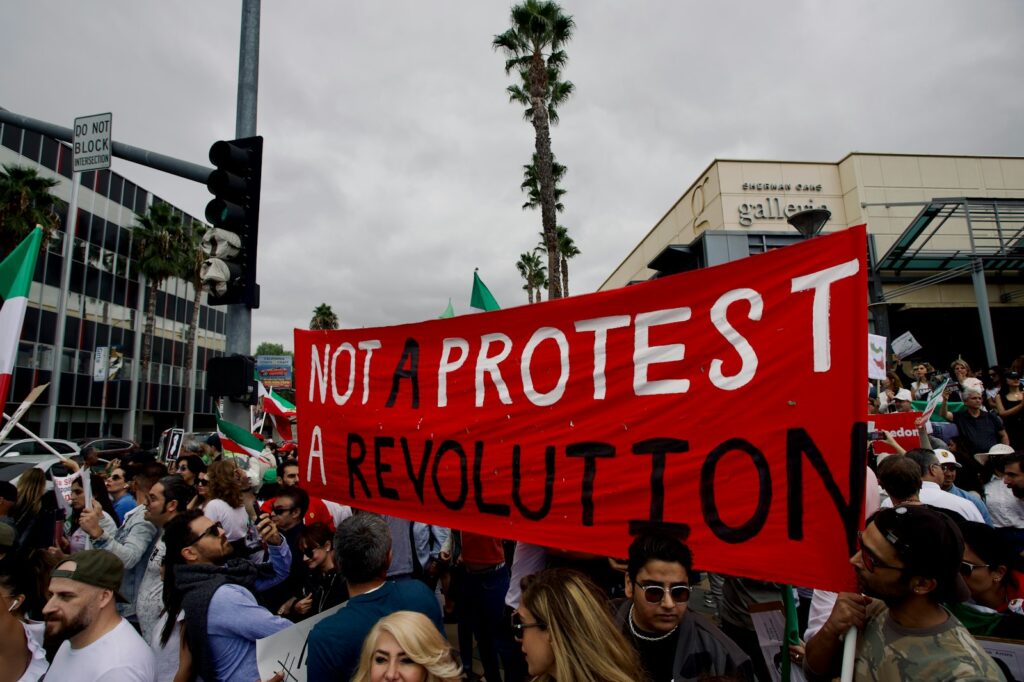
Every protest wave — 1999, 2009, 2017, 2019, 2022 — has been larger and more radical than the last. The generation born after the revolution has no loyalty to it. They did not choose this system. They inherited it. And they are increasingly unwilling to accept it.
The revolution of 1979 changed the Middle East. The next revolution — whenever it comes — may change it again. And the God who was sovereign over Khomeini’s rise is equally sovereign over whatever comes next.
“For I know the plans I have for you, declares the LORD, plans for welfare and not for evil, to give you a future and a hope.” (Jeremiah 29:11)
This verse was written to exiles — people whose world had been destroyed by conquest and revolution. It is a fitting word for Iran’s people today: exiled within their own country, waiting for a future that God has not abandoned.
Further Reading
- Iran in the Bible: A Complete Guide — The full biblical story of Iran
- Rise of the Ayatollahs: 1979-Today — How the revolution became a system
- The Mahdi and Iran’s Apocalyptic Ideology — The theology behind the theocracy
- Iran’s Underground Church: The Secret Revival — The revolution’s unintended consequence
- Iran Protests 2026: What Christians Need to Know — The people vs. the regime
Sources
- Congressional Research Service, Iran: Background and U.S. Policy, Updated May 2025.
- CIA FOIA Electronic Reading Room, Khomeini’s Iran.
- CIA FOIA Electronic Reading Room, The Battle for Iran, 1953 TPAJAX documentation.
- Defense Intelligence Agency, Iran Military Power, November 2019.
- Office of the Director of National Intelligence, 2025 Annual Threat Assessment.