
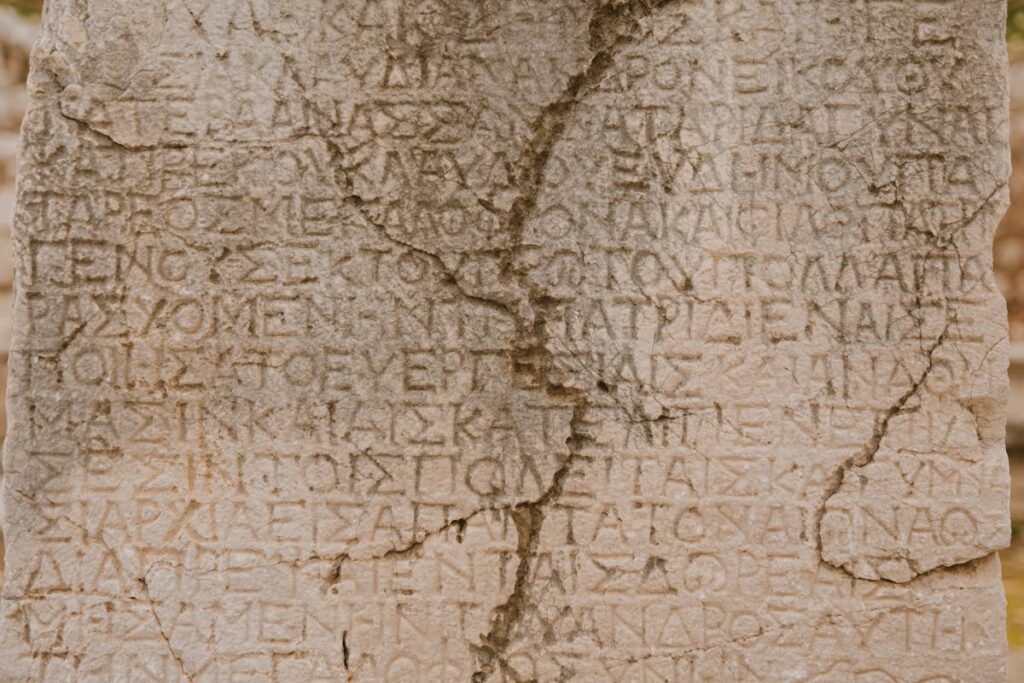
You have read John 1 in English. Possibly dozens of times. You may have memorized it, preached from it, clung to it in seasons when nothing else held. And yet there is a real sense in which you have never read John 1 at all.
That is not your fault. It is the nature of translation, and the distance across time and cultures. English is a blunt instrument trying to carve what Greek rendered with a scalpel. Where Greek offers five words with five distinct shades of meaning, English hands you one and wishes you luck. Where Greek verb tenses carry entire theological arguments in a single syllable, English flattens them into the same past tense and moves on.
Consider the opening line: “In the beginning was the Word.” In English, “Word” is just… a word. Four letters. You read it, nod, and continue. But logos is not just a word. It carries two thousand years of Greek philosophy on its back — Heraclitus, the Stoics, Philo of Alexandria — while simultaneously echoing the Hebrew dabar, the creative speech of God that called galaxies into existence. When John chose logos, he lit a fuse that detonated across two entire intellectual traditions at once. Your English Bible cannot show you that explosion. It can only show you the crater.
This article walks through twenty-seven Greek terms in John 1 — the ones that matter most, the ones where the original language doesn’t just add nuance but fundamentally changes what you understand the text to be saying. We are not doing this as an academic exercise. We are doing this because John wrote in Greek, and the Holy Spirit inspired every word he chose with surgical precision. To read John 1 without the Greek is like listening to a symphony through a wall. You get the melody. You miss the music.
You do not need to know Greek to benefit from what follows. You just need to be willing to slow down and let these ancient words do what they were always meant to do.
The Cosmic Terms (vv. 1–5)
The first five verses of John’s Gospel are among the most theologically dense sentences ever composed in any language. Every word is load-bearing. Here is where John lays the foundation for everything that follows — and where English loses the most.
1. Logos (λογος) — “Word”
Start here, because John does. “In the beginning was the Word” (John 1:1, NKJV). In English, “word” suggests speech, language, maybe a statement. “logos”Greek“λόγος”“logos”“noun,“word, is a universe larger.
For Greek philosophers, logos was the rational principle that structured and sustained all reality. Heraclitus, writing five centuries before Christ, argued that a divine logos governed the cosmos — an ordering intelligence behind the apparent chaos of existence.1 The Stoics developed this further: logos was the fiery reason permeating all things, the mind of God woven into the fabric of the universe. Philo of Alexandria, a Jewish philosopher contemporary with Jesus, used logos over thirteen hundred times in his writings, treating it as the mediating agent between the transcendent God and the material world.2
But John was also a Jew, steeped in the Hebrew Scriptures. And in Hebrew, dabar — the word of God — is not abstract. It acts. “By the word of the LORD the heavens were made” (Psalm 33:6, NKJV). God speaks and galaxies ignite. God speaks and seas part. The dabar of God is God’s power released into creation.
John takes both traditions — Greek rationality and Hebrew creative power — and transcends them both. His Logos is not an abstract principle. His Logos is not merely a force. His Logos is a Person. A Person who was with God and was God and would, fourteen verses later, become flesh and pitch His tent among us. No single English word can carry all of that. “Word” is the best we have. It is not enough.
2. En Archē (εν αρχη) — “In the Beginning”
This is not “once upon a time.” John opens his Gospel with a phrase his readers would have recognized immediately: “enGreek“ἐν“en“prepositional“in is the exact phrase the Septuagint — the Greek translation of the Old Testament — uses to open Genesis 1:1. John is not being subtle. He is writing a new Genesis. A new beginning. Or rather, he is revealing what was true at the original beginning but had not yet been fully disclosed.
The Greek word archē means more than a starting point in time. It carries the sense of origin, source, foundation — the absolute ground of all reality. When John says the Logos was en archē, he means: go back as far as you can go, past every created thing, past time itself, past the first tick of the cosmic clock — and the Word is already there. Not beginning. Already there.
3. Ēn (ην) vs. Egeneto (εγενετο) — “Was” vs. “Became”
This may be the single most important grammatical distinction in John 1, and English obliterates it completely.
In verses 1–2, John uses the Greek verb “ēn”Greek“ἦν”“ēn”“verb,“was — the imperfect tense of eimi (“to be”). The imperfect tense in Greek describes continuous, ongoing action in the past with no specified beginning or end. The Word was — continuously, perpetually, without origin. Ēn appears four times in the first two verses, hammering the point: existence without beginning.
Then in verse 3, John switches verbs. “egeneto”Greek“ἐγένετο”“egeneto”“verb,“became, — the aorist tense of ginomai (“to become, to come into being”). The aorist marks a definite point of origin. Everything that was made egeneto — it came into existence. It had a birthday. It was not, and then it was.
The Word ēn. Creation egeneto. Two different verbs. Two different tenses. An infinite ontological chasm between them. And then, in verse 14, the thunderclap: “And the Word became (egeneto) flesh.” The One who ēn — who existed eternally without beginning — egeneto — entered the category of created, temporal, finite existence. The verb change is the Incarnation in miniature.
4. Theos (θεος) Without the Article — “God”
“And the Word was God” (John 1:1c, NKJV). In Greek: kai “theos”Greek“θεός”“theos”“noun,“God ēn ho logos. Notice: no definite article before theos. This is not sloppy grammar. It is precision theology.
If John had written ho theos ēn ho logos (the God was the Word), he would have collapsed the Word into the Father — the heresy of modalism. If he had written ho logos ēn theios (the Word was divine), he would have made the Word a lesser, merely god-like being — the heresy of subordinationism. Instead, by placing theos before the verb without the article, John communicates that the Word fully shares the divine nature (theos is qualitative) while remaining personally distinct from the Father (ho theos, who appears in verse 1b).3 One essence. Two persons. Every major Christological heresy of the next four centuries is anticipated and excluded by this single clause. The Greek guards the mystery that English leaves exposed.
5. Katalambanō (καταλαμβανω) — “Comprehend” / “Overcome”
“And the darkness did not comprehend it” (John 1:5, NKJV). Other translations read “overcome it.” Who is right? Both. That is the genius of “katalambanō”Greek“καταλαμβάνω”“katalambanō”“verb”“to.
This word carries a double meaning that no single English term can replicate. It means both to grasp intellectually (to comprehend, to understand) and to seize physically (to overpower, to overcome). Darkness neither understood the light nor defeated it. The intellectual failure and the hostile assault are both present in the same word, layered on top of each other. Darkness tried to wrap its mind around the light and failed. Darkness tried to snuff out the light and failed. One Greek word. Two devastating verdicts.
The Identity Terms (vv. 6–13)
John now shifts from cosmic origins to historical arrival. The light enters the world. Witnesses are summoned. The drama of acceptance and rejection begins. And the Greek tells us things English cannot.
6. Martureō (μαρτυρεω) — “Testify” / “Witness”
John the Baptist came “for a witness, to bear witness” (John 1:7, NKJV). The Greek word is “martureō”Greek“μαρτυρέω”“martureō”“verb”“to, and it is legal language — courtroom vocabulary. A martus is one who testifies under oath. This is not casual recommendation. This is sworn testimony about matters of life and death.
This matters because the entire Gospel of John is structured as a cosmic trial. Witnesses are called. Evidence is presented. Verdicts are rendered. The word martureō and its cognates appear over seventy times in John’s Gospel — more than in any other New Testament book. From the very first chapter, you are not reading a biography. You are sitting in a courtroom. And the question before you is the question of the ages: Who is Jesus of Nazareth?
7. Phōs (φως) — “Light”
Christ is identified as “the true Light which gives light to every man” (John 1:9, NKJV). In Greek: to “phōs”Greek“φῶς”“phōs”“noun,“light to alēthinon. That adjective — alēthinos — does not mean “true” as opposed to “false.” It means genuine, ultimate, archetypal — the real thing of which all other instances are shadows. Every candle, every torch, every star, every insight that has ever illuminated a human mind is a faint echo of this Light. Christ is not a light. He is the Light — the source, the standard, the original from which all lesser lights derive their flicker.
8. Skotos / Skotia (σκοτος / σκοτια) — “Darkness”
Darkness in John is never merely the absence of light. “skotia”Greek“σκοτία”“skotia”“noun,“darkness is a domain — moral evil, spiritual blindness, the realm of Satan’s influence. It is active, aggressive, and hostile. When John says the light shines in the darkness (verse 5), he means the light has invaded enemy territory. This is not a gentle sunrise. It is a beachhead.
9. Lambanō (λαμβανω) — “Received”
“He came to His own, and His own did not receive Him” (John 1:11, NKJV). The verb “lambanō”Greek“λαμβάνω”“lambanō”“verb,“to in the aorist tense denotes a decisive, completed act. This is not gradual indifference. It is a definitive refusal. Israel looked at their Messiah, weighed the evidence, and shut the door. The aorist captures the finality of that rejection — a single, devastating verdict rendered by the very people who had been waiting for Him for two thousand years.
10. Exousia (εξουσια) — “Right” / “Authority”
To those who did receive Him, Christ gave “the right to become children of God” (John 1:12, NKJV). The Greek word “exousia”Greek“ἐξουσία”“exousia”“noun,“authority, is far stronger than “permission.” It denotes legal authority — a legitimate, granted right backed by sovereign power. This is not God looking the other way while sinners sneak into the family. This is God issuing a royal decree of adoption, signed and sealed by divine authority. No one can contest it. No court in heaven or earth can overturn it.
11. Tekna Theou (τεκνα θεου) — “Children of God”
John’s word for “children” here is “teknaGreek“τέκνα“tekna“noun“children, not huioi. The distinction matters. Huioi (sons) is the word Paul typically uses, emphasizing legal adoption and inheritance rights. Tekna comes from tiktō — to give birth. John emphasizes not adoption paperwork but birth. To become a child of God, in John’s vocabulary, is to be born — born of God (verse 13), born from above (John 3:3). New nature, new origin, new life at the cellular level. Not a change of status only, but a change of being.
The Incarnation Terms (vv. 14–18)
If the first five verses are the foundation and verses 6–13 are the drama, then verses 14–18 are the climax. This is where John tells us what actually happened — and the Greek words he uses to tell it are among the most carefully chosen in all of Scripture.
12. Sarx (σαρξ) — “Flesh”
“And the Word became flesh” (John 1:14, NKJV). John did not write sōma (body). He did not write anthrōpos (man). He wrote “sarx”Greek“σάρξ”“sarx”“noun,“flesh — the most visceral, most vulnerable, most uncomfortably physical word available to him. Sarx is flesh in its weakness, its mortality, its susceptibility to hunger and fatigue and pain and death. It is the word you use when you want to emphasize not the dignity of humanity but its frailty.
That is the scandal. The eternal Logos — the One who ēn without beginning, who was theos, through whom all things egeneto — took on sarx. Not a glorious angelic form. Not an exalted spiritual body. Flesh. The kind that bleeds. The kind that gets tired at wells and weeps at tombs. John could have softened this. He chose not to. The word sarx is John’s refusal to let you spiritualize the Incarnation into something comfortable.
13. Skēnoō (σκηνοω) — “Dwelt” / “Tabernacled”
The Word became flesh and “dwelt among us” (John 1:14, NKJV). The Greek says something far more vivid: eskēnōsen en hēmin — He pitched His tent among us. “skēnoō”Greek“σκηνόω”“skēnoō”“verb”“to comes from skēnē (tent), which is the Greek equivalent of the Hebrew mishkan — the tabernacle, the portable dwelling where God’s glory resided as Israel wandered through the wilderness.
The callback is unmistakable. In Exodus 40:34–35, the glory of the LORD filled the tabernacle so intensely that Moses could not enter. The mishkan derives from the verb shakan (to dwell), the root of Shekinah — the manifest, radiant dwelling-presence of God. John is telling you: that same glory, the glory that filled the tabernacle, the glory that hovered over the mercy seat, the glory that Moses begged to see — that glory has now taken up residence in human flesh. God did not send a representative. God moved in.
14. Monogenēs (μονογενης) — “Only Begotten” / “One and Only”
“The glory as of the only begotten of the Father” (John 1:14, NKJV). “monogenēs”Greek“μονογενής”“monogenēs”“adjective”“one-of-a-kind, has generated centuries of debate. It is formed from monos (only) and genos (kind, type), not gennaō (to beget). Its core meaning is not “only-born” but one-of-a-kind, unique, in a class by Himself. The Nicene Creed used “only-begotten” to defend Christ’s eternal generation from the Father, and that theological truth stands. But the word itself underscores something simpler and no less staggering: there is no one else like this. The Son’s relationship to the Father is utterly unique, unrepeatable, unshared. You can become a teknon of God. You will never be the monogenēs.
15. Doxa (δοξα) — “Glory”
“We beheld His glory” (John 1:14, NKJV). In classical Greek, “doxa”Greek“δόξα”“doxa”“noun,“glory, meant “opinion” or “reputation.” But the Septuagint pressed it into service to translate the Hebrew kabod — a word meaning weightiness, heaviness, splendor. The kabod of God was His manifest presence in overwhelming radiance. Moses asked to see it and was told no mortal could survive the sight (Exodus 33:18–20). Isaiah saw it fill the temple and cried out in terror (Isaiah 6:1–5). Ezekiel saw it depart from the temple and wept.
John says: we beheld it. Not from a distance. Not through a cloud. In a carpenter from Nazareth. In hands that broke bread and touched lepers. The kabod of God, walking the streets of Capernaum. That is what doxa means here. And it should stop you cold.
16. Charis (χαρις) — “Grace”
“Full of grace and truth” (John 1:14, NKJV). Then in verse 16: “Grace upon grace” — in Greek, “charis”Greek“χάρις”“charis”“noun,“grace, anti charitos. That little preposition anti means “in place of” or “upon.” The image is one grace replacing another, not because the first was deficient, but because the supply is inexhaustible. Picture standing in the ocean as waves hit the shore: one wave of grace arrives, and before it recedes, another replaces it. Then another. Then another. There is no moment when the grace is not coming. Charis is God’s disposition toward His people in Christ — unearned, unmerited, unending.
17. Plērēs (πληρης) — “Full”
Christ is “plērēs”Greek“πλήρης”“plērēs”“adjective”“full, of grace and truth — complete, overflowing, lacking nothing. This is not partial grace supplemented by our effort. Not measured grace dispensed in careful portions. Plērēs means filled to the brim and spilling over. Every grace you need is already in Christ. Every truth you seek terminates in Him. He does not offer a percentage. He offers fullness.
18. Exēgēsato (εξηγησατο) — “Declared” / “Made Known”
“The only begotten Son, who is in the bosom of the Father, He has declared Him” (John 1:18, NKJV). The Greek word is “exēgēsato”Greek“ἐξηγήσατο”“exēgēsato”“verb,“declared, — and yes, it is the root of the English word “exegesis.” To exegete is to draw out the meaning, to explain, to interpret. John is making a breathtaking claim: Jesus Christ is God’s self-interpretation. He did not merely tell us about the Father. He is the explanation. He is the exegesis of the invisible God. If you want to know what God is like — what He loves, what He hates, how He acts, what moves Him — you look at Jesus. He has exegeted the Father. There is no higher revelation. There is no deeper explanation. The final Word on God is the Word made flesh.
The Incarnation vocabulary of John 1:14-18 reveals that God did not send a message — He became the message. The eternal Logos took on sarx (vulnerable flesh), skēnoō-ed (pitched His tent) among us in a deliberate echo of the Old Testament tabernacle, and exēgēsato (exegeted) the invisible Father through a fully human life. Every Greek word in these verses insists: God did not delegate. God showed up.
The Testimony Terms (vv. 19–51)
The Prologue gives way to narrative. Witnesses step forward. Names are given. The first disciples encounter Jesus. And even here, in what seems like straightforward storytelling, the Greek reveals layers that English smooths over.
19. Amnos tou Theou (αμνος του Θεου) — “Lamb of God”
“Behold! The Lamb of God who takes away the sin of the world!” (John 1:29, NKJV). Two words in Greek. Two thousand years of sacrificial theology compressed into them. The Passover lamb whose blood on the doorposts turned away the angel of death (Exodus 12). The tamid — the daily sacrifice offered every morning and evening in the temple (Exodus 29:38–42). The lamb led to slaughter in Isaiah 53:7, silent before its shearers. When John the Baptist pointed at Jesus and said “amnosGreek“ἀμνὸς“amnos“noun“Lamb, every Jewish ear within range heard the entire sacrificial system distilled into a single identification. The lambs were always pointing forward. This is where they were pointing.
20. Rabbi (Ραββι) — “My Great One”
The first disciples address Jesus as “rabbi”Greek“Ῥαββί”“rabbi”“title”“my (John 1:38). In the first century, this title was not an academic credential. It was a declaration of total-life commitment. A rabbi’s disciples did not merely attend his lectures. They followed him everywhere — ate what he ate, walked where he walked, absorbed his way of seeing the world. The question “Rabbi, where are You staying?” (John 1:38) is not a request for an address. It is an offer of their lives. And Jesus’ answer — “Come and see” — is an invitation to exactly that.
21. Messias (Μεσσιας) — “Anointed One”
Andrew runs to his brother Simon and says: “We have found the Messias” (John 1:41, NKJV). John transliterates the Hebrew/Aramaic term and then translates it: “which is translated, the Christ.” “messias”Greek“Μεσσίας”“messias”“noun,“anointed — from the Hebrew mashiach, “anointed one” — carried the weight of centuries of expectation. The anointed King from David’s line who would restore Israel, defeat her enemies, and reign forever. Andrew is not making a theological observation. He is making the most explosive claim a first-century Jew could make: the waiting is over.
22. Kēphas / Petros (Κηφας / Πετρος) — “Rock”
Jesus looks at Simon and says: “You shall be called Cephas” (John 1:42, NKJV). “kēphas”Greek“Κηφᾶς”“kēphas”“noun,“rock, is Aramaic for “rock.” Petros is the Greek equivalent. This is not a nickname. It is a prophecy. Jesus looks at an impulsive, unreliable fisherman and speaks over him what he will become. The name change — like Abram to Abraham, Jacob to Israel — signals a divine remaking of identity. Jesus does not see Simon as he is. He sees Simon as grace will make him. That is how He sees all His own.
23. Alēthōs (αληθως) — “Truly” / “Genuinely”
Of Nathanael, Jesus says: “Behold, an Israelite indeed, in whom is no deceit!” (John 1:47, NKJV). The word rendered “indeed” is “alēthōs”Greek“ἀληθῶς”“alēthōs”“adverb”“truly, — truly, genuinely, authentically. Nathanael is a real Israelite, one who actually embodies what Israel was called to be: honest, open to God, without the guile that characterized Jacob (whose name means “deceiver” and who was renamed Israel). In one sentence, Jesus reads Nathanael’s character and connects him to the patriarchal narrative. Every word is doing triple duty.
24. Huion tou Theou (υιον του Θεου) — “Son of God”
Nathanael responds: “You are the Son of God! You are the King of Israel!” (John 1:49, NKJV). “huiosGreek“υἱὸν“huios“noun“Son in a first-century Jewish context was a messianic title drawn from Psalm 2:7 and 2 Samuel 7:14. Nathanael is confessing Jesus as the promised Davidic King. But John, writing decades later with the full weight of post-resurrection understanding, knows that this title means far more than Nathanael realized when he said it. The Son of God is not merely a royal designation. He is the monogenēs — the eternal, one-of-a-kind Son who was theos and was en archē. Nathanael spoke better than he knew.
25. Basileus tou Israēl (βασιλευς του Ισραηλ) — “King of Israel”
Paired with “Son of God,” “basileusGreek“βασιλεὺς“basileus“noun“King is Nathanael’s second confession — and it is political dynamite. Israel in the first century was an occupied nation under Rome. To call someone “King of Israel” was not a theological abstraction. It was a claim of sovereignty that could get you killed. John records this title early because it will echo through the entire Gospel, all the way to the cross, where Pilate will nail a sign above Jesus’ head: “The King of the Jews.” What Nathanael confessed in wonder, Pilate will write in mockery — and both will be telling the truth.
26. Angelous tou Theou (αγγελους του Θεου) — “Angels of God”
Jesus tells Nathanael: “You shall see heaven open, and the angels of God ascending and descending upon the Son of Man” (John 1:51, NKJV). This is a direct allusion to Jacob’s ladder in Genesis 28:12. But notice the substitution: in Genesis, the “angelousGreek“ἀγγέλους“angelous“noun“angels ascend and descend on a ladder. In John, they ascend and descend on the Son of Man. Jesus Himself is the ladder. He is the connection point between heaven and earth, the meeting place of God and humanity, the living bridge that Jacob’s dream only prefigured.
27. Huios tou Anthrōpou (υιος του ανθρωπου) — “Son of Man”
This is the title Jesus chose for Himself more than any other. “huiosGreek“υἱὸς“huios“noun“Son draws from Daniel 7:13–14, where “one like the Son of Man” approaches the Ancient of Days and receives an everlasting kingdom, dominion, and glory.4 It is simultaneously a claim to true humanity (son of man = human being) and to cosmic, divine authority (the Danielic Son of Man rules over all nations forever). In one title, the full arc of John 1 converges: the eternal Logos who was theos, who became sarx, who skēnoō-ed among us — He is the Son of Man. Fully God. Fully human. The one in whom heaven and earth, eternity and time, divinity and humanity are joined forever.
Reading John 1 Again for the First Time
You cannot unlearn what you have just read. The next time you open to John 1 in your English Bible, you will see the words on the page — but behind them, beneath them, you will know what is there. The logos that carries two civilizations on its back. The ēn that whispers of eternity and the egeneto that marks the moment God crossed over into our world. The sarx that refuses to let you look away from the scandal of the Incarnation. The exēgēsato that tells you Jesus is the final word on God — literally.
Every one of these words was chosen under divine inspiration with exacting precision. John was not reaching for the nearest available term. He was a theologian writing under the guidance of the Holy Spirit, and every word was load-bearing. The structure holds because every piece was placed with care.
This article has given you a glimpse. For a verse-by-verse exegesis of the entire chapter — every clause, every connection, every theological implication drawn out in full — see our Deep Dive into John 1. And for the historical world these words exploded into — the Roman politics, the Jewish expectations, the Greek intellectual climate that made this Prologue so revolutionary — see our Historical Context of John 1.
Twenty-seven Greek words. Each one chosen with surgical precision under divine inspiration. Together they reveal that John 1 is not merely an introduction to a Gospel — it is the entire story of God compressed into forty-nine verses: eternal existence (ēn), creative power (logos), sacrificial love (amnos), radical identification (sarx), and the unending, inexhaustible outpouring of grace upon grace (charin anti charitos). The Greek does not add decoration to the text. It is the text.
John 1 is forty-nine verses. Twenty-seven words in, and we have barely scratched the surface. That should tell you something about the kind of book the Bible is. It is the kind of book where every word repays a lifetime of attention — because every word was breathed out by a God who does nothing carelessly.