The World Behind Psalm 1 — Wisdom Literature, the Psalter’s Architecture, and Ancient Israel’s Worship
Six verses. No title. No superscription. No attribution. The psalm that opens the entire Psalter arrives without ceremony – and that silence is itself a statement. Psalm 1 does not announce who wrote it, when it was written, or what historical occasion produced it. It simply begins: “Blessed is the man.” As if to say: before you know anything else, you need to know this.
We read Psalm 1 as a devotional warm-up, a pleasant appetizer before the great feast of David’s laments and praises. But the people who placed it at the head of Israel’s hymnbook were not offering a devotional warm-up. They were erecting a gateway. A threshold. A condition of entry. And they did so within a world whose literary traditions, worship practices, agricultural rhythms, and urban structures gave every phrase of this psalm a resonance we have almost entirely lost.
The gap between us and the original audience of Psalm 1 is not merely chronological. It is agricultural, architectural, literary, and liturgical. We do not winnow grain on hilltop threshing floors. We do not sit in city gates to render judgment. We do not know what it means to live in a semi-arid climate where the difference between a tree planted by irrigation channels and a shrub in the desert is the difference between life and death. We do not understand, instinctively, why the “two ways” motif would have struck an ancient Israelite with the force of a proverb they had heard since childhood – because the same motif had been echoing through the wisdom literature of the ancient Near East for a thousand years before the Psalter was compiled.
What follows is an attempt to recover that world – not exhaustively, but vividly enough that the next time you read Psalm 1, you hear what they heard.
1. The Wisdom Literature Tradition
Psalm 1 is not a hymn. It is not a lament. It is not a prayer. It contains no address to God, no petition, no cry of distress, no burst of praise. It is, in the precise terminology of biblical scholarship, a wisdom psalm – a didactic poem that instructs the reader in the art of righteous living. And that classification places it squarely within one of the oldest and most sophisticated literary traditions in the ancient world.
Wisdom literature – the Hebrew “chokmah”Hebrew“חָכְמָה”“chokmah”“noun,“wisdom, tradition – was Israel’s contribution to a genre that spanned the entire ancient Near East. From Egypt’s Instruction of Amenemope to Mesopotamia’s Counsels of Wisdom, from the Sumerian Instructions of Shuruppak to Israel’s own Proverbs, Ecclesiastes, and Job, the wisdom tradition addressed a single overarching question: How should a person live in order to flourish? Not how should a nation worship, not what covenant has God made with His people, not what is the prophetic word for this generation – but the more fundamental, more universal question: What does a well-lived human life look like?
This is precisely the question Psalm 1 answers. Gordon Wenham observes that the psalm poses its question with stark simplicity: “There are two types of people, two types of life, and two conclusions. Which will you choose to follow?” (Wenham, The Psalter Reclaimed, p. 53). And it answers it in the characteristic form of the wisdom tradition: the “two ways” motif. There are exactly two paths through life. One leads to blessedness; the other leads to ruin. One produces a tree; the other produces chaff. One is known by God; the other perishes. No third option. No middle ground. No spectrum of moral gradations.
The connection to Proverbs is unmistakable. Proverbs 1-9 develops this same binary at length: the way of wisdom versus the way of folly, the path of the righteous versus the path of the wicked. Proverbs 4:18-19 captures it succinctly: “But the path of the just is like the shining sun, that shines ever brighter unto the perfect day. The way of the wicked is like darkness; they do not know what makes them stumble.” The vocabulary is shared. The logic is identical. The categories are the same. Psalm 1 is Proverbs compressed into six verses and set at the doorway of the Psalter.
The connection to Ecclesiastes is subtler but equally real. Ecclesiastes questions whether the two-ways framework actually holds in the observable world – whether the righteous truly prosper and the wicked truly perish. “There is a vanity which occurs on earth,” the Preacher observes, “that there are just men to whom it happens according to the work of the wicked; again, there are wicked men to whom it happens according to the work of the righteous” (Ecclesiastes 8:14). Psalm 1 affirms the framework that Ecclesiastes interrogates. The Psalter begins with the confident assertion that the two ways are real and their outcomes are certain – and then spends the next 149 psalms wrestling with the agonizing exceptions.
The word “letsim”Hebrew“לֵצִים”“letsim”“noun,“scornful, in Psalm 1:1 is itself a wisdom term. It appears twenty times in Proverbs but only here in the entire Psalter.1 Proverbs 21:24 provides the definition: “A proud and haughty man – ‘Scoffer’ is his name; he acts with arrogant pride.” The scoffer is the terminus of the downward spiral: the man who has passed through moral looseness and habitual sin into settled, intellectualized contempt for everything sacred. Keil and Delitzsch observe that this vocabulary “points us to the time of Solomon and onwards” – to the era when the chokmah tradition reached its full maturity in Israel.
The Tyndale notes classify Psalm 1 explicitly as a “wisdom psalm” and list it alongside Psalms 15, 24, 33, 34, 37, 73, 90, and 107 as part of this instructional genre within the Psalter. But Psalm 1 stands apart from all of them by virtue of its position. It is not merely one wisdom psalm among many. It is the wisdom psalm that controls how every other psalm is read. The editors of the Psalter placed it first because they understood that the entire prayer book of Israel must be approached with the categories of wisdom: there are two ways, and you must know which one you are on before you can pray.
Psalm 1 is a wisdom psalm – a didactic poem in the tradition of Proverbs, Ecclesiastes, and the ancient Near Eastern instruction literature. Its “two ways” motif, its vocabulary (especially the wisdom term letsim), and its lack of any address to God mark it as a product of Israel’s chokmah tradition. Placed first in the Psalter, it functions as the wisdom framework through which all 150 psalms are to be read.
2. The Psalter’s Architecture — Five Books Mirroring the Torah
The Psalter is not a random anthology. It is a carefully constructed collection, arranged with deliberate editorial intent – and Psalm 1 is the keystone of the entire structure.
The most significant architectural feature of the Psalter is its division into five books, each closing with a doxology:
- Book I (Psalms 1-41) – doxology at 41:13
- Book II (Psalms 42-72) – doxology at 72:18-19
- Book III (Psalms 73-89) – doxology at 89:52
- Book IV (Psalms 90-106) – doxology at 106:48
- Book V (Psalms 107-150) – Psalm 150 serves as the closing doxology for the entire collection
This fivefold division is ancient and deliberate. The church father Hippolytus, writing in the early third century, noted that the Hebrews divided the Psalter into five books “so that it might be another Pentateuch.”2 The Midrash confirms this: “Moses gave the Israelites the five books of the Torah, and corresponding to these, David gave them the Book of Psalms, which consists of five books.” The Psalter is the Torah’s echo – the devotional response to the revelatory word. As the Torah begins with God speaking, the Psalter begins with the blessedness of the one who listens.
Keil and Delitzsch elaborate this structural principle with characteristic precision: “The division of the Psalter into five parts makes it the copy and echo of the Torah, which it also resembles in this particular: that as in the Torah Elohistic and Jehovistic sections alternate, so here a group of Elohistic Psalms (42-84) is surrounded on both sides by groups of Jehovistic Psalms (1-41, 85-150).” The alternation of divine names is not accidental; it is architecturally coordinated across the five books.
Gerald Wilson’s landmark study demonstrated that the Psalter is “bound together by two frameworks: the inner framework relates to the Davidic covenant (Psalms 2, 72, 89, 144), whereas the outer is a final wisdom frame (Psalms 1, 73, 90, 107, 145)” (cited in Wenham, The Psalter Reclaimed, p. 31). Within this architecture, Psalm 1’s placement is programmatic. The Tyndale notes state it plainly: “The editors placed Psalms 1 and 2 as an introduction to the whole book of Psalms. Both psalms give idealized portraits: Psalm 1 portrays the ideal godly person who lives by God’s instruction. Psalm 2 portrays the Messiah, the ideal king of Israel. The rest of the Psalter develops and deepens these portraits, while at the same time exploring how neither the people of God nor their king were able to fulfill God’s ideals.”
The Talmud (Berachoth 9b) records that Psalms 1 and 2 were originally considered a single composition – a double gateway, one ethical and the other prophetic. The evidence for this ancient reading is partly linguistic: Psalm 1 opens with “ashre”Hebrew“אַשְׁרֵי”“ashre”“O and Psalm 2 closes with the same word: “Blessed are all those who put their trust in Him” (Psalm 2:12). The two psalms form an inclusio – a literary frame – with ashre as its opening and closing bracket.
But their functions are distinct. Psalm 2 introduces the Psalter’s messianic and prophetic vision: the nations rage, the kings conspire, and God laughs from heaven as He installs His Anointed on Zion’s holy hill. Psalm 1 introduces the Psalter’s ethical and sapiential vision: the fundamental moral binary that governs all human life. Together they establish the two coordinates – the ethical and the eschatological – by which the entire Psalter navigates.
Keil and Delitzsch capture the editorial logic: “Psalm 1 being the proper prologue of the Psalter in its pentateuchal arrangement after the pattern of the Torah. For the Psalter is the Yea and Amen in the form of hymns to the word of God given in the Torah. Therefore it begins with a Psalm which contrasts the lot of him who loves the Torah with the lot of the ungodly – an echo of that exhortation, Joshua 1:8, in which, after the death of Moses, the LORD charges his successor Joshua to do all that is written in the book of the Torah.”
This connection to Joshua 1:8 is striking and probably deliberate. Joshua was told: “This Book of the Law shall not depart from your mouth, but you shall meditate in it day and night, that you may observe to do according to all that is written in it.” Psalm 1:2 echoes: “In His law he meditates day and night.” Joshua stood at the threshold of the Promised Land; the reader of Psalm 1 stands at the threshold of the Psalter. Both are charged with the same task: saturate yourself in the word of God before you proceed.
The editorial history of the Psalter is complex, stretching across centuries. Keil and Delitzsch trace the earliest collection to the Solomonic era, noting the subscription at Psalm 72:20 – “The prayers of David the son of Jesse are ended” – as the marker of the oldest psalm-collection. The Tyndale notes observe that “the process of collecting and editing was likely completed following the exile to Babylon,” with 1 Chronicles 16:36 serving as evidence that the fivefold structure was already in place by the time of the Chronicler. The implication is that Psalm 1 was placed at the head of the collection during the final editorial stages – a post-exilic community deliberately choosing a wisdom psalm, not a royal psalm or a hymn of praise, as the gateway to Israel’s prayer book. Bruce Waltke dates this final arrangement with some precision: “During the postexilic period, probably about 520 BC, the Psalms were edited in such a way as to focus on the king. This final editing significantly affected both the Psalter’s interpretation and theology” (Waltke, An Old Testament Theology, p. 507).
The Psalter’s five-book structure mirrors the five books of the Torah, making it the devotional echo of God’s revelatory word. Psalms 1 and 2 function as a double gateway – one ethical, one messianic – establishing the coordinates by which all 150 psalms navigate. Psalm 1’s placement is an editorial decision with profound theological implications: before you can pray, you must reckon with the binary of blessedness.
3. Ancient Israelite Worship — How Psalms Were Used
To understand Psalm 1’s function, we need to understand the world of worship into which it was placed. The psalms were not private devotional reading. They were the soundtrack of Israel’s public worship – sung, chanted, and performed in the context of temple liturgy, festival processions, and communal prayer. As Walvoord and Zuck note, “The Psalms have served God’s people down through the ages as the inspiration for and often the instrument of praise to God. But they have also brought comfort and hope to individual souls in their times of greatest needs, teaching them how to pray, and giving them the confidence of answered prayers” (Walvoord and Zuck, The Bible Knowledge Commentary: Wisdom, p. 76).
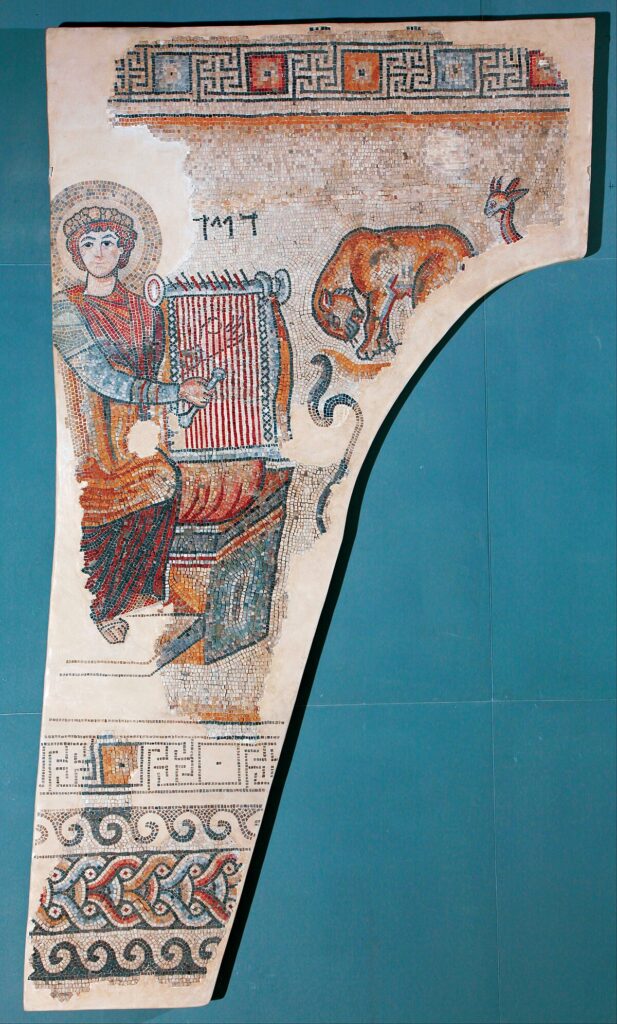
David himself was the architect of Israel’s musical worship. According to 1 Chronicles 23:5, he appointed four thousand Levites as singers and musicians for the tabernacle service on Mount Zion, dividing them into twenty-four courses under the direction of three chief musicians: Asaph, Heman, and Ethan (also known as Jeduthun). These were not amateurs. They were professional musicians, set apart for the work of sacred song, trained in the schools of the prophets that Samuel had founded (1 Samuel 19:19-20). Keil and Delitzsch note that David “multiplied the instruments, particularly the stringed instruments, by his own invention” (1 Chronicles 23:5; Nehemiah 12:36). The sweet psalmist of Israel was also its master composer and instrument maker.
The instruments themselves are worth lingering over. The Tyndale notes observe that the Hebrew word “mizmor”Hebrew“מִזְמוֹר”“mizmor”“noun,“psalm, – the most frequent genre designation in the psalm titles – “is related to a verb meaning ‘to play a stringed instrument.’” Psalms were songs for the lyre. The “nevel”Hebrew“נֵבֶל”“nevel”“noun,“harp, was a stringed instrument with a resonating body above the strings; the “kinnor”Hebrew“כִּנּוֹר”“kinnor”“noun,“lyre, was the smaller, portable lyre that David played before Saul. Cymbals, trumpets, and wind instruments accompanied the strings. The result was not a solo performance but a full orchestral and choral presentation, with multiple choirs singing antiphonally and instrumental ensembles providing accompaniment.
The temple itself was the venue. David established three places of sacrifice during his reign: beside the ark on Zion, in Gibeon beside the Mosaic tabernacle, and later on the threshing floor of Ornan (the future Temple Mount). Solomon’s temple consolidated these into a single magnificent complex, and the musical worship David had established became the permanent liturgy of the sanctuary. The Levitical choirs sang the psalms as part of the daily tamid service – the morning and evening sacrifices – and with particular intensity during the three great pilgrimage festivals: Passover, Pentecost (Shavuot), and Tabernacles (Sukkot).
Specific psalms were assigned to specific occasions. The Egyptian Hallel (Psalms 113-118) was sung at Passover – this is the “hymn” Jesus and His disciples sang before going out to the Mount of Olives (Matthew 26:30). The Songs of Ascents (Psalms 120-134) were sung by pilgrims ascending to Jerusalem for the festivals. Psalm 30 was designated “a song for the dedication of the Temple.” Psalm 92 was the psalm for the Sabbath day. The Great Hallel (Psalms 120-136) accompanied the major festivals with sustained, congregational praise.
But Psalm 1 stands apart from this liturgical system. It has no musical notation. No superscription indicating a tune or instrument. No assignment to a festival or occasion. No “Selah” to mark an instrumental interlude. Its silence on all these matters is itself significant. Psalm 1 is not a psalm to be sung in the temple service. It is a psalm to be read, studied, and internalized before the service begins. It is, as Matthew Henry observed, the preface: “Whoever collected the psalms of David with good reason put this psalm first, as a preface to the rest, because it is absolutely necessary to the acceptance of our devotions that we be righteous before God, and therefore that we be right in our notions of blessedness and in our choice of the way that leads to it. Those are not fit to put up good prayers who do not walk in good ways.”3
The verb “yehgeh”Hebrew“יֶהְגֶּה”“yehgeh”“qal“he in Psalm 1:2 – typically translated “meditates” – is itself connected to the world of vocal performance. The root hagah describes not silent reflection but audible murmuring, the low recitation of sacred text. Keil and Delitzsch define it: “hagah, of a deep, dull sound, as if vibrating between within and without, here signifies the quiet soliloquy of one who is searching and thinking.” It is the same word used for the growling of a lion (Isaiah 31:4), the cooing of a dove (Isaiah 38:14), and the low rumble of thunder. When applied to Scripture, it describes a man who speaks the words of God to himself throughout the day – a practice deeply rooted in the oral culture of ancient Israel, where texts were read aloud, memorized by repetition, and internalized through constant vocal rehearsal.
This practice of vocal meditation was not uniquely Israelite. Throughout the ancient Near East, scribes and students memorized instructional texts by reciting them aloud repeatedly. What was uniquely Israelite was the object of meditation: not the wisdom of human sages, but the “torah”Hebrew“תּוֹרָה”“torah”“noun,“instruction, of the LORD – the revealed word of God. The blessed man of Psalm 1 is distinguished not merely by his piety but by the source of his wisdom: it comes from outside himself, from above, from the God who speaks.
Israel’s worship was a full sensory experience – orchestral music, choral singing, sacrificial ritual, and festival procession. David appointed four thousand Levites as professional musicians, and specific psalms were assigned to specific occasions. But Psalm 1 stands outside this liturgical system. It has no musical notation, no assigned occasion, and no superscription. It is the preface to the prayer book – the moral prerequisite that must be settled before worship can begin.
4. The Gate and the City Square
Three images in Psalm 1:1 – the “counsel of the ungodly,” the “way of sinners,” and the “seat of the scornful” – place the reader squarely in the social geography of the ancient Israelite city. To understand what these phrases meant to their original audience, we need to understand where public life happened.
The city gate was the center of civic life in ancient Israel. It was not merely an entrance; it was a complex architectural structure, typically consisting of multiple chambers flanking a passageway, with benches built into the walls. Here elders sat to render judgment, merchants conducted business, prophets delivered oracles, and the community gathered to hear news, settle disputes, and conduct public affairs. Boaz went to the gate to settle the matter of Ruth’s redemption (Ruth 4:1-2). Absalom stood beside the road leading to the gate to intercept litigants and subvert his father’s authority (2 Samuel 15:2). The gate was where “counsel” was given and received.
The Hebrew word “etsah”Hebrew“עֵצָה”“etsah”“noun,“counsel, in Psalm 1:1 belongs to this world. To “walk in the counsel of the ungodly” is not merely to entertain bad thoughts in private. It is to adopt the operating principles of men who sit in the gate – men whose advice shapes public policy, whose worldview determines community direction, whose authority sets the terms of social life. In the ancient Israelite city, counsel was a public act, delivered by recognized figures in recognized spaces. The blessed man is the one who refuses to take his cues from men whose moral compass is untethered from God.
The “derek”Hebrew“דֶּרֶךְ”“derek”“noun,“way, – “the way of sinners” – is equally concrete. Ancient Israelite cities were built on tells (artificial mounds formed by centuries of successive habitation), with narrow streets running between densely packed houses. The major routes through the city connected the gate to the market, the threshing floor, the water source, and the high place or sanctuary. To “stand in the way of sinners” is to take up a position on these well-traveled routes – to plant yourself where sinners walk and do what sinners do, in plain sight, as a matter of established practice.
The “moshav”Hebrew“מוֹשָׁב”“moshav”“noun,“seat, – “the seat of the scornful” – is the most static and the most damning of the three. Keil and Delitzsch note that moshav, like the Arabic majlis, signifies both a seat and an assembly – both the physical position and the social gathering. To sit in the seat of the scornful is to have found your permanent company among the cynics, to have assumed a posture of settled authority in their circle. It evokes the image of a man who has claimed his customary place on the bench in the gate or the gathering place in the square – not as a visitor but as a regular, not as a listener but as a presiding voice.
The progression from walking to standing to sitting, from counsel to way to seat, traces a journey from the periphery of a city’s social life to its center. The man who first merely passes through the gate where ungodly counsel is given ends by taking up permanent residence on its bench. He has become one of the elders of an alternative assembly – not the congregation of the righteous (Psalm 1:5), but the moshav of the scornful.
The three images of Psalm 1:1 – counsel, way, and seat – map directly onto the social geography of the ancient Israelite city. The city gate was where counsel was given, the streets were where life was lived in public, and the moshav was where men of influence took their customary seats. The progression traces a journey from casual exposure to settled residence in a world of ungodly authority.
5. Agricultural Imagery — Trees, Chaff, and the Palestinian Climate
Psalm 1’s central metaphors – the tree planted by water and the chaff driven by wind – are drawn directly from the agricultural realities of ancient Palestine. For readers who lived in this landscape, no explanation was needed. For us, some context is essential.
The climate of ancient Israel was Mediterranean semi-arid: hot, dry summers lasting from May to October, and mild, rainy winters from November to April. Rainfall was concentrated in the winter months and was geographically uneven – plentiful in the Galilee and the coastal plain, sparse in the Judean wilderness and the Negev. The difference between fertile land and desert could be a matter of miles. A tree’s survival depended entirely on its access to water.
The phrase “rivers of water” in Psalm 1:3 translates “palgeHebrew“פַּלְגֵי“palge“noun“channels. The word “peleg”Hebrew“פֶּלֶג”“peleg”“noun,“channel, does not denote a wild river or a seasonal wadi. It denotes a managed irrigation channel – a stream of water that has been deliberately directed to nourish crops and trees. The practice of managed water supply was ancient and widespread. Stephen Bertman describes how “In southern Mesopotamia… they used river water by digging and maintaining a system of irrigation canals,” sometimes transporting water by means of the shaduf, a counterweighted pole and bucket device “still being used by farmers” in the region today (Bertman, Handbook to Life in Ancient Mesopotamia, p. 259). The same technology that sustained civilizations along the Tigris and Euphrates is the background for the psalm’s central image. Keil and Delitzsch explain: “Peleg means the brook meandering and cleaving its course for itself through the soil and stones; the plural denotes either one brook regarded from its abundance of water, or even several which from different directions supply the tree with nourishing and refreshing moisture.”
This distinction is critical. In a landscape where rainfall was seasonal and unreliable, a tree that depended on rain alone was vulnerable. A tree planted by irrigation channels, however, had a constant, engineered supply of water – water that flowed regardless of season, regardless of drought, regardless of the scorching khamsin winds that blew in from the eastern desert. The tree by the palge mayim was not merely fortunate. It was deliberately placed in the one location where survival was guaranteed.
The word “shatul”Hebrew“שָׁתוּל”“shatul”“qal“transplanted, intensifies this point. As the Jalkut (614) explains, shatul, in distinction from the common word natua (“planted”), means “firmly planted, so that no winds that may rage around it are able to remove it from its place.” The tree was not self-sown. It was deliberately dug up from its original soil and replanted in the best possible location – a gardener’s intentional act. Anyone who had watched a farmer transplant a fruit tree from rocky ground to irrigated soil would have understood the metaphor immediately: the blessed man is where he is because someone put him there.
The same tree metaphor echoes throughout the Psalter. Walvoord and Zuck note that in Psalm 92:12-15, “the righteous will flourish like… palm trees and cedars of Lebanon. These trees picture fruitfulness and vitality under God’s good hand (cf. 1:3)” (The Bible Knowledge Commentary: Wisdom, p. 139). The image that begins the Psalter recurs as a sustained promise. The fruit “in its season” (“be’itto”Hebrew“בְּעִתּוֹ”“be’itto”“prep“in) reflects the seasonal rhythms of Palestinian agriculture. The olive harvest came in autumn. The grape harvest in late summer. The fig tree bore fruit in stages across the warm months. The almond tree blossomed in late winter, the earliest sign of spring. Each fruit had its appointed time, and a healthy tree could be counted on to produce at that time without fail. The blessed man’s fruitfulness is not forced or artificial; it emerges naturally, on schedule, from the deep roots and steady water supply that sustain him.
The opposite image – chaff – is drawn from the threshing floor, one of the most familiar landmarks in the ancient Israelite landscape. Threshing floors were typically located on hilltops or ridgelines, exposed to the prevailing winds. After the grain harvest (barley in April-May, wheat in May-June), the sheaves were brought to the threshing floor and beaten or trampled by oxen to separate the kernels from the stalks. The threshed grain was then winnowed: tossed into the air with a fork or shovel so that the wind could blow away the light husks – the “motz”Hebrew“מֹץ”“motz”“noun,“chaff” – while the heavy grain fell back to the floor.
Chaff was the waste product of the harvest. It had no nutritional value. It could not be stored or sold. It was useful only as kindling – or as nothing at all. Once the wind caught it, it was gone. The Dictionary of Biblical Imagery describes the process vividly: “The resulting mixture of chaff and kernels were then winnowed by tossing them into the air and letting the breeze carry the light chaff away while the heavier kernels fell straight down. Threshing was so much part of the process of producing food that, along with the winepress, the threshing floor summed up harvest and therefore God’s provision for his people” (Ryken, Wilhoit, and Longman, Dictionary of Biblical Imagery, p. 999). The image was so universally understood in the ancient Near East that it became a standard prophetic metaphor for divine judgment: Isaiah 17:13 compares the nations to chaff before the wind; Hosea 13:3 likens the wicked to chaff blown from the threshing floor; John the Baptist would later use the same image: “His winnowing fan is in His hand, and He will thoroughly clean out His threshing floor, and gather His wheat into the barn; but He will burn up the chaff with unquenchable fire” (Matthew 3:12).
The contrast between tree and chaff would have been visually immediate to any Israelite. They had seen both. They had planted trees by water channels and watched them flourish. They had stood on threshing floors in the afternoon breeze and watched the chaff scatter into nothing. The psalm was not trafficking in abstract theology. It was describing what they could see from their back door.
Psalm 1’s metaphors are rooted in the agricultural realities of semi-arid Palestine: irrigation channels that guaranteed survival in a landscape of seasonal drought, transplanted trees that bore fruit on schedule, and hilltop threshing floors where chaff was separated from grain by the wind. The original audience did not need commentaries to explain these images. They lived them.
6. Torah in Ancient Israel — What “The Law of the LORD” Meant
“His delight is in the law of the LORD, and in His law he meditates day and night” (Psalm 1:2). This verse is the theological center of the psalm. Everything else – the three negatives, the tree metaphor, the chaff, the two ways – radiates from this single affirmation. But what did “the law of the LORD” mean to the people who first heard this psalm?
The word “torah”Hebrew“תּוֹרָה”“torah”“noun,“instruction, is routinely narrowed in English translation to “law,” evoking the image of a legal code – a list of rules, a set of prohibitions, a body of legislation. But torah is far broader than any of these. Its root, “yarah”Hebrew“יָרָה”“yarah”“qal“to, means “to direct” or “to instruct.” Torah is God’s comprehensive instruction – His revelation of who He is, what He has done, what He requires, and how life is to be lived. It encompasses narrative, law, poetry, prophecy, and wisdom. It is not merely what God commands but what God says about everything.
The question of which Torah the psalmist had in mind depends on when the psalm was composed, and this is a matter of scholarly debate. If Psalm 1 dates to the Solomonic or early monarchic period, the “torah of the LORD” would have referred primarily to the Pentateuch – the five books of Moses – along with whatever additional prophetic and wisdom materials had been collected by that time. If the psalm was placed at the head of the Psalter during the post-exilic editorial process, the editors may have understood torah in a broader sense, encompassing the full body of sacred Scripture available to the restored community.
John Gill expands the reference: the word “signifies ‘doctrine’ and may intend the evangelic doctrine… the Scriptures, as much and as many parts of them as were written in David’s time; particularly the five books of Moses, which are called the Law and the Testimony of the Lord.” The Tyndale notes define it as “the full revelation of God’s instructions.”
Wenham underscores how central this theme is to the Psalter’s structure: “Both the first psalm and the longest psalm breathe a passionate devotion to the law,” yet “this devotion is coupled with frequent acknowledgments of failure to live up to the law’s highest demands” (Wenham, Psalms As Torah, p. 114). What is clear is that the blessed man’s relationship to torah is not one of dutiful compliance but of passionate delight. The Hebrew “chephets”Hebrew“חֵפֶץ”“chephets”“noun,“delight, describes deep desire, not reluctant obedience. This is a man who finds in Scripture what other men find in wealth or pleasure – the satisfaction of his deepest longings. And his engagement with torah is continuous: “day and night,” a merism indicating not merely morning and evening devotions but the constant background frequency of a life saturated in the word of God.
In the ancient Israelite context, this practice of constant engagement with torah was not merely aspirational. It was architecturally supported. The scribal culture of post-exilic Judaism – the world in which the Psalter received its final form – was deeply committed to the copying, studying, and teaching of sacred texts. The sofer (scribe) was not merely a copyist but a scholar and teacher. The synagogue, which developed during and after the exile as a center of Scripture reading and instruction, made torah meditation a communal practice, not just an individual discipline. The man of Psalm 1:2 is the prototype of the devoted student of Scripture – the man who, as Joshua was charged, keeps the book of the law on his lips day and night (Joshua 1:8).
The rabbinic tradition would later develop this practice into an elaborate system. The Targum renders ashre in Psalm 1:1 as “the goodness of the man” – emphasizing moral quality rather than mere fortune. The Talmud (Berachoth 9b) connected Psalm 1 with Psalm 2 as a double gateway, one ethical and one messianic. The rabbis spoke of the Torah as pre-existent, as the blueprint God consulted when making the world – a tradition that finds its echo in Proverbs 8, where personified Wisdom declares: “When He prepared the heavens, I was there” (Proverbs 8:27).
For the Christian reader, the connection deepens further. As the Torah begins with God speaking the world into existence (“And God said”), the Psalter begins with the blessedness of the one who listens to what God has said. The word of God is not merely information to be processed but living water to be drunk – the irrigation channel that sustains the tree’s roots and produces its fruit in season. Psalm 1’s portrait of the torah-delighting man is, in the New Testament’s retrospect, a portrait of the human being as God intended: one whose life is shaped, root and branch, by the word of God.
The “law of the LORD” in Psalm 1:2 is not a legal code but the full scope of God’s instruction – encompassing narrative, command, wisdom, and promise. The psalmist’s relationship to it is one of passionate delight, not mere compliance, and his engagement is continuous. In the scribal and synagogue culture of post-exilic Israel, this constant meditation on torah was both an individual discipline and a communal practice.
7. The Two Ways in Ancient Near Eastern Literature
The “two ways” motif at the heart of Psalm 1 was not an Israelite invention. It was one of the most widespread and enduring themes in the wisdom literature of the ancient Near East – a tradition stretching back over a millennium before the Psalter was compiled.
Egypt produced the most extensive body of wisdom literature in the ancient world. The Instruction of Ptahhotep (ca. 2400 BC), one of the oldest surviving literary compositions, draws a sharp contrast between the obedient son who follows wisdom and the rebellious son who rejects it. The obedient son prospers; the rebellious son comes to ruin. The binary is not identical to Psalm 1’s, but the underlying logic is the same: there are two fundamental orientations of human life, and their outcomes are determined by the choice one makes.
The Instruction of Amenemope (ca. 1200-1000 BC) is the Egyptian text most frequently compared to Israelite wisdom. Its parallels with Proverbs 22:17-24:22 are so striking that most scholars acknowledge some form of literary dependence.4 Amenemope distinguishes between the “heated man” – impulsive, aggressive, consumed by appetite – and the “silent man” – calm, self-controlled, devoted to ma’at (truth, order, justice). The silent man flourishes; the heated man destroys himself. Chapter 4 of Amenemope even uses a tree metaphor strikingly similar to Psalm 1:3: the silent man is “like a tree growing in a garden; it flourishes and doubles its fruit; it stands in the presence of its lord. Its fruit is sweet, its shade is pleasant, and its end is reached in the garden.”
The parallel is not exact – Amenemope’s tree stands in a garden rather than by irrigation channels, and the source of its flourishing is ma’at rather than torah. But the structural similarity is unmistakable: the righteous/wise man is compared to a fruitful tree, the wicked/foolish man is compared to something that perishes, and the distinction between them is traced to their relationship with divine order.
Mesopotamia contributed its own body of instruction literature. The Counsels of Wisdom (a Babylonian text probably dating to the Cassite period, ca. 1500-1200 BC) advises the student to avoid the company of the wicked, to speak truthfully, and to reverence the gods. The Instructions of Shuruppak (Sumerian, ca. 2600-2500 BC, one of the oldest literary compositions known) counsels the student to avoid evil companions and pursue wisdom. The advice to avoid wicked company – to refuse to walk in their counsel, stand in their way, or sit in their seat – resonates across the Mesopotamian instruction tradition.
Israel inherited this tradition but transformed it. Wenham notes that Wilson’s editorial reading reinforces this transformation: the enthronement psalms were “placed at this point in the Psalter by its editor to reassure postexilic Israel that God is still in control, despite the absence of a Davidic king” – a reminder that the entire Psalter, beginning with Psalm 1’s wisdom framework, was designed to orient a displaced people around God’s sovereign rule (Wenham, Psalms As Torah, p. 51). The critical difference between Psalm 1 and its ancient Near Eastern parallels is not structural but theological. In Egyptian wisdom, the source of the “good way” is ma’at – the cosmic principle of order, truth, and justice that the gods established at creation. In Mesopotamian wisdom, it is the collective wisdom of the sages, transmitted from generation to generation. In Psalm 1, the source is torah – the personal, revealed instruction of the living God, mediated through covenant, spoken in history, and received by faith. The blessed man does not align himself with an impersonal cosmic principle or the accumulated insights of human sages. He delights in the word of a God who speaks, who acts, who knows him by name.
This is the Psalm’s revolutionary claim within the wisdom tradition of the ancient Near East: the “two ways” are real – the entire tradition got that right. But the fork in the road is not between human wisdom and human folly. It is between the torah of the LORD and everything else. The compass is not ma’at or sage counsel but divine revelation. The water that sustains the tree is not generic wisdom but the specific, covenantal word of the God of Israel.
Deuteronomy 30:15-19 gives the “two ways” motif its most explicit Old Testament formulation: “See, I have set before you today life and good, death and evil… I call heaven and earth as witnesses today against you, that I have set before you life and death, blessing and cursing; therefore choose life.” Psalm 1 compresses that same choice into six verses and places it at the threshold of Israel’s prayer book. The reader must choose before proceeding.
The “two ways” motif was widespread in ancient Near Eastern wisdom – from Egypt’s Instruction of Amenemope (with its own tree metaphor) to Mesopotamia’s Counsels of Wisdom. What makes Psalm 1 unique is not the structure but the source of the right way: not cosmic ma’at or sage tradition, but the torah of the LORD – the personal, revealed instruction of the living God.
8. Authorship, Dating, and the Editorial Gateway
Psalm 1 is anonymous. It carries no superscription attributing it to David, Asaph, the sons of Korah, or any other known psalmist. In a collection where seventy-three psalms bear David’s name and over a hundred psalms have titles of some kind, this absence is conspicuous – and almost certainly deliberate.
The anonymity serves a theological purpose. A psalm attributed to David would be read as David’s psalm, colored by his biography, his struggles, his triumphs. An anonymous psalm belongs to everyone. The blessed man of Psalm 1 is not David, not Solomon, not any particular historical figure. He is the man – the generic, idealized human being who represents what every reader is invited to become. The Tyndale notes capture this: “This idealization of the godly person (as in Psalm 8) highlights the Lord’s expectations of his people and especially of the coming Messiah.”
The question of when Psalm 1 was composed has generated significant scholarly debate. Keil and Delitzsch offer a careful assessment. On the one hand, the presence of the wisdom term letsim (“scoffers”) – a word concentrated in Proverbs and appearing only here in the Psalter – “points us to the time of Solomon and onwards,” the era when Israel’s chokmah tradition reached maturity. On the other hand, Keil and Delitzsch note that Psalm 1 “is earlier than the time of Jeremiah; for Jeremiah was acquainted with it. The words of curse and blessing, Jeremiah 17:5-8, are like an expository and embellished paraphrase of it.” Jeremiah’s passage – which contrasts the man who trusts in human strength (a shrub in the desert) with the man who trusts in the LORD (a tree planted by water) – is almost certainly dependent on Psalm 1, expanding its compact imagery into a more elaborate prophetic oracle.
This places the psalm’s composition somewhere between the Solomonic era and the late seventh century BC – a wide range. Keil and Delitzsch acknowledge the difficulty: “Since it contains no indications of contemporary history whatever, we give up the attempt to define more minutely the date of its composition.”
But the date of composition and the date of placement are two different questions. Waltke confirms the editorial significance of Psalm 1’s position: “Most agree that Psalms 1–2 are the Psalter’s introduction and Psalms 146–50, its climactic finale of praise. The first two psalms lack a superscription, unlike the rest of Book I; share similar vocabulary; and expound a uniform message: the pious and righteous are fully rewarded, and in the time of judgment they triumph over the wicked” (Waltke, An Old Testament Theology, p. 507). There is strong evidence that Psalm 1 was placed at the head of the Psalter during the final editorial arrangement of the collection – a process that likely occurred during or after the Babylonian exile.
The evidence for this late editorial placement includes several factors:
-
The absence of a title. In a collection where most psalms have superscriptions indicating authorship, musical notation, or occasion, the lack of any title on Psalm 1 suggests that it was chosen for its content and function rather than its historical provenance.
-
The connection to Psalm 2. The Talmud’s tradition that Psalms 1 and 2 were considered a single composition, bound together as a double gateway, implies that their pairing was an editorial act – a deliberate decision to frame the Psalter with an ethical psalm and a messianic psalm.
-
The fivefold structure. The division of the Psalter into five books mirroring the Torah is itself an editorial achievement, and Psalm 1’s position as the prologue to this structure is integral to its architecture.
-
The ashre inclusio. The opening of Psalm 1 with ashre (“Blessed is the man”) and the closing of Psalm 2 with ashre (“Blessed are all those who put their trust in Him”) creates a literary frame that is almost certainly the work of an editor who arranged these two psalms to function as the Psalter’s threshold.
Some scholars, notably Hitzig, attempted to date Psalm 1 as late as the Maccabean period, attributing it to Alexander Jannaeus (103-76 BC). Keil and Delitzsch reject this firmly: “From all that we know of the character and disposition of Alexander Jannaeus it is morally impossible that this despot should be the author of the first and second Psalms.” The language, theology, and literary parallels all point to a pre-exilic composition that was placed in its present position during the post-exilic editorial process.
Grant Osborne captures the scholarly consensus: “Scholarship no longer considers the psalms as isolated works artificially collected together in haphazard fashion. Rather, the psalter is recognized as a canonical whole,” a turning point traced to Gerald H. Wilson’s The Editing of the Hebrew Psalter (1985), which demonstrated that “the psalter was carefully edited” using discernible structural principles (Osborne, The Hermeneutical Spiral, p. 286). The result is a psalm that functions simultaneously as an ancient composition and a late editorial statement. Written in the pre-exilic period, drawing on a wisdom tradition that stretches back to the earliest centuries of Israel’s literary culture, it was selected by post-exilic editors as the gateway to the entire Psalter – the text that every reader must encounter before proceeding into the world of Israel’s prayers and praises. The editors chose this psalm because they understood that worship requires a moral foundation. Before you can sing, you must choose. Before you can pray, you must know which path you are on. Before you can enter the cathedral, you must pass through the porch.
Matthew Henry captures the editorial logic: “It is absolutely necessary to the acceptance of our devotions that we be righteous before God, and therefore that we be right in our notions of blessedness and in our choice of the way that leads to it.” The anonymous editors of the Psalter agreed – and they placed Psalm 1 at the threshold to ensure that every worshiper would reckon with that necessity.
Psalm 1 is anonymous – deliberately so. It belongs to the wisdom tradition, likely composed between the Solomonic era and the late seventh century BC, and placed at the head of the Psalter during the post-exilic editorial arrangement of the collection. Its anonymity, its lack of a title, and its position as the ethical gateway to the Psalter are all editorial decisions with profound theological implications: the psalm belongs to everyone, and its demand is universal.
The Gateway That Demands a Decision
Psalm 1 was not written in a vacuum. It was written within – and against – a world of competing wisdom traditions, elaborate temple worship, semi-arid agricultural struggle, and dense urban social life. Its imagery of trees and chaff, its vocabulary of counsel and scoffers, its architecture as the gateway to a fivefold collection mirroring the Torah – all of these features are rooted in the specific historical, cultural, and literary world of ancient Israel.
But the psalm transcends its context even as it inhabits it. The “two ways” motif had been circulating in the ancient Near East for over a thousand years before the Psalter was compiled. Egyptian sages drew the same contrast between the righteous and the foolish. Mesopotamian scribes advised their students to avoid the company of the wicked. The entire wisdom tradition of the ancient world was groping toward the truth that Psalm 1 states with crystalline simplicity: there are two and only two orientations of the human soul, and everything depends on which one you choose.
What makes Psalm 1 different from all its parallels is not the structure of the claim but the ground of it. The blessed man is not aligned with ma’at or sage tradition or philosophical principle. He is aligned with torah – the specific, covenantal, revealed instruction of the God of Israel. The water that sustains the tree is not generic wisdom but divine revelation. The knowledge that guards the righteous man’s path is not an impersonal cosmic principle but the intimate, covenantal yada of a God who knows him by name.
Walter Brueggemann has described the Psalms as “a dramatic struggle from obedience (Psalm 1) through dismay (Psalm 73 after 72) to praise (Psalm 150)” (cited in Wenham, The Psalter Reclaimed, p. 31). The post-exilic editors who placed this psalm at the head of the Psalter understood something that the contemporary church has largely forgotten: worship requires categories. Before you can cry out to God in lament, before you can praise Him in triumph, before you can confess your sin or celebrate His mercy, you must reckon with the fundamental binary. Are you a tree or chaff? Are you rooted or rootless? Is your delight in the torah of the LORD, or have you made yourself at home in the seat of the scornful?
Two thousand years of Christian devotion have not softened these categories. They have simply made them familiar – and familiarity, as always, is the enemy of weight. Strip away the familiarity. Stand on a threshing floor in the hill country of Judah, with the afternoon wind rising and the chaff beginning to scatter. Look across the valley at the tree planted by the irrigation channel, green and laden with fruit in the heat of summer. And hear the psalm again for the first time:
“Blessed is the man who walks not in the counsel of the ungodly.”
That is not a devotional warm-up. That is a condition of entry into the presence of God.
Sources cited: Keil and Delitzsch, Commentary on the Old Testament; John Gill, Exposition of the Old and New Testaments; Matthew Henry, Commentary on the Whole Bible; Tyndale Open Study Notes; Flavius Josephus, Antiquities of the Jews; Adolf Erman, Eine gyptische Quelle der Sprche Salomos; Miriam Lichtheim, Ancient Egyptian Literature; W.G. Lambert, Babylonian Wisdom Literature; James L. Crenshaw, Old Testament Wisdom; Brevard Childs, Introduction to the Old Testament as Scripture; Gerald H. Wilson, The Editing of the Hebrew Psalter; Willem VanGemeren, Psalms (EBC); Gordon Wenham, The Psalter Reclaimed (Crossway); Gordon Wenham, Psalms As Torah (Baker Academic); Bruce K. Waltke, An Old Testament Theology (Zondervan); John F. Walvoord and Roy B. Zuck, The Bible Knowledge Commentary: Wisdom (David C Cook); Stephen Bertman, Handbook to Life in Ancient Mesopotamia (Oxford University Press); Leland Ryken, James C. Wilhoit, and Tremper Longman III, Dictionary of Biblical Imagery (InterVarsity Press); Grant R. Osborne, The Hermeneutical Spiral (InterVarsity Press).
This article is part of our Psalm 1 Deep Dive series. For a verse-by-verse exegesis, see Psalm 1 Commentary: Two Trees, Two Paths, Two Destinies. For a study of the Hebrew vocabulary, see Hebrew Words That Unlock Psalm 1. For the theology of the psalm, see Two Trees, Two Paths: The Theology of Psalm 1.