
Two Trees, Two Paths: The Theology of Blessedness, Retribution, and the Knowledge of God
Why Psalm 1 Is the Most Important Psalm You’ve Never Studied Theologically
Six verses. Forty-three Hebrew words. No title, no superscription, no named author. And yet Psalm 1 may be the most theologically dense gateway in the entire Old Testament.
Most readers glide through it on their way to the drama of Psalm 22 or the comfort of Psalm 23. They treat it as a pleasant introduction – a warm-up act before the main performance. This is a catastrophic misreading. Psalm 1 is not a warm-up. It is the foundation. Every psalm that follows – every lament, every praise, every imprecation, every messianic vision – assumes the theological framework that Psalm 1 establishes in its opening breath.
The Talmud records that Psalms 1 and 2 were originally considered a single composition (Berachoth 9b), functioning together as the double gateway to the Psalter: one ethical, the other prophetic. The early church father Hippolytus confirms this tradition. But their functions are distinct. Psalm 2 introduces the Psalter’s messianic horizon – the nations rage, and God installs His King on Zion. Psalm 1 introduces its moral architecture – the fundamental division of humanity into two categories, two trajectories, two destinies.
This is not devotional poetry. This is systematic theology compressed into verse. Psalm 1 makes claims about the nature of human happiness, the moral structure of reality, the purpose of Scripture, the character of divine judgment, the meaning of God’s knowledge, and the identity of the coming Messiah. Each of these claims demands serious theological engagement.
What follows is that engagement. We will move through the major theological doctrines embedded in Psalm 1 – not as an academic exercise, but because these doctrines are the load-bearing walls of the entire biblical worldview. Pull one out and the structure collapses. Understand them, and the rest of Scripture opens like a door.
“Blessed is the man who walks not in the counsel of the ungodly, nor stands in the path of sinners, nor sits in the seat of the scornful. But his delight is in the law of the LORD, and in His law he meditates day and night.” (Psalm 1:1-2, NKJV)
1. The Doctrine of Blessedness: What Ashrey Actually Means
The Psalter opens with a word that our culture thinks it understands: “blessed.” But the Hebrew behind the English is not what most readers expect, and the gap between what the psalm means and what we assume it means is where most theological confusion begins.
The word is “ashrey”Hebrew“אַשְׁרֵי”“ashrey”“noun,“O. It is not the word one might expect. There are two primary Hebrew terms for blessing, and the distinction between them matters enormously for the theology of this psalm.1
“barak”Hebrew“בָּרַךְ”“barak”“verb”“to is a priestly and covenantal term. It describes God’s act of conferring blessing upon someone, or a human’s act of blessing God in worship. It is top-down. It moves from the throne of God to the life of the recipient. When the priest raises his hands and says, “The LORD bless you and keep you” (Numbers 6:24), that is barak.
Ashrey is something entirely different. It is a wisdom term – an exclamation of the happiness, the well-going, the enviable state of the person who lives a certain way. As Walvoord and Zuck observe in The Bible Knowledge Commentary, the Psalms have served God’s people “as the inspiration for and often the instrument of praise to God” while also bringing “comfort and hope to individual souls in their times of greatest needs” (Bible Knowledge Commentary: Wisdom, p. 76) – and this dual function begins with the very first word of the Psalter. Its root “ashar”Hebrew“אָשַׁר”“ashar”“verb”“to carries the sense of things being in proper alignment, rightly ordered, functioning as designed. The form is exclamatory and plural: literally, “O the blessednesses of the man!” The plural intensifies – this is not a single blessing but a cascade of blessings, a comprehensive state of flourishing that encompasses every dimension of life.
John Gill renders it: “He is doubly blessed, a thrice happy and blessed man; blessed in things temporal and spiritual; happy in this world, and in that to come.”2
This distinction reshapes how we understand the entire psalm. Psalm 1 is not a promise that God will confer blessings on the obedient from above – though He does. It is an observation that the man who lives a certain way is already in a state of comprehensive well-being. The blessedness is not a future reward dangled before the faithful. It is the present reality of a life rightly ordered around God and His word. The psalm is saying: “Look at this man. Consider his life. He is the one to envy. He is the one who has it right.”
The theological implications are immediate and devastating to the modern prosperity gospel, the therapeutic gospel, and the secular gospel alike.
The prosperity gospel says: blessedness is material wealth, physical health, and worldly success, conferred by God as a reward for sufficient faith. Psalm 1 says nothing of the sort. The blessedness here is the state of the man who delights in torah, not the stuff he accumulates.
The therapeutic gospel says: blessedness is emotional well-being, self-actualization, the feeling of being loved and affirmed. Psalm 1 roots blessedness not in feelings but in orientation – in what you refuse (verse 1) and what you love (verse 2). The blessed man’s happiness is not the product of his circumstances but of his character.
The secular gospel says: blessedness is the freedom to define your own path, to live authentically, to follow your own counsel. Psalm 1 says the opposite with blunt force: the man who follows his own counsel – the counsel of the ungodly – is on the path to destruction. True happiness is found not in autonomous self-determination but in delighted submission to divine instruction.
The Psalter opens with ashrey, and the Sermon on the Mount opens with its Greek equivalent, “makarioi”Hebrew“μακάριοι”“makarioi”“adjective,“blessed,. Jesus’ Beatitudes in Matthew 5 are the New Testament exposition of what Psalm 1 inaugurates. Both texts insist that blessedness is not what the world thinks it is. Both texts locate true happiness in a particular relationship to God, His word, and His kingdom. And both texts present blessedness not as the exception but as the norm – the way things are supposed to work when human life is aligned with the grain of the universe rather than against it.
Calvin pressed this point with characteristic precision: the blessed man of Psalm 1 is not blessed because he is successful. He is blessed because he is rightly positioned. His roots reach the water. His delight is in the right object. His meditation fills the right hours. The fruit and the prosperity that follow are consequences, not causes. They are symptoms of health, not the health itself. The health is the orientation of the whole person toward God through His revealed word.
The Puritan Thomas Watson pressed this point with devastating clarity: “It is our union with God, the chief good – which makes us blessed. Most men think because God has blessed them with an estate, therefore they are blessed. Alas, God often gives these worldly things in anger” (Thomas Watson, The Beatitudes, p. 12). Watson’s warning strips away every counterfeit version of blessedness and returns us to the psalm’s original claim.
This is the first theological claim of the Psalter: genuine human flourishing is inseparable from genuine engagement with God. Strip that engagement away and you may have pleasure, power, fame, and fortune. But you will not have ashrey. You will have chaff.
Psalm 1 opens with ashrey – not a promise of divine reward but an exclamation over the enviable state of the one who is rightly oriented toward God. True blessedness is not material wealth, emotional wellness, or autonomous self-determination. It is the comprehensive flourishing of a life aligned with the Creator’s design through delighted engagement with His word.
2. The Theology of the Two Ways: Why There Is No Third Path
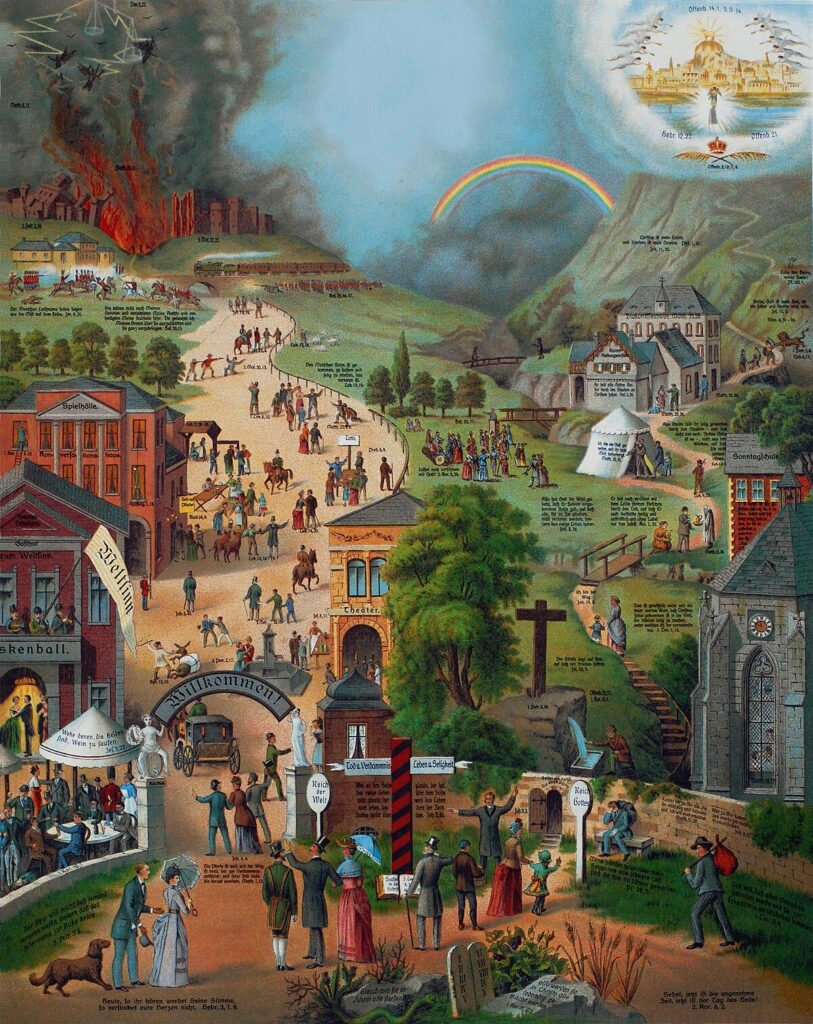
Psalm 1 divides the entire human race into two categories. Not three. Not a spectrum. Two. You are either a tree or you are chaff. You are either rooted by the water or blown across the threshing floor. You are either known by God or perishing away from Him.
This binary strikes the modern ear as simplistic, reductive, even offensive. We have been trained to think in gradients. We are comfortable with spectrums. We prefer nuance to sharp edges. And so the Two Ways doctrine of Psalm 1 – the idea that there are exactly two orientations of the human soul, two paths through life, and two destinations at the end – feels like an oversimplification of moral reality.
It is not. It is the foundation of moral reality. Gordon Wenham states the binary with unflinching precision: “There are two types of people, two types of life, and two conclusions. Which will you choose to follow? is the question posed by Psalm 1” (Gordon Wenham, The Psalter Reclaimed, p. 53). The psalm’s own answer is clear, and the rest of the Psalter develops this contrast between the wicked and the righteous with relentless thoroughness.
The binary of Psalm 1 is not an invention of the psalmist. It is embedded in the structure of creation itself. In the beginning, God separated light from darkness, water from dry land, day from night (Genesis 1). The world was built on distinctions, on separations, on the refusal to let everything blur into everything else. Psalm 1 extends that creative principle into the moral realm. As Matthew Henry observed, the division of the children of men into saints and sinners, righteous and unrighteous, “is ancient, ever since the struggle began between sin and grace, the seed of the woman and the seed of the serpent, so it is lasting, and will survive all other divisions and subdivisions of men into high and low, rich and poor, bond and free; for by this men’s everlasting state will be determined, and the distinction will last as long as heaven and hell.”3
The theological term for this binary is the Doctrine of the Two Ways, and it runs like a scarlet thread through the entire canon of Scripture. Moses set it before Israel in Deuteronomy 30:19: “I have set before you life and death, blessing and cursing; therefore choose life.” Joshua issued the same demand: “Choose for yourselves this day whom you will serve” (Joshua 24:15). The wisdom literature institutionalized it: Proverbs 4:18-19 contrasts the path of the just with the way of the wicked. Jeremiah 21:8 declares: “Behold, I set before you the way of life and the way of death.” And Jesus Himself drew the sharpest line of all: “Enter by the narrow gate; for wide is the gate and broad is the way that leads to destruction, and there are many who go in by it. Because narrow is the gate and difficult is the way which leads to life, and there are few who find it” (Matthew 7:13-14).
There is no third gate. There is no middle road. There is no “spiritual but not religious” option in the moral architecture of Scripture.
Why not? Because the Two Ways are not arbitrary categories imposed by a demanding God. They reflect the ontological structure of reality. God is the source of all being, all life, all goodness. To orient yourself toward Him is to orient yourself toward the source of everything that sustains existence. To orient yourself away from Him is to orient yourself toward non-being, toward the dissolution of meaning, toward avaddon – the abyss of ruin. There is no neutral ground between being and non-being, between life and death, between the water and the desert. You are either moving toward the source or away from it. The direction may be imperceptible at any given moment, but the trajectory is relentless, and the destination is binary.
Augustine understood this profoundly. In the City of God, he described all of human history as the interplay between two cities – the City of God and the City of Man – distinguished not by geography or ethnicity but by the fundamental orientation of their love. “Two cities have been formed by two loves: the earthly by the love of self, even to the contempt of God; the heavenly by the love of God, even to the contempt of self.” Psalm 1 is the seed from which that vast Augustinian vision grows. The Two Ways are, at bottom, two loves. The blessed man delights in the torah of the LORD. The ungodly delight in themselves. And these two delights produce two kinds of lives, two kinds of communities, and two kinds of eternities.
The progressive descent described in verse 1 – walking, standing, sitting; counsel, way, seat; ungodly, sinners, scornful – is the psalmist’s way of illustrating how the wrong orientation accelerates. Sin is not static. It is gravitational. The man who walks past evil lingers, then stops, then sits, then makes himself at home. Keil and Delitzsch trace the progression with clinical precision: the “resha’im”Hebrew“רְשָׁעִים”“resha’im”“noun,“ungodly, are the morally lax, “devoid of stay, and as it were gone beyond the reasonable bounds of true unity.” The “chatta’im”Hebrew“חַטָּאִים”“chatta’im”“noun,“sinners, are habitual transgressors who have made missing the mark their trade. The “letsim”Hebrew“לֵצִים”“letsim”“noun,“scornful, are the cynics who have intellectualized their rebellion and now wear contempt as a badge of sophistication.4
The practical application of the Two Ways doctrine is not complicated. It is a question that every person must answer, and that the psalm refuses to let anyone evade: Which way are you walking? Not which way do you intend to walk. Not which way do you think you are walking. But which way does your actual, practiced, daily life reveal? Is your delight in the torah of the LORD? Or have you settled, perhaps imperceptibly, into the counsel, the way, the seat of those who live without reference to God?
The psalm offers no ambiguity. There is no third option.
Psalm 1 divides all humanity into two categories – not a spectrum but a binary rooted in the ontological structure of creation itself. You are either oriented toward the source of life or away from it. The progressive descent from walking to standing to sitting illustrates sin’s gravitational pull. The Two Ways are ultimately two loves: delight in God’s word or delight in self. There is no third path.
3. The Doctrine of Scripture: Torah as the Means of Grace
The turning point of Psalm 1 comes in verse 2, where the blessed man’s character pivots from what he avoids to what he loves. And what he loves is “torah”Hebrew“תּוֹרָה”“torah”“noun,“instruction,. This single word carries more theological freight than perhaps any other term in the Old Testament, and misunderstanding it has led to centuries of distorted readings of Psalm 1 and of the Christian life.
English readers instinctively narrow torah to “law” – a set of rules, a legal code, a list of prohibitions. But torah is far broader and richer. Its root “yarah”Hebrew“יָרָה”“yarah”“verb”“to means “to direct” or “to instruct.” Torah is God’s comprehensive self-revelation – His instruction concerning who He is, what He has done, what He requires, and how life is to be lived under His lordship. In David’s time, this encompassed the Pentateuch and whatever additional revelation had been given. For the Christian reader, it encompasses the full canon of Scripture – every word breathed out by God for teaching, reproof, correction, and training in righteousness (2 Timothy 3:16).
As Gill rightly observes, the word “signifies ‘doctrine’ and may intend the evangelic doctrine” – the full scope of God’s self-disclosure to His people, including the gospel itself. Gordon Wenham confirms this broader reading: “The variety of terms for the law – ‘commandment,’ ‘word,’ ‘promise,’ ‘precepts’ – points to the fact that law is understood to be much more than regulations and rules, such as are found in the Pentateuch. ‘Law’ or ‘instruction’ covers all God’s revelation to Israel, whether it is found in the Pentateuch or other parts of the Bible” (Gordon Wenham, Psalms As Torah, p. 114).5
The blessed man’s relationship to torah is described with two phrases that together constitute a full theology of Scripture’s role in the Christian life.
First: “His delight is in the law of the LORD.” The Hebrew for “delight” is “chephets”Hebrew“חֵפֶץ”“chephets”“noun,“delight,. This is not the language of dutiful compliance. Chephets is a word of deep desire, of passionate attraction, of the kind of pleasure that draws the whole person in. It is the same word used in Isaiah 53:10 of God’s sovereign, purposeful will. The psalm is describing not a man who reads his Bible because he ought to, but a man who reads it because he cannot stop. His affection is engaged. His appetite is aroused. He finds in Scripture what other men find in wealth, pleasure, or power – the satisfaction of his deepest longings.
This is, implicitly, a doctrine of sola Scriptura in seed form. The blessed man’s delight is not in religious tradition, philosophical speculation, mystical experience, or the counsel of wise men. It is in the torah of the LORD. His operating system is God’s revealed word. His decision-making framework is not drawn from the wisdom of the age, the consensus of the culture, or the feelings of his own heart. It is drawn from the text that God Himself has given. The Reformers would later articulate this principle with full theological precision, but the seed was planted here, in the opening verses of Israel’s hymnbook.
Second: “In His law he meditates day and night.” The verb is “yehgeh”Hebrew“יֶהְגֶּה”“yehgeh”“verb,“he, from the root hagah. This is one of the most evocative words in the Hebrew Bible, and it does not mean what most modern readers assume. Hagah does not describe silent, abstract contemplation in the Western philosophical sense. It describes a physical act – murmuring, muttering, speaking under one’s breath. Keil and Delitzsch define it precisely: “Hagah of a deep, dull sound, as if vibrating between within and without, here signifies the quiet soliloquy of one who is searching and thinking.”6
When applied to meditation on Scripture, hagah describes a man who speaks the words of God to himself as he walks, works, eats, lies down, and rises up. His lips are never far from sacred text. This is the biblical method of meditation, and it is emphatically not the Eastern practice of emptying the mind. It is the practice of filling the mind – with specific words, specific promises, specific commands. It is reading aloud. It is memorization. It is the quiet rehearsal of Scripture throughout the ordinary hours of an ordinary day.
The phrase “day and night” is a merism – a figure of speech in which two extremes represent the totality of what lies between them. It means “always,” “at every time.” Not that the blessed man reads Scripture literally every moment, but that his engagement with God’s word is the constant background frequency of his life.
The theological significance of verse 2 extends beyond personal devotion. The psalm is making a claim about the means of grace – the channels through which God sustains, nourishes, and transforms His people. In Psalm 1’s theology, Scripture is not merely informational. It is formational. It is the water that feeds the roots (verse 3). It is the source of fruitfulness, endurance, and prosperity. The blessed man does not merely know the torah; he is shaped by it, the way a tree is shaped by the water in which its roots grow.
Wenham further observes that the psalm’s devotion to torah is coupled with an awareness of human limitation: “Psalms 1; 19; 119 breathe a passionate devotion to the law,” yet this devotion “is coupled with frequent acknowledgments of failure to live up to the law’s highest demands” (Gordon Wenham, Psalms As Torah, p. 110). The psalmist prays, “Oh that my ways may be steadfast in keeping your statutes!” – a prayer that acknowledges the gap between aspiration and achievement and thereby points forward to the One who would close it.
Calvin drew out this application with force: the blessed man’s delight in the law is not a supplement to ordinary living but the governing center of his entire existence. The torah is not something he adds to his schedule alongside other interests. It is the lens through which he sees everything else – his work, his relationships, his suffering, his joy. When a man finds that kind of sweetness in Scripture, the bitter allurements of the wicked lose their power entirely.
This is also, implicitly, a rebuke to every form of Christianity that minimizes the centrality of Scripture. The charismatic movement that prioritizes experience over exegesis. The liturgical tradition that allows ritual to substitute for personal engagement with the text. The progressive theology that treats the Bible as a culturally conditioned artifact to be critiqued rather than a divine word to be obeyed. Psalm 1 says plainly: the blessed man’s delight is in this book. Not in experiences of God. Not in traditions about God. Not in speculations about God. In the torah – the revealed, inscripturated, written word of the LORD. And in that word he meditates day and night.
The relationship between verses 1 and 2 also reveals the psalm’s implicit anthropology: the human soul cannot remain empty. It will be filled with something. The man who empties himself of the counsel of the ungodly but fills himself with nothing has only created a vacuum – and vacuums do not last. Jesus made this point explicitly in His parable of the unclean spirit (Matthew 12:43-45): the house swept clean but left empty becomes the dwelling of seven spirits worse than the first. The negatives of verse 1 are sustainable only because verse 2 provides a positive replacement. The blessed man does not merely refuse the wrong food; he feasts on the right food. And the feast is so satisfying that the old diet loses its appeal.
Torah in Psalm 1 is not mere legislation but God’s comprehensive self-revelation – the full scope of His instruction for human life. The blessed man’s relationship to it involves both delight (deep, passionate desire) and meditation (the physical murmuring of Scripture throughout ordinary hours). This is sola Scriptura in seed form: the blessed man’s operating system is God’s revealed word, not cultural wisdom, mystical experience, or human tradition. Scripture is the means of grace – the water that feeds the roots and produces the fruit.
4. The Retribution Principle: Does the Righteous Always Prosper?
“Whatever he does shall prosper” (verse 3). “The way of the ungodly shall perish” (verse 6). Psalm 1 states the retribution principle with what appears to be absolute, unqualified confidence: the righteous flourish, and the wicked are destroyed. Plant yourself by the water and you will bear fruit. Live as chaff and the wind will blow you away.
This raises what is perhaps the most difficult theological question in the Psalter: Is it true?
Does the righteous man always prosper? Does the wicked man always perish? What about the righteous who suffer – who lose their children, their health, their livelihoods, their very lives? What about the wicked who prosper – who accumulate wealth, power, fame, and die peacefully in their beds? If Psalm 1 is the gateway to the Psalter, and the retribution principle is the gateway to Psalm 1, then the entire hymnbook of Israel rests on a claim that experience seems to contradict on a daily basis.
The Psalter itself knows this tension. It does not ignore it. It wrestles with it, and the wrestling is one of the Psalter’s greatest theological achievements.
Psalm 73 – the opening psalm of the third book – is the most sustained engagement with this problem in the entire collection. Asaph begins with a confession: “Truly God is good to Israel, to such as are pure in heart. But as for me, my feet had almost stumbled; my steps had nearly slipped. For I was envious of the boastful, when I saw the prosperity of the wicked” (Psalm 73:1-3). He describes the wicked in terms that flatly contradict the retribution principle of Psalm 1: they are not blown away like chaff; they are “not in trouble as other men” (73:5). They “increase in riches” (73:12). Their eyes “bulge with abundance” (73:7). Meanwhile, the righteous Asaph has been “plagued” and “chastened every morning” (73:14).
The resolution comes only when Asaph enters the sanctuary: “Until I went into the sanctuary of God; then I understood their end” (73:17). The key word is end. The retribution principle of Psalm 1 is true, but it is true eschatologically – in terms of final outcomes, not immediate circumstances. The wicked may prosper for a season, but “surely You set them in slippery places; You cast them down to destruction” (73:18). The righteous may suffer for a season, but “You will guide me with Your counsel, and afterward receive me to glory” (73:24).
Job makes the same argument from a different angle. Job is the righteous man par excellence – “blameless and upright, one who feared God and shunned evil” (Job 1:1) – and yet he loses everything. His friends insist on the retribution principle in its crudest form: you are suffering, therefore you must have sinned. Job insists on his innocence and demands an explanation. God’s answer from the whirlwind is not a defense of the retribution principle but a revelation of God’s incomprehensible sovereignty. The resolution is not that the retribution principle is false, but that it operates within a framework of divine wisdom that exceeds human comprehension.
So how should we read the prosperity promise of Psalm 1:3?
Gill provides the most careful reading: “Whatever he does shall prosper – meaning not so much in things temporal, of which Arama interprets it, for in these the good man does not always succeed, but in things spiritual: whatever he does in faith, from love, to the glory of God, and in the name of Christ, prospers.”7
The Hebrew “yatsliach”Hebrew“יַצְלִיחַ”“yatsliach”“verb,“shall comes from the root tsalach, which Keil and Delitzsch define as “to divide, press forward, press through.” It does not mean that everything the blessed man touches turns to gold. The word carries the sense of advancement, of forward motion, of a life that pushes through obstacles and reaches its intended destination. The prosperity is real but not carnal. It is the prosperity of a life aligned with the purposes of God – a life that may suffer, may lose, may be persecuted, but that cannot finally be defeated because it is rooted in the only soil that lasts.
The retribution principle, properly understood, is not a transactional guarantee – “do good and receive good things” – but a description of the moral grain of the universe. It is the way things ultimately work out when the full scope of God’s purposes is taken into account. In the short term, the grain may seem reversed: the wicked prosper and the righteous suffer. But Psalm 1 takes the long view. Very long. Eschatologically long. And in that long view, the tree by the water always outlasts the chaff in the wind.
This is why the Psalter places Psalm 1 at the beginning and not the end. It does not resolve the tension between the retribution principle and the reality of innocent suffering. It creates the tension, deliberately, and then allows the rest of the Psalter to wrestle with it. Wenham captures this structural design: the Psalter should be seen “as a dramatic struggle from obedience (Psalm 1) through dismay (Psalm 73 after 72) to praise (Psalm 150)” (Gordon Wenham, The Psalter Reclaimed, p. 31). The retribution principle of Psalm 1 is the opening move in a canonical argument that will not reach its resolution until the final Hallelujah. The laments of Psalm 22 and Psalm 88, the anguished questions of Psalm 44 and Psalm 73, the imprecations of Psalm 109 and Psalm 137 – all of these are the Psalter’s sustained engagement with the binary that Psalm 1 establishes. The gateway sets up the question. The cathedral explores the answer. And the answer turns out to be not a formula but a Person – the One who fully embodied Psalm 1 and yet was “despised and rejected by men, a Man of sorrows and acquainted with grief” (Isaiah 53:3).
Psalm 1’s promise that “whatever he does shall prosper” is not a prosperity gospel guarantee but a description of the moral grain of the universe, understood eschatologically. The righteous may suffer in the short term, but the trajectory of their lives pushes through to God’s intended destination. The Psalter itself wrestles with this tension – Psalm 73 is the sustained counterpoint to Psalm 1 – and the resolution is found not in a formula but in the long view of divine sovereignty and, ultimately, in the Person who fulfilled Psalm 1 while hanging on a cross.
5. The Doctrine of Judgment: Eschatological Winnowing
“Therefore the ungodly shall not stand in the judgment, nor sinners in the congregation of the righteous.” (Psalm 1:5)
The metaphor shifts in verse 4 from agriculture to threshing, from planting to winnowing. And with this shift, the psalm introduces one of the most consequential doctrines in all of Scripture: the final separation.
The wicked are “motz”Hebrew“מֹץ”“motz”“noun,“chaff”. The word draws from the winnowing floor, one of the most familiar scenes in ancient Israelite agriculture. At harvest time, the threshed grain was tossed into the air on a hilltop threshing floor. The heavy grain fell back; the light chaff was caught by the wind and blown away, never to be gathered again.
This image reverberates throughout Scripture until it reaches its fullest expression on the lips of John the Baptist, standing at the Jordan, announcing the coming Messiah: “His winnowing fan is in His hand, and He will thoroughly clean out His threshing floor, and gather His wheat into the barn; but He will burn up the chaff with unquenchable fire” (Matthew 3:12). The eschatological winnowing prophesied in Psalm 1:4-5 becomes, in the New Testament, the doctrine of final judgment.
Matthew Henry captures the layered significance of the chaff metaphor: “Would you value them? Would you weigh them? They are like chaff, of no worth at all in God’s account, how highly soever they may value themselves. Would you know the temper of their minds? They are light and vain; they have no substance in them. Would you know their end? The wrath of God will drive them away.”8
Rydelnik draws attention to the deliberate literary artistry of this contrast: “They are compared to chaff in another deliberate contrast through sound with the man who is compared to a tree: (ke’ets; like a tree … kamots; like chaff). In the Hebrew, two out of three consonants are identical, as is their order. Chaff is by nature short-lived and unstable, while a healthy fruit-producing tree is firmly established and long lasting” (Michael Rydelnik, The Moody Handbook of Messianic Prophecy, p. 251). The contrast is not merely conceptual but phonological – woven into the very sound of the Hebrew text.
The theological significance of the winnowing image runs deeper than most readers recognize. Judgment does not create the distinction between righteous and wicked – it reveals it. The righteous and wicked already are what they are before the wind blows. The winnowing simply makes visible what was always true. The chaff was never grain. It only appeared to be part of the harvest because it was mixed in with the grain on the threshing floor. When the wind of God’s judgment blows, the pretense is stripped away, and the chaff is exposed for what it always was: weightless, rootless, fruitless.
This is why verse 5 introduces the forensic language of “mishpat”Hebrew“מִשְׁפָּט”“mishpat”“noun,“judgment,. The ungodly shall not “yaqumu”Hebrew“יָקֻמוּ”“yaqumu”“verb,“stand, in the judgment. The verb carries the forensic sense of standing trial and being vindicated. They cannot maintain their case. They cannot present a defense. When God’s righteous judgment examines their lives, they will be found wanting.
The Targum renders this verse: “The ungodly shall not be justified in the great day.” Gill applies it with characteristic Reformed precision: “There will be no standing for the wicked when he appears; they will all stand before the judgment seat of Christ, to take their trial and hear their sentence, but they shall not stand in the same place with the righteous, not at Christ’s right hand, but at his left.”9
The second clause of verse 5 tightens the exclusion: “nor sinners in the congregation of the righteous.” The word “adat”Hebrew“עֲדַת”“adat”“noun,“congregation, denotes the gathered community of God’s people. In this present age, the congregation of the righteous includes visible members who are not truly righteous. There are tares among the wheat, goats among the sheep, chaff mixed in with the grain. But the day is coming when the sorting will be final and permanent.
There is a devastating symmetry between verse 1 and verse 5 that deserves attention. In verse 1, the blessed man refuses to sit in the seat of the scornful – he voluntarily excludes himself from the company of the wicked. In verse 5, the wicked are involuntarily excluded from the congregation of the righteous. The choices we make about companionship in this life foreshadow the companionship we receive in the next. Those who choose the seat of the scornful over the assembly of the righteous will discover that their choice has been ratified for eternity.
Jesus’ parable of the sheep and the goats (Matthew 25:31-46) is the narrative expansion of Psalm 1:5. The Son of Man sits on His throne, gathers all nations, and separates them. The sheep enter the kingdom. The goats depart into everlasting fire. There is no third category. No ambiguous middle ground. No appeals court. The sorting is final, and it follows the logic that Psalm 1 laid down a thousand years before Christ spoke it into parabolic form.
The doctrine of final judgment is not popular in contemporary Christianity. It has been softened, qualified, and in some circles, abandoned entirely. But Psalm 1 will not permit the abandonment. The psalm ends with the word “perish” (toved), and that word carries the full weight of eschatological finality. The Two Ways lead to two destinations, and the destinations are permanent. Any theology that removes the doctrine of judgment from the Christian faith has severed the nerve that runs through the entire Psalter, from the first word (ashrey) to the last (hallelujah).
The winnowing metaphor of Psalm 1:4-5 introduces the doctrine of final separation. Judgment does not create the distinction between righteous and wicked – it reveals what was always true. The chaff was never grain; the wind merely exposes the pretense. Jesus’ parable of the sheep and goats is the narrative expansion of Psalm 1:5. The sorting will be final, the exclusion permanent, and the choices we make about companionship in this life foreshadow the companionship we receive in the next.
6. The Knowledge of God: Yada as Covenantal Intimacy
“For the LORD knows the way of the righteous.” (Psalm 1:6a)
The final verse of Psalm 1 is its theological foundation. Everything that precedes it – the blessedness, the Two Ways, the tree and the chaff, the standing and the falling – rests on a single truth: God knows. And what God knows, and what He does not know, determines everything.
The verb is “yodea”Hebrew“יוֹדֵעַ”“yodea”“verb,“knows,. This is yada – one of the most theologically loaded words in the Hebrew Bible. And it does not mean what a casual English reader might assume.
God is omniscient. He is aware of every person’s existence, every heartbeat, every thought. He “knows” the wicked in that bare, informational sense. But yada in its covenantal usage means something far deeper. It is the word used for the most intimate human knowledge: “Adam knew Eve his wife” (Genesis 4:1). It is the word God uses for His elective, covenantal relationship with Israel: “You only have I known of all the families of the earth” (Amos 3:2). It is the word that denotes not merely awareness but approval, not merely observation but engagement, not merely sight but love.
Keil and Delitzsch define it with precision that has not been surpassed: “What is intended is, as the schoolmen say, a nosse con affectu et effectu, a knowledge which is in living, intimate relationship to its subject and at the same time is inclined to it and bound to it by love.”10
The LORD knows the way of the righteous. He watches over it. He approves of it. He sustains it. He guards it. He ensures that it reaches its destination. The righteous man’s path is not a solitary road through an indifferent universe. It is a road that God Himself is walking alongside, watching over, and bringing to its appointed end.
This is the doctrine that sustains the believer through every trial, every dark night, every season when the retribution principle seems to have failed. “The LORD knows.” Not merely: “The LORD is aware.” But: “The LORD is intimately, covenantally, lovingly engaged with the way you are walking.” He sees what no one else sees. He approves what the world despises. He sustains what circumstances threaten to destroy. And He brings to its destination what looks, from every human perspective, hopelessly lost.
The contrast with the second half of verse 6 is devastating: “But the way of the ungodly shall perish.” Notice the asymmetry. God knows the way of the righteous – active, relational, sustaining knowledge. But the way of the ungodly simply perishes – no agent is named. God does not destroy the wicked so much as He withdraws from them, and in His withdrawal, they collapse under the weight of their own emptiness.
The Hebrew “toved”Hebrew“תֹּאבֵד”“toved”“verb,“shall carries the sense not merely of cessation but of loss – the tragic squandering of something that might have been otherwise. The way of the wicked does not simply stop. It dissolves. It comes to nothing. Everything the wicked built, everything they accumulated, everything they prided themselves on – their counsel, their way, their seat – all of it unravels into nothingness.
Keil and Delitzsch capture the contrast with devastating simplicity: “The way of the righteous has God as its goal; God knows this way, which on this very account also unfailingly reaches its goal. On the contrary, the way of the ungodly perishes, because left to itself – goes down to avaddon, loses itself, without reaching the goal set before it, in darkest night. The way of the righteous only is derek olam (Psalm 139:24), a way that ends in eternal life.”
The most terrifying thing about the fate of the wicked is not that God acts against them but that God leaves them to themselves. And a life left to itself, without the sustaining knowledge of God, cannot stand. The chaff is not set on fire in Psalm 1. It is simply blown away. The way is not demolished. It simply loses itself. The judgment of the ungodly is, in the final analysis, the natural consequence of being unknown by the God who sustains all things.
Matthew Henry draws out the pastoral comfort for the righteous: “Let this support the drooping spirits of the righteous, that the Lord knows their way, knows their hearts, knows their secret devotions, knows their character, how much soever it is blackened and blemished by the reproaches of men, and will shortly make them and their way manifest before the world, to their immortal joy and honour.”11
This is the gospel in embryonic form. The righteous are not saved by their own performance but by the knowledge of God – by His active, elective, sustaining attention to their way. And the wicked are not destroyed by arbitrary divine wrath but by the withdrawal of the only thing that holds any life together: the intimate, covenantal knowledge of the Creator.
The verb yada in Psalm 1:6 is not mere omniscience but covenantal intimacy – knowledge with affection and effect. God watches over, approves, sustains, and brings to completion the way of the righteous. The wicked perish not because God destroys them but because He withdraws from them, and a life left to itself, without the sustaining knowledge of God, cannot stand. This is the theological foundation of the entire psalm.
7. The Christological Reading: Jesus as the Ultimate Blessed Man
Every theological theme we have explored – blessedness, the Two Ways, torah delight, the retribution principle, final judgment, the knowledge of God – converges on a single question that Psalm 1 raises but cannot answer within its own six verses: Has anyone ever actually lived this way?
The psalm paints a portrait of the ideal blessed man: one who never walks in the counsel of the ungodly, whose delight is perfectly and continuously in the torah of the LORD, who brings forth fruit in every season without a single withered leaf. But has any human being ever fully embodied this portrait?
Israel as a nation failed. The Torah itself records their repeated descent into the counsel of the ungodly, the way of sinners, and the seat of the scornful. David, the sweet psalmist of Israel, failed – spectacularly, publicly, in ways that involved murder and adultery. Solomon failed, drawn away by foreign wives and foreign gods. Josiah came close, but even the great reforms of the best kings could not produce the sustained, unbroken, perfect righteousness that Psalm 1 describes.
The Tyndale notes observe that the psalm’s portrait of the ideal godly person “highlights the Lord’s expectations of his people and especially of the coming Messiah.”12 The psalm paints a portrait that exceeds every historical Israelite – and thereby points forward to the One who would fulfill it.
Bruce Waltke traces this messianic trajectory at the level of the Psalter’s editorial structure: “The didactic generalization that the righteous prevail over the wicked (Ps. 1), is fleshed out in salvation history as happening through I AM’s anointed king (Ps. 2)” (Bruce K. Waltke, An Old Testament Theology, p. 507). The theological claim of Psalm 1 cannot be separated from the royal-messianic claim of Psalm 2; together they form a single gateway, one ethical and the other prophetic, both pointing toward the same Person.
Jesus of Nazareth is the true Blessed Man of Psalm 1. To read Psalm 1 Christologically is not to allegorize it. It is to read it the way the psalm itself demands to be read: as a portrait of blessedness that no mere human can fully embody, and that therefore cries out for the one Man who could.
Consider the correspondence:
He is the one who never walked in the counsel of the ungodly. He was “in all points tempted as we are, yet without sin” (Hebrews 4:15). When Satan offered Him the counsel of the ungodly in the wilderness – power, fame, self-preservation – He refused every word. He did not walk. He did not stand. He did not sit.
He is the one whose delight was in the torah of the LORD. Rydelnik identifies a stunning phonological detail that supports this reading: “The phonological parallel between the divine name and the verb ‘meditate’ (YHWH … yehegeh) – three out of the four consonants are identical and follow the same order. The effect is to link the act of human meditation with YHWH,” so that “the torah of the Lord could be read as the torah of the man, equating him with the deity” (Michael Rydelnik, The Moody Handbook of Messianic Prophecy, p. 250). The very sounds of the Hebrew text blur the line between the meditating man and the God whose word he meditates upon – a distinction that collapses fully only in the incarnation. He opened the scroll of Isaiah in the synagogue and read it as His own commission (Luke 4:16-21). He responded to every temptation with “It is written” (Matthew 4:4, 7, 10). He declared that He came not to abolish the Law but to fulfill it (Matthew 5:17). His meat was to do the will of the Father (John 4:34). He meditated in the torah not day and night but every waking moment of a sinless life.
He is the tree planted by the water. He is the vine from which every branch draws life (John 15:5). He bore the fruit of redemption in His appointed season – on the cross, at the Passover, on the day the Father had determined before the foundation of the world. His leaf did not wither, even in Gethsemane, even on Golgotha, even in the grave. And whatever He did prospered – not with the world’s prosperity, but with the Father’s, as He was raised on the third day and given the name that is above every name (Philippians 2:9-11).
But here is where the Christological reading plunges into the deepest mystery of the gospel. The One who perfectly fulfilled Psalm 1 – who never walked in the counsel of the ungodly, who delighted in torah day and night, who brought forth fruit in every season – was treated as though He were the chaff. He was driven away. He was condemned in the judgment. He was excluded from the congregation. He was forsaken by the God whose knowledge sustains the righteous: “My God, My God, why have You forsaken Me?” (Psalm 22:1).
The retribution principle, which says the righteous prosper and the wicked perish, was inverted at the cross. The only truly righteous man who ever lived was treated as though He were wicked. He was made chaff so that the chaff could become trees. He was driven by the wind of divine judgment so that those who deserved to be blown away could be planted by streams of living water.
Paul states the exchange with lapidary precision: “He made Him who knew no sin to be sin for us, that we might become the righteousness of God in Him” (2 Corinthians 5:21). The tree was cut down so that the chaff could be rooted. The blessed man absorbed the curse so that the cursed could receive the blessing. And every other blessed man or woman who has ever lived is blessed only by virtue of being grafted into Him – the tree planted by the water, from whom all fruit, all greenness, all prosperity of soul ultimately flows.
This is why the Psalter could not begin with a psalm about David. It had to begin with a psalm about the ideal blessed man – a man no one in Israel’s history had ever been, and that therefore pointed forward to the One who was coming. As Rydelnik demonstrates, scholars have “persuasively argued for interpreting the Psalms as a coherent postexilic redaction with an eschatological/messianic theme throughout the Psalter” (Michael Rydelnik, The Moody Handbook of Messianic Prophecy, p. 355). Psalm 1 is not an isolated wisdom poem; it is the first chapter in a messianic argument that runs through the entire collection. Psalm 1 is messianic not because it explicitly predicts Christ, but because it describes a life that only Christ could live. And in describing that life, it establishes the standard against which all human striving is measured and found wanting – and the grace by which all who trust in Christ are nevertheless counted as trees, not chaff.
Jesus is the only human being who has fully lived the blessed life of Psalm 1 – never walking in the counsel of the ungodly, delighting perfectly in torah, bearing fruit in every season. Yet at the cross, the retribution principle was inverted: the truly righteous One was treated as chaff so that the chaff could become trees. Every believer’s blessedness flows not from their own performance but from being grafted into Christ, the true tree planted by the water.
8. Practical Theology: What Psalm 1 Demands of the Modern Christian
Psalm 1 is not a poem to admire. It is a diagnostic to apply. And when applied honestly, it exposes the gap between the life the psalm describes and the life most Christians actually live.
The psalm demands three things of the modern believer, and none of them is easy.
The Audit of Influence
Verse 1 describes a progressive descent from walking to standing to sitting – from casual contact with ungodly counsel to permanent residence in cynicism. The three categories of influence – counsel, way, seat – correspond to three domains: how you think, what you do, who you are.
The practical question is not whether you attend church or read your Bible. It is: Whose counsel is shaping your thinking?
For the first time in human history, the average person is exposed to more ungodly counsel in a single day than previous generations encountered in a lifetime. The algorithms of social media, the presuppositions of news media, the worldview embedded in entertainment, the philosophical assumptions of higher education – all of these function as counsel. They are frameworks for interpreting reality. They are operating systems for making decisions. And the vast majority of them operate on assumptions that are flatly incompatible with the worldview of Psalm 1.
The psalm does not say: “Blessed is the man who occasionally encounters ungodly counsel.” It says: “Blessed is the man who does not walk in it” – who does not adopt it as his framework, his rhythm, his habitual mode of navigation. The question is not whether you are exposed to ungodly counsel (you are; it is inescapable in the modern world) but whether you have walked in it – whether it has become the operating system by which you interpret reality, make decisions, and form judgments.
The practical application is brutal and specific: audit your inputs. What are you reading? What are you watching? Whose voices fill the background noise of your life? Whose assumptions have you absorbed without examining them? The blessed man of Psalm 1 is not naive. He is not uninformed. But his interpretive framework – his counsel – is the torah of the LORD, not the consensus of the culture.
The Discipline of Delight
Verse 2 says the blessed man’s delight is in the law of the LORD. Not his duty. Not his discipline. His delight.
This is the hardest demand of Psalm 1, because delight cannot be manufactured. You cannot force yourself to enjoy Scripture any more than you can force yourself to enjoy a food you hate. And yet the psalm makes delight in torah the defining characteristic of the blessed man. Without it, the entire structure collapses. Without delight, meditation becomes drudgery, avoidance becomes legalism, and the tree metaphor becomes a fantasy.
How does delight in Scripture develop? The psalm itself suggests the answer: by practice. The verb yehgeh is in the imperfect tense, indicating continuous, habitual, ongoing action. The blessed man does not meditate once and wait for delight to arrive. He meditates habitually, persistently, day and night, and the delight grows in the doing. As C. S. Lewis observed about prayer, the duty exists to stimulate the delight, not to replace it. You begin with the discipline of daily engagement with the text. You read it. You murmur it. You memorize it. You carry it with you into the hours of the day. And somewhere in the process – not immediately, not predictably, but inevitably – the duty becomes desire, the discipline becomes delight, and you find yourself returning to the text not because you must but because you want to.
Spurgeon captured this dynamic with his characteristic force: “The man who finds his delight in the Scriptures will find the Scriptures his delight.” The circularity is intentional. The practice produces the desire that sustains the practice. But someone must begin. And the beginning is always an act of will, not an experience of emotion.
The Patience of Fruitfulness
Verse 3 says the tree brings forth its fruit in its season. Not immediately. Not on demand. Not according to the timetable of human impatience. In its season.
This is a rebuke to the modern church’s obsession with immediacy. We want instant fruit. We want visible results. We want the conference, the program, the technique that will produce measurable outcomes on a quarterly basis. Psalm 1 says: the tree brings forth its fruit in its season. Some seasons are for growing roots, not bearing fruit. Some years are for deepening before widening.
Keil and Delitzsch are precise on the emphasis: “The fruit which one expects from it, it yields, and that at its appointed, proper time, without ever disappointing that hope in the course of the recurring seasons.” The tree does not fail to produce. But neither does it produce out of season. The blessed man trusts the rhythms of God’s timing. He does not panic during the fallow seasons because he knows the fruit will come when it ought to come.
Calvin drew a sharper application: “The impious, though they may display precocious fruits, produce nothing but what is abortive.” The wicked may appear productive – flashy, impressive, immediately fruitful. But their fruit is premature, rootless, and destined to rot. The righteous man’s fruit takes longer but endures.
The practical demand is patience. Plant yourself by the water. Meditate day and night. Refuse the counsel of the ungodly. And wait. The fruit will come in its season. The leaves will not wither. The life that is rooted in God’s word and sustained by God’s knowledge cannot, in the final analysis, fail. Not because you are strong enough to make it succeed, but because the LORD knows your way – and what the LORD knows, the LORD keeps.
This is the final word of Psalm 1’s practical theology: blessedness is not an achievement. It is a position. The blessed man is blessed not because he is strong enough to resist evil or disciplined enough to meditate on Scripture, but because the LORD knows his way. The tree endures because the Gardener endures. The roots hold because the water holds. And the water – the inexhaustible provision of God’s grace through His word and Spirit – never runs dry.
Psalm 1 demands three things of the modern Christian: (1) an audit of influence – whose counsel is shaping your thinking in an age of algorithmic media saturation; (2) the discipline of delight – beginning with the daily practice of Scripture meditation that progressively produces genuine desire; and (3) the patience of fruitfulness – trusting God’s seasonal rhythms rather than demanding immediate results. Blessedness is not an achievement but a position: rooted by the water, sustained by the knowledge of God.
Conclusion: The Gateway That Demands a Decision
Psalm 1 is the gateway to the Psalter, and the Psalter is the prayer book of the people of God. But this gateway has a condition. Before you can pray the prayers that follow – the laments, the praises, the confessions, the thanksgivings, the imprecations, the Hallelujahs – you must reckon with the binary that Psalm 1 establishes. There are two kinds of people. Two paths. Two destinations. And you must know which you are before you can know how to pray.
The theology of Psalm 1 is not abstract. It is urgent. It asks: Do you know what blessedness actually is? Have you rejected the counsel that shapes the thinking of your age? Is your delight in God’s word, or in the ten thousand substitutes that promise fulfillment and deliver emptiness? Are you rooted, or rootless? Are you producing fruit, or being blown? Are you known by God – intimately, covenantally, with affection and effect – or are you perishing in the darkness of your own autonomy?
The psalm ends on the word “perish.” It is deliberately jarring. After the beauty of the tree, the abundance of the fruit, the evergreen leaves, the prospering of all endeavors – the final syllable of the psalm is destruction. The reader is left not with a resolution but with a choice. The psalm does not tell you which path you are on. It simply tells you where each path ends. And it leaves you standing at the fork.
But the psalm also points beyond itself – beyond the binary it establishes and the tension it creates – to the One who would stand at that fork and walk both paths simultaneously. He walked the path of the righteous with perfect fidelity and absorbed the destruction reserved for the wicked with perfect love. He was the tree and the chaff, the blessed and the cursed, the one known by God and the one forsaken by God. And He did it so that those who trust in Him – who are grafted into His roots, watered by His Spirit, and sustained by His knowledge – might stand in the judgment, take their place in the congregation of the righteous, and hear, at the last, the word that Psalm 1 speaks over the blessed man:
Ashrey.
O the blessednesses. O the happiness. O the right-going of this man.
This article is part of the Psalms Deep Dive Series. For related studies, see: – Psalm 1 Commentary: Two Trees, Two Paths, Two Destinies – Verse-by-verse exegesis – Hebrew Words That Unlock Psalm 1 – Key terms the English hides – The World Behind Psalm 1 – Wisdom literature, the Psalter’s structure, and Israel’s worship