
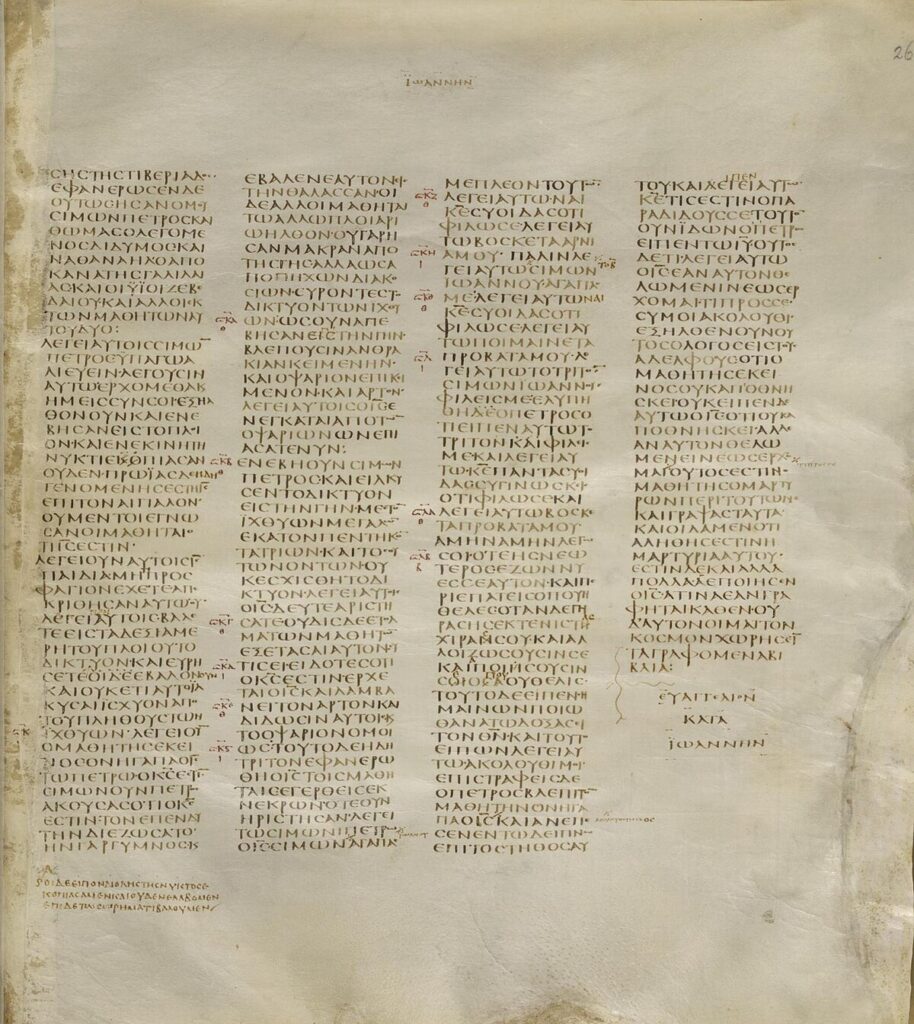
The Greek Words That Unlock John 3: Born from Above, Lifted Up, Loved Beyond Reason
John 3 is the most quoted chapter in the Bible. It is also the most flattened. English has smoothed its edges, rounded its corners, and sanded away the grain of the wood until what remains is something polished and familiar – and far less dangerous than what John actually wrote.
Consider: when Jesus tells Nicodemus he must be “born again,” the English suggests a do-over – a fresh start, a spiritual reset button. But the Greek word is anothen, and it does not mean “again.” Or rather, it does not only mean again. It means from above – from heaven, from God, from outside the closed system of human capability. The entire Reformation debate about regeneration hinges on whether you hear “again” or “from above” in that single word. English gives you one. Greek gives you both, simultaneously, and dares you to hold them together.
Or consider the word “perish” in John 3:16 – the verse every child memorizes and every theologian still wrestles with. In English, “perish” sounds almost gentle. Things perish. Flowers perish. The Greek is apollymi, and it means utter, total, irreversible destruction. It is the word you use for a city razed to its foundations, for a ship that goes down with all hands, for something so thoroughly ruined that no recovery is possible. That is the alternative to eternal life. Not fading. Not diminishing. Destruction.
This article examines twenty-three key Greek terms across John 3, organized by the chapter’s three movements: the nighttime conversation with Nicodemus about the new birth (vv. 1-15), the Gospel compressed into six verses (vv. 16-21), and the Baptist’s final testimony (vv. 22-36). For each term, we will look at the original word, its range of meaning, why the English translation falls short, and what the Greek reveals about the theology embedded in the text’s DNA.
You do not need to know Greek to read what follows. You just need to be willing to discover that the most famous chapter in the Bible has been saying more than you heard.
Part One: The New Birth (3:1-15)
The first fifteen verses of John 3 contain the most important private conversation in the Gospels. A Pharisee comes to Jesus in the dark. Jesus tells him that everything he has built his life on – his lineage, his learning, his law-keeping – cannot get him into the kingdom of God. What follows is a crash course in regeneration, delivered in Greek words so precisely chosen that every syllable carries theological weight.
1. Anothen – “Again” / “From Above”
“Unless one is born again, he cannot see the kingdom of God.” (John 3:3)
This is the word that detonates the conversation. “anōthen”Greek“ἄνωθεν”“anōthen”“adverb”“from has two distinct meanings in Greek, and Jesus chose it precisely because it carries both simultaneously. The primary meaning is spatial: from above, from a higher place, from heaven. It is used this way in John 3:31 (“He who comes from above”), in John 19:11 (“You could have no power at all against Me unless it had been given you from above”), and in James 1:17 (“Every good gift and every perfect gift is from above”). The secondary meaning is temporal: again, a second time, anew.
Nicodemus heard only the second meaning. He heard “again” and responded with bewildered sarcasm: “How can a man be born when he is old? Can he enter a second time into his mother’s womb?” He was not being stupid. He was a brilliant theologian who heard half the word. As Millard Erickson notes, “The Greek word used here, anothen, can also be rendered ‘from above.’ That ‘again’ or ‘anew’ is the correct rendering” is far from certain – the ambiguity is built into the word itself (Christian Theology, p. 428). He heard the temporal anothen and missed the spatial anothen. He heard “do it again” when Jesus was saying “it must come from above.”
The difference is everything. If anothen means only “again,” then regeneration is a human project – something you do, a decision you make, a second attempt at spiritual life. If anothen means “from above,” then regeneration is a divine invasion – something God does to you, from outside the system, from heaven. The entire Reformation debate about the nature of salvation is compressed into this single adverb.1
The concept behind anothen is not without Old Testament precedent. The Anchor Bible Dictionary observes that though the word palingenesia does not occur in the LXX, “the concept of regeneration is central to the OT, as circumcision of the heart (Deut 30:6), in Ezekiel’s restoration of dead bones (Ezek 37:1-14), and in God’s promise to raise Israel from spiritual death (Jer 24:7; Ezek 11:19; 36:26-27)” (The Anchor Bible Dictionary, ed. David Noel Freedman, vol. 5, p. 7378).
John, as a literary craftsman, almost certainly intended both meanings. He loved double-meaning words – pneuma (wind/spirit), hypsoo (lift up/exalt), katalambano (comprehend/overcome). The double meaning of anothen is not ambiguity. It is precision. You must be born again and from above. The repetition is necessary. The origin is divine. One word. Two truths. And Nicodemus, the foremost theologian in Israel, missed the one that mattered most.
2. Gennaō – “To Beget” / “To Be Born”
“Unless one is born of water and the Spirit, he cannot enter the kingdom of God.” (John 3:5)
The verb behind “born” throughout this passage is “gennaō”Greek“γεννάω”“gennaō”“verb”“to, and its voice – active or passive – carries an entire theological argument.
In the active voice, gennaō means to beget – the action of the father who generates life. In the passive voice, it means to be born – the experience of the one who receives life. The distinction matters enormously because in John 3, the verb appears in the passive: one must be born (gennēthē) from above. The person being regenerated is not the agent. They are the recipient. They do not birth themselves any more than a baby chooses to be born. They are acted upon by Another.
The Holman Illustrated Bible Dictionary confirms this passive dimension: “The new birth is caused by the gracious and sovereign act of God apart from man’s cooperation (John 1:13; Eph. 2:4-5). God brings the new birth about through the preaching of the word of God (1 Pet. 1:23; James 1:18)” (Holman Illustrated Bible Dictionary, ed. Charles W. Draper, p. 1206). This is why R.C. Sproul insisted that regeneration precedes faith. The passive voice of gennaō is the grammar of monergism – the doctrine that the new birth is entirely God’s work. “Just as you did not do anything for your natural birth except be born,” Sproul taught, “so your rebirth is a matter of the mercy and grace of God.” The flesh does not generate the Spirit. The Spirit generates new life in the flesh. The passive voice tells you who is doing the work, and it is not you.
3. Pneuma – “Spirit” / “Wind” / “Breath”
“The wind blows where it wishes, and you hear the sound of it, but cannot tell where it comes from and where it goes. So is everyone who is born of the Spirit.” (John 3:8)
This is the word Jesus exploits for maximum theological effect. “pneuma”Greek“πνεῦμα”“pneuma”“noun,“spirit, carries three meanings in Greek, and all three are active in Jesus’ statement. It means wind – the invisible, powerful, uncontrollable movement of air. It means breath – the sign of life, the animating force that distinguishes the living from the dead. And it means spirit – the immaterial reality that transcends the physical.
The Holman Illustrated Bible Dictionary traces the semantic range: “Metaphorically speaking, pneuma could be extended to mean a kind of breath that blew from the invisible realms; thus, it could designate spirit, a sign of the influence of the gods upon persons, and the source of a relationship between mankind and the divine” (Holman Illustrated Bible Dictionary, ed. Charles W. Draper, p. 1695). The Hebrew equivalent, “ruach”Hebrew“רוּחַ”“ruach”“wind,, carries the identical triple meaning. In Ezekiel 37, God tells the prophet to prophesy to the ruach (breath/wind/spirit) and command it to enter the dry bones so they might live. The same word does triple duty: it is the wind that blows across the valley, the breath that enters the corpses, and the Spirit of God who accomplishes the resurrection.
Gerhard Kittel’s Theological Dictionary of the New Testament underscores this multi-layered significance, noting that in Paul’s usage the Holy Spirit “affects the whole person and cannot be explained psychologically,” and that pneuma can denote “the whole person” or “psychological functions” depending on context – yet “in the last resort, the pneuma is for Paul the God-given pneuma that is alien to us” (TDNT, abridged ed., p. 512). Jesus makes the same play in John 3:8. “The pneuma blows where it wishes” – there, pneuma means wind. “So is everyone who is born of the pneuma” – there, it means Spirit. The transition is seamless because the word is the same. And the theological point is devastating: the Holy Spirit is like the wind. You cannot see Him. You cannot control Him. You cannot predict Him. You can only observe His effects. He blows where He wishes – not where you wish, not where the church schedules Him, not where human programs direct Him. Sovereign. Free. Uncontainable.
The triple meaning of pneuma (wind, breath, spirit) is not a linguistic accident. It is a theological revelation. The Spirit who regenerates is as invisible as the wind, as vital as breath, and as sovereign as God Himself. You cannot see Him move. You cannot dictate His path. You can only hear His effects and know that He has been there. This is the grammar of divine sovereignty applied to the most intimate act in the Christian life.
4. Sarx – “Flesh”
“That which is born of the flesh is flesh, and that which is born of the Spirit is spirit.” (John 3:6)
In English, “flesh” sounds almost neutral – bodily tissue, physical existence. “sarx”Greek“σάρξ”“sarx”“noun,“flesh, in John’s theology is anything but neutral. It denotes humanity in its natural state – not merely physical but unregenerate, incapable of producing spiritual life, locked within the closed system of creaturely existence.
John’s use of sarx differs from Paul’s. For Paul, sarx often carries an explicitly moral connotation – the sinful nature, the seat of ungodly desires (Galatians 5:19-21). For John, sarx is broader: it is human nature considered apart from divine intervention. It is not necessarily sinful in the sense of morally corrupt, but it is categorically insufficient. The flesh can produce religion, morality, theological sophistication, and impeccable Pharisaic observance. What it cannot produce is spiritual life. That is its limitation, and it is absolute.
Jesus’ statement in verse 6 is a law of spiritual biology: flesh begets flesh. Spirit begets spirit. These are two different orders of existence, and there is no bridge from one to the other built from the materials of the first. Nicodemus, with all his learning, could not think his way into the kingdom. The flesh, no matter how educated, how pious, how sincere, remains flesh. Only the Spirit produces spirit. The categories do not mix, and the order does not reverse.
5. Amēn Amēn – “Truly, Truly”
“Most assuredly, I say to you…” (John 3:3, 5, 11)
The double amēn formula appears three times in this conversation alone, and twenty-five times across John’s Gospel. “amēnGreek“ἀμὴν“amēn“double“truly, is unique to the Fourth Gospel. The Synoptic Gospels record Jesus using a single amēn to introduce solemn declarations. Only John doubles it.
The significance is both literary and theological. In the Old Testament, the doubled expression intensifies and certifies. Joseph said to Pharaoh: “The dream was repeated to Pharaoh twice because the thing is established by God, and God will shortly bring it to pass” (Genesis 41:32). When Jesus says amēn amēn, He is making a declaration so certain, so divinely established, that He stakes His own being on its truth.
No Old Testament prophet ever spoke this way. The prophets said, “Thus says the LORD.” They were messengers delivering another’s words. Jesus says, “I say to you” – and prefaces it with a divine oath formula. R.C. Sproul captured the force of it: “It’s more than most assuredly. It’s multi-maximal most assuredly. As assuredly as it could ever be.” The doubled amēn is an implicit claim to deity. Only God can swear by Himself (Hebrews 6:13). When Jesus does it twenty-five times across a single Gospel, He is not being emphatic. He is being God.
6. Hydōr – “Water”
“Unless one is born of water and the Spirit, he cannot enter the kingdom of God.” (John 3:5)
The word “hydōr”Greek“ὕδωρ”“hydōr”“noun,“water” has generated more interpretive debate in John 3:5 than perhaps any other term in the passage. Three major readings compete.
The baptismal interpretation sees “water” as a reference to Christian baptism, yielding a doctrine of baptismal regeneration. The Bible Knowledge Commentary catalogs no fewer than six major interpretive options for “born of water and the Spirit,” noting that the baptismal regeneration view “contradicts other Bible verses that make it clear that salvation is by faith alone; e.g., John 3:16, 36; Eph. 2:8-9; Titus 3:5” (The Bible Knowledge Commentary, ed. John F. Walvoord and Roy B. Zuck, p. 236). But as Sproul observed, “there’s no reason in the world why Jesus would expect a teacher of Israel to understand that” – Christian baptism had not yet been instituted. The natural birth interpretation sees “water” as amniotic fluid – the water of physical birth, contrasted with the Spirit of spiritual birth. This is lexically possible but contextually strained; the Old Testament provides a far richer background.
Everett Ferguson offers a careful synthesis of the grammatical evidence: “The verbal parallels equate the birth of water and the Spirit (3:5) with the birth from above (3:3) and contrast it with the natural birth that Nicodemus mentions (3:4). The one begetting is derived from two elements – water and Spirit,” with “the emphasis on the activity of the Spirit, the element that distinguished the new birth from the baptism of John” (Baptism in the Early Church, p. 96). The most compelling interpretation – and the one most Reformed commentators favor – connects hydōr to the Old Testament prophetic tradition, particularly Ezekiel 36:25-27: “I will sprinkle clean water on you, and you shall be clean from all your filthiness… I will put My Spirit within you.” Water represents purification; Spirit represents vivification. Both are necessary. The sinner must be cleansed and made alive – washed from defilement and raised from spiritual death.
This interpretation explains Jesus’ rebuke in verse 10: “Are you THE teacher of Israel, and do not know these things?” If “water and Spirit” echoes Ezekiel 36-37, then the foremost Jewish theologian absolutely should have recognized the reference. These were the prophets’ own images. Nicodemus’ failure was not ignorance of obscure doctrine but blindness to the very Scriptures he had spent his life teaching.2
7. Dei – “It Is Necessary”
“Even so must the Son of Man be lifted up.” (John 3:14)
This small, unassuming verb is one of the most theologically loaded words in the New Testament. “dei”Greek“δεῖ”“dei”“verb,“it expresses not personal preference or strategic recommendation but divine necessity – the inexorable, sovereign, predetermined will of God that cannot be circumvented.
It appears twice in John 3, and both appearances are seismic. In verse 14: the Son of Man must be lifted up. The cross is not Plan B. It is not an unfortunate detour that God redirected for good. It is the eternal, necessary, non-negotiable plan of redemption. And in verse 30: “He must increase, but I must decrease.” The Baptist’s diminishment is not a strategy he devised but a divine imperative he received. Both uses of dei point to the same reality: God’s plan unfolds according to necessity, not contingency. What must happen will happen. The cross was necessary. The Baptist’s decrease was necessary. Your regeneration, if you are in Christ, was necessary. Dei is the vocabulary of a God who has a plan and does not consult.
8. Hypsoō – “To Lift Up” / “To Exalt”
“And as Moses lifted up the serpent in the wilderness, even so must the Son of Man be lifted up.” (John 3:14)
This is the word that refuses to let you separate the cross from the glory. “hypsoō”Greek“ὑψόω”“hypsoō”“verb”“to means both to physically elevate – to raise something up off the ground – and to exalt – to glorify, to honor, to enthrone. In most contexts, you choose one meaning or the other. In John’s Gospel, you cannot. Both are active at once.
The Dictionary of Biblical Imagery captures the typological connection: “The story of the bronze serpent in Numbers 21:4-9 plays upon common ancient Near Eastern associations with the snake or serpent as a symbol of evil power and chaos from the underworld as well as a symbol of fertility, healing and life.” The image of Moses lifting up the serpent “is used by the NT text of John 3:14-15 as a precursor of Jesus who was ‘lifted up’ on the cross, signifying both his” crucifixion and glorification (Dictionary of Biblical Imagery, ed. Leland Ryken, p. 699). When Jesus says the Son of Man must be “lifted up,” He is referring simultaneously to the crucifixion (physical lifting onto a cross) and the glorification (exaltation to the highest place). This double meaning recurs throughout John: in 8:28 (“When you lift up the Son of Man, then you will know that I am He”) and in 12:32-34 (“And I, if I am lifted up from the earth, will draw all peoples to Myself”). Each time, crucifixion and glorification are fused into one event.
R.C. Sproul captured the layers: “Usually the primary understanding of being lifted up in Scripture is to be exalted. Lift up your hearts, lift up your voices… But Jesus is speaking more directly to what has to happen for people to enter into His kingdom. That He must be lifted up upon a cross.” The cross is not defeat followed later by victory. In John’s theology, the cross is the victory. The lifting up on the wood and the lifting up in glory are the same event seen from two angles. Hypsoō refuses to let you separate them. One word. Two realities. An entire atonement theology compressed into four syllables.
9. Epigeios / Epouranios – “Earthly Things” / “Heavenly Things”
“If I have told you earthly things and you do not believe, how will you believe if I tell you heavenly things?” (John 3:12)
These paired adjectives create a vertical axis that structures the entire conversation. “epigeios”Greek“ἐπίγειος”“epigeios”“adjective”“earthly, – from epi (upon) and gē (earth) – describes things that belong to the terrestrial realm. “epouranios”Greek“ἐπουράνιος”“epouranios”“adjective”“heavenly, – from epi (upon) and ouranos (heaven) – describes things that belong to the celestial realm.
The contrast is not between secular and sacred, or between unimportant and important. Both categories contain divine truth. The “earthly things” Jesus has told Nicodemus – the new birth, the analogy of the wind, the distinction between flesh and spirit – are earthly in the sense that they describe realities experienced on earth, spiritual phenomena that have terrestrial effects. The “heavenly things” He has not yet told him are the deeper mysteries of the divine counsel – the inner life of the Trinity, the eternal plan of redemption, the love that existed between Father and Son before the foundation of the world.
Jesus’ question is devastating: if Nicodemus cannot grasp the earthly illustrations, how will he handle the heavenly realities they point to? If the analogy stumps him, the substance will overwhelm him. The epigeios/epouranios contrast is Jesus’ way of saying: you are failing the introductory course, and you want to enroll in the graduate seminar.
Part Two: The Gospel in a Sentence (3:16-21)
Most commentators believe that Jesus’ direct speech to Nicodemus ends at verse 15, and that verses 16-21 are John’s theological reflection on the conversation – the evangelist stepping back to explain the cosmic significance of what Jesus has just revealed. Whether the speaker is Jesus or John, the authority is the same: the Holy Spirit who inspired every word. And the Greek words in these six verses are among the most carefully chosen in all of Scripture.
10. Monogenēs – “Only Begotten” / “One of a Kind”
“For God so loved the world that He gave His only begotten Son…” (John 3:16)
No Greek word in the New Testament has generated more theological debate than “monogenēs”Greek“μονογενής”“monogenēs”“adjective,“one. The traditional translation “only begotten” (KJV, NKJV) suggests biological generation – as though the Son were produced or created by the Father. Modern translations favor “one and only” (NIV) or “only” (ESV). The linguistics favor the modern rendering, but the theology defended by the traditional one remains true.
The word is formed from monos (only) and genos (kind, type, class), not from gennaō (to beget). Its root meaning is “one of a kind, unique, in a class by itself.” Kittel’s Theological Dictionary of the New Testament confirms this: “In compounds with -genes, adverbs describe the nature rather than the source of derivation. Hence monogenes is used for the only child. More generally it means ‘unique’ or ‘incomparable’” (TDNT, abridged ed., p. 346). The Evangelical Dictionary of Theology adds that “the word’s second half is not derived from gennan (to beget), but is an adjectival form derived from genos (origin, race)” (Evangelical Dictionary of Theology, ed. Daniel J. Treier, p. 618). The Septuagint uses it to describe Isaac in Genesis 22:2 – Abraham’s “only” son (though Ishmael also existed). Isaac was monogenēs not because he was the only child Abraham had fathered but because he was the unique, one-of-a-kind son of the promise, in a category no one else occupied.
Applied to Christ, monogenēs declares that the Son’s relationship to the Father is utterly unique, unrepeatable, and unshared. Believers become tekna theou – children of God by adoption and new birth (John 1:12). But no believer will ever be monogenēs. The Son is in a category by Himself. The Nicene Creed’s “only-begotten” was defending the Son’s eternal, uncreated relationship to the Father against the Arian heresy that made Him a created being. That theology is sound. But the word itself points not to a process of generation but to an absolute uniqueness. There is no one else like this. There has never been. There never will be.3
11. Kosmos – “World”
“For God so loved the world…” (John 3:16)
In English, “world” is a straightforward word. In John’s Gospel, “kosmos”Greek“κόσμος”“kosmos”“noun,“world, is anything but. John uses kosmos seventy-eight times – more than any other New Testament author – and it shifts meaning depending on context.
Sometimes kosmos refers to the created order: “the world was made through Him” (1:10). Sometimes it refers to humanity in general: “He was in the world, and the world was made through Him, and the world did not know Him” (1:10). Sometimes it refers to the organized system of human rebellion against God: “If the world hates you, you know that it hated Me before it hated you” (15:18). And sometimes – as here in 3:16 – it emphasizes the unworthiness of the object of God’s love.
John MacArthur presses this point: “It is important to note that ‘world’ is a nonspecific term for humanity in a general sense. The statement in verse 17, ‘that the world might be saved through Him,’ proves that it does not mean everyone who has ever lived” (Daily Readings from the Life of Christ, vol. 1, p. 291). This is the key to 3:16 that popular usage obliterates. The wonder of the verse is not that God loves – love is His nature. The wonder is what He loves. He loves the kosmos – the world that did not know Him (1:10), that did not receive Him (1:11), that loved darkness rather than light (3:19), that hates Him and His own (15:18-19). God did not love a world that loved Him back. He loved a world in active rebellion against Him.
R.C. Sproul pressed this point with unforgettable clarity: “Would you have the guts to come to God and say, ‘You haven’t done enough for this world that hates you?’” The kosmos is not a compliment. It is the measure of divine love’s reach. God loved the unlovable. He loved the hostile. He loved the world that would murder His Son – and He loved it enough to send that Son anyway.
12. Krinō / Krisis – “To Judge” / “Judgment”
“For God did not send His Son into the world to condemn the world…” (John 3:17)
The verb “krinō”Greek“κρίνω”“krinō”“verb”“to and its noun form “krisis”Greek“κρίσις”“krisis”“noun,“judgment, carry a range that English “condemn” and “judgment” do not fully capture. The root sense is to separate, to distinguish, to render a decision. It is courtroom vocabulary – the language of a judge weighing evidence and pronouncing a verdict. The Theological Dictionary of the New Testament traces the full semantic range: “The word krino means ‘to sunder,’ then ‘to select,’ ‘to decide,’ ‘to judge,’ ‘to assess,’ ‘to go to law,’ ‘to seek justice,’ also ‘to expound,’ then ‘to believe,’ ‘to resolve.’ The NT sense is usually ‘to judge’ with God or man as subject and in either an official or a personal sense” (TDNT, abridged ed., Gerhard Kittel, p. 266).
The English word “crisis” descends directly from krisis, and the etymological connection is illuminating. A krisis in Greek is a decisive moment – a point where a judgment must be rendered, where the situation demands a verdict one way or the other. The coming of Christ into the world creates exactly this kind of krisis. His presence forces a decision. Neutrality becomes impossible. You either come to the light or retreat into the darkness. You either believe or you are “condemned already” (ēdē kekritai, John 3:18).
The perfect tense of kekritai in verse 18 is devastating: “has already been judged.” Not “will be judged someday.” Not “faces the possibility of judgment.” Has already been judged. The verdict is not pending. It is rendered. The unbeliever does not become condemned at some future tribunal – he is condemned, right now, in his current state of unbelief. The encounter with Christ does not create the condemnation. It reveals the condemnation that was already there.
13. Apollymi – “To Perish” / “To Destroy Utterly”
“…that whoever believes in Him should not perish but have everlasting life.” (John 3:16)
English “perish” has been domesticated by overuse. Things perish in refrigerators. The thought perishes. The word has lost its teeth. “apollymi”Greek“ἀπόλλυμι”“apollymi”“verb”“to has not.
In the middle voice (as here), apollymi means to be utterly destroyed, to be ruined beyond any possibility of restoration, to come to total and final ruin. It is the word used for the destruction of Sodom (Luke 17:29), for the old wineskins that are “ruined” when new wine is poured into them (Matthew 9:17), and for the “lost” sheep, coin, and son in Luke 15 – where “lost” does not mean merely misplaced but in a state of ruin and separation from where they belong.
The alternative Jesus presents in John 3:16 is not between a pleasant life and a slightly less pleasant life. It is between eternal life and apollymi – between indestructible existence in the presence of God and utter, irreversible destruction apart from Him. The stakes could not be higher. The language could not be more severe. And the English word “perish” hides all of it behind a curtain of familiarity.
The Greek behind John 3:16 reveals stakes that English familiarity obscures. Monogenēs tells you what the gift cost – God gave His one-of-a-kind, utterly unique Son. Kosmos tells you who received it – a world in active rebellion against Him. Apollymi tells you the alternative – not gentle fading but utter, irreversible destruction. Every word in this verse is load-bearing. Remove any one and the Gospel collapses.
14. Phōs / Skotia – “Light” / “Darkness”
“And this is the condemnation, that the light has come into the world, and men loved darkness rather than light, because their deeds were evil.” (John 3:19)
John’s cosmic moral vocabulary operates on a single axis, and these two words define its poles. “phōs”Greek“φῶς”“phōs”“noun,“light is not merely physical illumination. It is the self-disclosure of God, the domain of truth and righteousness, the realm where reality is seen as it actually is. “skotia”Greek“σκοτία”“skotia”“noun,“darkness is not merely the absence of light. It is a domain – moral evil, spiritual blindness, the realm of Satan’s influence, the territory where lies masquerade as truth and sin masquerades as freedom.
In the prologue, John established this vocabulary: “The light shines in the darkness, and the darkness did not overcome it” (1:5). Now in chapter 3, the vocabulary returns with a devastating application. The light has come. The light is here. And men loved the darkness rather than the light. The verb is ēgapēsan – the same agapaō used of God’s love in verse 16. Men loved the darkness with the same intensity of devotion that God loved the world. The parallel is intentional and horrifying: God’s love sends His Son into the darkness; humanity’s love clings to the darkness and rejects the Son.
15. Ponēros – “Evil” / “Wicked”
“For everyone practicing evil hates the light and does not come to the light, lest his deeds should be exposed.” (John 3:20)
The English word “evil” has become elastic – stretched to cover everything from bad weather to genocide. “ponēros”Greek“πονηρός”“ponēros”“adjective”“evil, in Greek is more specific. It denotes not passive badness but active malice – not mere ignorance or weakness but deliberate, intentional wickedness. It is the word used for the “evil one” (Satan) in Matthew 13:19 and 1 John 5:19. It describes not a deficiency but a disposition – a settled orientation toward what is harmful, destructive, and opposed to God.
When John says that people whose deeds are ponēra (the plural form) hate the light, he is not describing a mistake or an oversight. He is describing a moral posture. The reason people flee the light is not that they are confused. It is that they know exactly what the light will reveal, and they do not want it revealed. Ponēros implies awareness. These are not innocent bystanders caught in the wrong neighborhood. These are agents who have chosen their side and who actively avoid exposure. The flight from the light is not accidental. It is strategic.
16. Alētheia – “Truth”
“But he who does the truth comes to the light, that his deeds may be clearly seen, that they have been done in God.” (John 3:21)
In modern English, “truth” is primarily intellectual – factual accuracy, correspondence between a statement and reality. “alētheia”Greek“ἀλήθεια”“alētheia”“noun,“truth, in the Greek of John’s Gospel is far richer. Etymologically, it derives from the alpha-privative a- plus lēthō/lanthanō (to be hidden, to escape notice) – literally, “un-hiddenness,” the state of being unconcealed, fully disclosed, brought into the open.
For John, truth is not merely something you know. It is something you do. “He who does the truth” (poiōn tēn alētheian) – the phrase in verse 21 – would sound strange in English. How do you do truth? You do truth by living in alignment with reality as God defines it, by refusing to hide, by bringing your life into the light rather than retreating into the comfortable concealment of darkness.
This is why alētheia in John’s Gospel is virtually interchangeable with divine revelation itself. Jesus says “I am the way, the truth, and the life” (14:6) – not “I tell the truth” but “I am the truth.” Truth is not merely a property of propositions. It is a Person. And to “do the truth” is to live in communion with that Person, in the light He provides, with nothing hidden and nothing concealed.
Part Three: The Baptist’s Final Testimony (3:22-36)
The chapter’s final movement shifts from theology to testimony. John the Baptist’s disciples are anxious about the growing crowds around Jesus. The Baptist’s response is the most selfless declaration any minister has ever made – and the Greek vocabulary reveals depths of humility, clarity, and theological precision that English smooths into a platitude.
17. Nymphios – “Bridegroom”
“He who has the bride is the bridegroom…” (John 3:29)
The word “nymphios”Greek“νυμφίος”“nymphios”“noun,“bridegroom, is not merely a wedding term. It is a messianic title rooted in the Old Testament prophetic tradition.
Throughout the Hebrew prophets, God’s relationship with Israel is described as a marriage. Hosea married Gomer to embody God’s faithful love for an unfaithful people (Hosea 1-3). Isaiah proclaimed: “As the bridegroom rejoices over the bride, so shall your God rejoice over you” (Isaiah 62:5). Jeremiah spoke of Israel as God’s bride who forgot her wedding love (Jeremiah 2:2). Ezekiel 16 is an extended marriage metaphor – God found Israel abandoned, raised her, adorned her, married her, and she proved unfaithful.
Warren Wiersbe observes that “the image of the Bridegroom would have been significant to the Jewish people, for Jehovah had a ‘marriage covenant’ with the nation (Isa. 54:5; 62:4ff.; Jer. 2:2; 3:20; Ezek. 16:8; Hos. 2:19ff.). Alas, Israel had been unfaithful to her vows” (The Wiersbe Bible Commentary: New Testament, p. 240). When the Baptist calls Jesus the nymphios, he is not making a casual analogy. He is identifying Jesus with the God of the Old Testament who claimed Israel as His bride. The messianic bridegroom is not merely a godly man taking a wife. He is God Himself, come to reclaim the covenant people He betrothed at Sinai. The New Testament develops this theme to its consummation in Revelation 19:7-9, where the marriage supper of the Lamb celebrates the final, permanent, unbreakable union between Christ and His church. The Baptist saw this from the beginning. His joy was not the joy of a spectator. It was the joy of a best man who understood the eschatological significance of the wedding he was announcing.
18. Philos tou Nymphiou – “Friend of the Bridegroom”
“…but the friend of the bridegroom, who stands and hears him, rejoices greatly because of the bridegroom’s voice.” (John 3:29)
The phrase “philosGreek“φίλος“philos“noun“friend describes a specific role in ancient Jewish wedding custom. The shoshbin (Aramaic) or philos tou nymphiou (Greek) was not merely a guest. He was the groom’s personal representative who arranged the wedding logistics, served as intermediary between the groom and the bride’s family, guarded the bridal chamber, and – crucially – stepped aside once the groom arrived.
The shoshbin did not compete with the groom. His entire purpose was directed toward the groom’s joy, the bride’s preparation, and the successful union of the two. His happiest moment was not when he stood in the spotlight but when he heard the voice of the bridegroom and knew the wedding was proceeding. His role was to decrease. His joy was in the decreasing.
R.C. Sproul developed this: “John is saying, I am not the bridegroom. The bride isn’t mine. The bride is His. But I’m the best man, and I get to go to the wedding feast and stand right next to the bridegroom as he enters into the joy of this wedding, and for John that is an unspeakable privilege.” This is the healthiest understanding of Christian ministry ever articulated. The pastor is not the bridegroom. The church is not his bride. He is the philos tou nymphiou, and his joy is fulfilled not when people follow him but when they go to Christ.
19. Elattoō – “To Decrease” / “To Diminish”
“He must increase, but I must decrease.” (John 3:30)
The verb “elattoō”Greek“ἐλαττόω”“elattoō”“verb,“to means to grow smaller, to become less, to diminish. It is used in Hebrews 2:7 of Christ being made “a little lower” than the angels during the Incarnation. The word carries connotations of deliberate, voluntary reduction – not defeat or failure but purposeful self-diminishment.
What makes the Baptist’s use of elattoō extraordinary is the word that precedes it: dei – “it is necessary.” The Baptist does not say “I choose to decrease” or “I think it wise to decrease.” He says “I must decrease.” The divine imperative governs his diminishment just as it governs the cross. God has not merely permitted the Baptist to fade. God has required it. And the Baptist embraces this requirement not with resignation but with fulfilled joy.
This is the opposite of how the world – and much of the church – operates. In a culture that measures success by growth, influence, and visibility, elattoō is a foreign concept. To deliberately become less, to intentionally shrink, to joyfully step out of the spotlight so that someone else can occupy it – this is not natural. It is supernatural. It is the fruit of a man who understood his vocation so clearly that he could release it without bitterness when the time came.
20. Auxanō – “To Increase” / “To Grow”
“He must increase…” (John 3:30)
The counterpart to elattoō is “auxanō”Greek“αὐξάνω”“auxanō”“verb,“to, which means to grow, to increase, to become greater in scope, influence, and recognition. In agricultural contexts, it describes the growth of a plant from seed to full maturity. In Paul’s letters, it describes the growth of the church (1 Corinthians 3:6-7: “I planted, Apollos watered, but God gave the increase”).
The Baptist’s statement yokes auxanō and elattoō together under the same divine necessity (dei). Christ’s increase and the Baptist’s decrease are not two separate events. They are one movement with two aspects. As the sun rises, the morning star fades – not because the star has failed but because the dawn has made it unnecessary. The Baptist is the morning star. Christ is the dawn. The fading of one is the proof that the other has arrived.
The Baptist’s final testimony is constructed from Greek terms that describe a deliberate, joyful, divinely mandated self-reduction. He is the philos tou nymphiou – the best man whose purpose is fulfilled when the groom arrives. He elattoō-s – decreases by divine necessity, not personal strategy. Christ auxanō-s – increases because the Father has given all things into His hand. The Baptist’s joy is not diminished by Christ’s rise. It is completed by it.
21. Orgē – “Wrath”
“…but the wrath of God abides on him.” (John 3:36)
The chapter’s final word of judgment is among its most important – and most misunderstood. “orgē”Greek“ὀργή”“orgē”“noun,“wrath, does not mean what modern English speakers hear when they hear “wrath.” We think of rage – hot, impulsive, emotional, out of control. Orgē is the opposite. It is settled, deliberate, righteous indignation – the sustained, principled opposition of a holy God to everything that violates His character.
Greek has another word for explosive, impulsive anger: thymos – the burst of fury that flares and subsides. Orgē is not thymos. Orgē is the deep, abiding, unchanging disposition of God toward sin. It is not a mood swing. It is not God losing His temper. It is the necessary and permanent response of infinite holiness to moral evil. A God who did not have orgē toward sin would not be holy. He would be indifferent. And an indifferent God is not a loving God – He is a God who does not care enough to be offended by what destroys His creatures.
The Reformers understood this. God’s wrath and God’s love are not competing attributes that cancel each other out. They flow from the same character. It is precisely because God loves His creatures that He burns with orgē against the sin that ruins them. The cross is where orgē and agapē meet – where the full weight of divine wrath falls on the Son so that the full measure of divine love can flow to the sinner.
22. Menō – “Abides” / “Remains”
“…but the wrath of God abides on him.” (John 3:36)
The final Greek term in John 3 is one of John’s most characteristic words. “menō”Greek“μένω”“menō”“verb,“to appears forty times in John’s Gospel – more than in any other New Testament book. It describes the Spirit remaining on Jesus at His baptism (1:32-33). It describes the invitation to “come and see” where Jesus was staying (1:39). It will become the dominant metaphor for the believer’s relationship with Christ: “Abide in Me, and I in you” (15:4).
But here, in the chapter’s closing verse, menō describes something terrifying: the wrath of God abiding on the unbeliever. The present tense is crucial. This is not a future threat. This is a present reality. The wrath does not arrive at some future judgment day and descend from above. It is already there. It remains. It stays. It abides – continuously, without interruption, without relief.
The contrast with how menō is used elsewhere in John is deliberate and devastating. The same word that describes the believer’s secure, permanent, life-giving union with Christ also describes the unbeliever’s secure, permanent, death-dealing exposure to wrath. Both are abiding realities. Both are present-tense conditions. The believer abides in Christ. The wrath of God abides on the unbeliever. And the only thing that moves a person from one abiding to the other is the verb that sits at the center of the verse: pisteuōn – believing. Faith in the Son is the only door out of the house of wrath and into the house of life.
23. Houtōs – “So” / “In This Way”
“For God so loved the world…” (John 3:16)
We return, finally, to the word that begins the most famous verse in the Bible – because it is the word most consistently misread. “houtōs”Greek“οὕτως”“houtōs”“adverb”“in does not primarily mean “so much” – as though John were quantifying the love of God. It means “in this way” or “thus” – it points to the manner and demonstration of God’s love, not merely its volume.
“God so loved the world” does not mean “God loved the world a really, really lot.” It means “God loved the world in this way: He gave His only begotten Son.” The proof of God’s love is not a feeling or a sentiment. It is a historical act. It is a body on a cross. It is the monogenēs handed over to the kosmos so that those who believe will not apollymi but will have everlasting life.
This recalibration matters because it moves the emphasis from God’s subjective emotional state (which we cannot measure) to God’s objective historical act (which we can point to). The question is never “Does God love me enough?” The question is “What has God done?” And the answer is houtōs – like this. He gave His Son. That is what divine love looks like when it meets a world in rebellion. Not a feeling. An act. Not a sentiment. A sacrifice. Not words of affection whispered from heaven. A body broken on a cross.
Reading John 3 Again for the First Time
You cannot unlearn what you have just read. The next time you open to John 3 in your English Bible, you will see the familiar words on the page – “born again,” “only begotten,” “everlasting life,” “must decrease.” But behind them, beneath them, you will know what is there. The anōthen that means “from above” and not merely “again.” The pneuma that blows where it wishes with sovereign freedom. The hypsoō that fuses crucifixion with glorification in a single syllable. The apollymi that refuses to let you soften “perish” into something comfortable. The orgē that is not rage but the settled, holy, permanent opposition of God to everything that destroys His creatures. And the menō that tells you it is not coming – it is already here.
Twenty-three Greek words. Each one chosen under divine inspiration with surgical precision. Together they reveal that John 3 is not merely the most famous chapter in the Bible – it is the most dangerous. It tells you that your best religious performance cannot get you into the kingdom of God. It tells you that the new birth comes from above and that you are as passive in receiving it as a baby being born. It tells you that the alternative to eternal life is not gentle fading but utter destruction. It tells you that the wrath of God is not a future possibility but a present reality that abides on every person who refuses the Son. And it tells you that the only door out of that wrath is faith in the One who was lifted up – simultaneously crucified and glorified – so that whoever looks to Him will live.
Twenty-three Greek words across thirty-six verses, and they reveal that John 3 is a single, sustained revelation in three movements. The new birth reveals what humanity lacks (life from above that no human effort can produce). The Gospel in a sentence reveals what God has done about it (given His one-of-a-kind Son so that the perishing might live). The Baptist’s testimony reveals the only appropriate human response (joyful self-decrease so that Christ might increase). The Greek does not add decoration to John 3. It is John 3. And what it says, in every word and every tense and every voice, is this: you must be born from above – and the One who makes that possible has been lifted up for you.
The most famous chapter in the Bible is also the most humbling. It leaves no room for human boasting, no platform for religious achievement, and no escape from the binary it presents: believe in the Son and receive eternal life, or refuse the Son and the wrath of God menei – remains, abides, stays. Those are the only two options John 3 offers. There is no third.
This article is part of the John Deep Dive Series. For related studies, see: – John 3 Commentary: Born from Above, Lifted on a Cross, Loved Beyond Reason – The complete verse-by-verse pillar article – The World Behind John 3 – Pharisees, the Sanhedrin, and what Nicodemus risked by coming to Jesus – Born from Above: The Theology of John 3 – Regeneration, sovereignty, and the most important doctrine you’ve never heard preached – The Greek Words That Unlock John 2 – The companion study for the previous chapter
Sources Cited
- Erickson, Millard J. Christian Theology. Grand Rapids: Baker Academic.
- Ferguson, Everett. Baptism in the Early Church: History, Theology, and Liturgy in the First Five Centuries. Grand Rapids: Eerdmans.
- Freedman, David Noel, ed. The Anchor Bible Dictionary. 6 vols. New York: Doubleday.
- Kittel, Gerhard, and Gerhard Friedrich, eds. Theological Dictionary of the New Testament. Abridged in one volume by Geoffrey W. Bromiley. Grand Rapids: Eerdmans, 1985.
- MacArthur, John. Daily Readings from the Life of Christ. 3 vols. Chicago: Moody.
- Ryken, Leland, James C. Wilhoit, and Tremper Longman III, eds. Dictionary of Biblical Imagery. Downers Grove: InterVarsity Press.
- Draper, Charles W., ed. Holman Illustrated Bible Dictionary. Nashville: Holman.
- Treier, Daniel J., ed. Evangelical Dictionary of Theology. 3rd ed. Grand Rapids: Baker Academic.
- Walvoord, John F., and Roy B. Zuck, eds. The Bible Knowledge Commentary: New Testament. Colorado Springs: David C Cook.
- Wiersbe, Warren W. The Wiersbe Bible Commentary: New Testament. Colorado Springs: David C Cook.