
The Question You’re Asking Is the Wrong One
Can you lose your salvation? It is one of the most searched questions in the Christian world — and it is the wrong question entirely. The perseverance of the saints does not begin with your grip on God. It begins with God’s grip on you. And until you understand that distinction, you will spend your entire Christian life in a panic that Scripture never intended.
The real question is not “Can I lose my salvation?” The real question is: Who is holding you?
If you are holding yourself, then yes — you should be terrified. You will let go. You are weak, fickle, forgetful, and prone to wander. But if the God who chose you before the foundation of the world is the one holding you, then no power in heaven or earth or hell can pry you from His hand. That is not wishful thinking. That is what Jesus said.
What Is the Perseverance of the Saints?
The perseverance of the saints is the “P” in TULIP — the final point of the doctrines of grace, and in many ways, the capstone of the entire system. It teaches that all those whom God has elected, redeemed, and effectually called will be preserved by His power through faith unto final salvation. Not one of them will be lost.
But let us be precise about what this doctrine does not mean.
It does not mean “once saved, always saved” in the shallow, careless sense — as if a person could pray a prayer at age twelve, live a life of unrepentant rebellion for fifty years, and coast into glory on the fumes of a childhood decision. That is not perseverance. That is presumption. And Scripture has terrifying things to say about presumption.
The doctrine of perseverance teaches that God causes His elect to persevere — in faith, in repentance, in holiness, in the ongoing war against sin. They may stumble. They may fall grievously. But they will not fall finally. God will not let them. He finishes what He starts.
The Westminster Confession of Faith, Chapter 17, states it with surgical precision: “They whom God hath accepted in His Beloved, effectually called and sanctified by His Spirit, can neither totally nor finally fall away from the state of grace; but shall certainly persevere therein to the end, and be eternally saved.” This is not a human achievement. It is a divine guarantee.
And that changes everything.
The Unbreakable Chain: Romans 8:28-39
If there is one passage in all of Scripture that demolishes every anxious “What if I lose it?” question, it is Romans 8:28-39. Paul lays out what theologians call the golden chain of redemption — and there is not a single weak link in it.
“For those whom he foreknew he also predestined to be conformed to the image of his Son, in order that he might be the firstborn among many brothers. And those whom he predestined he also called, and those whom he called he also justified, and those whom he justified he also glorified.”
— Romans 8:29-30 (ESV)
Read that chain again. Slowly. Foreknew. Predestined. Called. Justified. Glorified.
Notice the tense of that last word. Paul does not say “will glorify.” He says glorified — past tense. It is already done. In the economy of God, the glorification of every believer is as certain as their justification. It is as accomplished as the cross itself. God does not begin a sentence He cannot finish.
Leon Morris, in his commentary on Romans, observes that the aorist tense used for “glorified” is staggering in its implications — it treats the future glorification of believers as a completed fact, so certain is God’s commitment to those He has chosen. There are no dropouts in this chain. No one whom God foreknew fails to be predestined. No one predestined fails to be called. No one called fails to be justified. And no one justified fails to be glorified.
Every link holds. The chain is unbreakable.
But Paul does not stop there. He goes on the offensive.
“Who shall separate us from the love of Christ? Shall tribulation, or distress, or persecution, or famine, or nakedness, or danger, or sword? … No, in all these things we are more than conquerors through him who loved us. For I am sure that neither death nor life, nor angels nor rulers, nor things present nor things to come, nor powers, nor height nor depth, nor anything else in all creation, will be able to separate us from the love of God in Christ Jesus our Lord.”
— Romans 8:35, 37-39 (ESV)
That is not a tentative hope. That is an apostolic declaration under divine inspiration. Paul searches the entire cosmos — every dimension, every power, every timeline — and finds nothing capable of severing the bond between Christ and His people. If eternal security is in the Bible, it is here. And it is not fragile. It is adamantine.
Free Resource
TULIP Explained: The Five Points That Changed Everything
Understand all five points of Reformed theology — with scripture and common objections answered.
“My Sheep Hear My Voice”: John 10:27-29
If Romans 8 is the theological architecture, John 10 is the personal promise — straight from the lips of Christ himself.
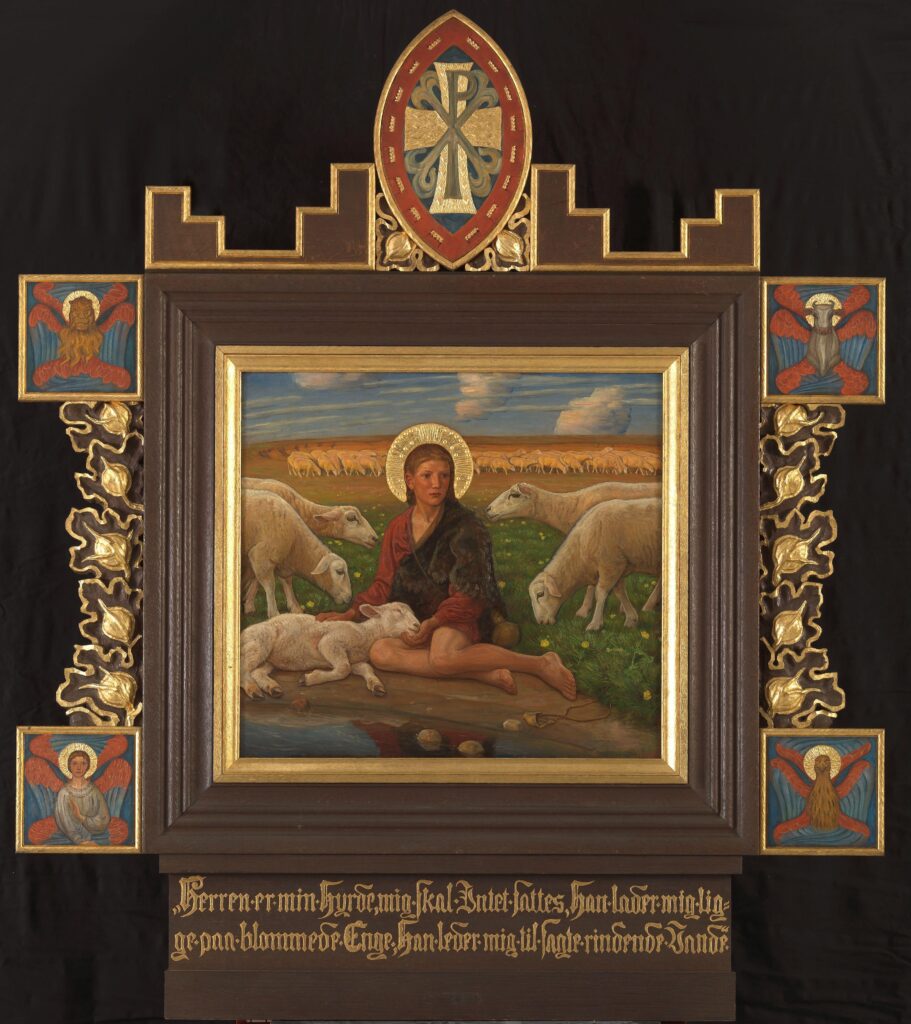
“My sheep hear my voice, and I know them, and they follow me. I give them eternal life, and they will never perish, and no one will snatch them out of my hand. My Father, who has given them to me, is greater than all, and no one is able to snatch them out of the Father’s hand.”
— John 10:27-29 (ESV)
Three things demand attention here.
First, the life Jesus gives is eternal. Not probationary. Not conditional upon future performance. Eternal. If it could be revoked, it was never eternal to begin with. The word means what it means.
Second, Jesus says His sheep “will never perish.” The Greek construction here — ou me with the subjunctive — is the strongest form of negation in the language. It is not “probably won’t perish” or “might not perish.” It is an emphatic, absolute denial. They will never, ever perish.
Third, notice the double security. The sheep are in the Son’s hand and in the Father’s hand. Two hands. Two persons of the Trinity. To lose a sheep, you would have to overpower both the Son and the Father. And Jesus’ own commentary on this is breathtaking in its simplicity: “No one is able.”
Here is what most people miss about this passage.
The once saved always saved doctrine, rightly understood, is not a license for carelessness. It is a declaration of ownership. These are His sheep. He knows them. They follow Him. The mark of a true sheep is not a one-time decision but an ongoing relationship — hearing, knowing, following. And the security is not in the sheep’s ability to keep following, but in the Shepherd’s refusal to lose a single one.
He Who Began a Good Work: Philippians 1:6
Paul writes to the Philippians from a Roman prison, and even there, his confidence is unshakable — not in the Philippians’ faithfulness, but in God’s.
“And I am sure of this, that he who began a good work in you will bring it to completion at the day of Jesus Christ.”
— Philippians 1:6 (ESV)
The logic is devastatingly simple. God started it. God will finish it. The “good work” is not your moral improvement project. It is the entire work of salvation — regeneration, faith, justification, sanctification, glorification. God initiated every phase, and God will complete every phase.
John Owen, the great Puritan theologian, argued extensively in his Works that the perseverance of the saints rests not on the creature’s strength but on the Creator’s covenant faithfulness. Owen saw the new covenant promises of Jeremiah 31 and Ezekiel 36 — “I will put my law within them,” “I will give you a new heart” — as God’s unilateral commitment to preserve His people. The “I will” of God is not a suggestion. It is a sovereign decree.
R.C. Sproul put it memorably: “If God is sovereign enough to elect, He is sovereign enough to preserve.” You cannot affirm total depravity, unconditional election, limited atonement, and irresistible grace — and then suddenly make the final link of the chain dependent on human willpower. If God chose you when you were dead, called you when you were deaf, and justified you when you were guilty, He is certainly capable of keeping you until the end.
Key Insight: “If you could lose your salvation, you would.” — John MacArthur. The doctrine of perseverance is not about the strength of our grip on God, but the strength of His grip on us.
That single sentence captures the entire doctrine. Left to ourselves, we would wander. Left to ourselves, we would deny Him by Friday, just like Peter. But we are not left to ourselves. That is the whole point.
What About Those Who “Fall Away”?
This is where the objections come. And they deserve a serious answer.
The most common challenge comes from Hebrews 6:4-6, which speaks of those who were “once enlightened,” who “tasted the heavenly gift,” and who “have fallen away.” Does this not prove that genuine believers can lose their salvation?
No. And the text itself tells us why.
The language of Hebrews 6 describes an extraordinary proximity to the things of God — enlightenment, tasting, participation — without ever describing saving faith, regeneration, or union with Christ. A person can sit under powerful preaching, experience the gifts of the Spirit in a community, taste the goodness of the Word, and still never be born again. Judas walked with Jesus for three years. He saw every miracle. He heard every sermon. He was never saved.
But the definitive verse on this question is not in Hebrews. It is in 1 John.
“They went out from us, but they were not of us; for if they had been of us, they would have continued with us. But they went out, that it might become plain that they all are not of us.”
— 1 John 2:19 (ESV)
There it is. The apostle John does not say “they were of us and then stopped being of us.” He says they were never of us. Their departure did not cause them to become non-Christians. Their departure revealed that they never were Christians. The falling away is not the loss of salvation. It is the exposure of its absence.
Joel Beeke, in A Puritan Theology, draws out this distinction with characteristic care: the Puritans understood that there is a “common grace” experience of the Spirit’s work that falls short of saving grace. People can be morally reformed, doctrinally educated, emotionally moved, and ecclesiastically involved — and still be unregenerate. The test is not the intensity of the experience but its permanence. True faith endures. Because God makes it endure.
And this brings us to the question that matters most.
Why This Matters: Assurance, Not Arrogance
The perseverance of the saints is not a doctrine that produces arrogance. It produces the exact opposite — profound humility and unshakable assurance.
Humility, because this doctrine strips you of every ground for boasting. You did not choose God. God chose you. You did not keep yourself. God kept you. You will not deliver yourself to glory. God will deliver you. From first to last, salvation is of the Lord. There is nothing left for the creature to brag about.
And assurance, because your confidence is no longer anchored to your own performance. On your best day, your obedience is stained with mixed motives. On your worst day, you wonder if you were ever saved at all. But the perseverance of the saints says: look away from yourself. Look to Christ. Your standing before God depends not on the quality of your faith but on the object of your faith — and the object of your faith is the risen, reigning, interceding Son of God, who even now sits at the right hand of the Father, making intercession for you.
This is the capstone of TULIP. If God elected a people in unconditional love, if Christ redeemed them with His own blood, if the Spirit called them from death to life, if God justified them by grace alone — then the idea that this same God might lose them at the finish line is not humility. It is an insult to His sovereignty.
The golden chain has no broken links. Foreknew. Predestined. Called. Justified. Glorified. It is finished.
Frequently Asked Questions
Can a true Christian lose their salvation?
No. According to Scripture, those whom God has truly saved — elected, called, justified, and sealed by the Holy Spirit — cannot lose their salvation. Jesus promises in John 10:28 that His sheep “will never perish, and no one will snatch them out of my hand.” Romans 8:30 treats glorification as already accomplished for every justified believer. The golden chain of redemption has no broken links. Those who appear to “lose” their salvation were, according to 1 John 2:19, never truly saved to begin with: “They went out from us, but they were not of us.”
What does “once saved always saved” really mean?
Rightly understood, “once saved always saved” means that God preserves every genuine believer unto final salvation. It does not mean that a person can profess faith, live in unrepentant sin, and still be assured of heaven. The doctrine of perseverance teaches that God causes His people to persevere in faith and holiness — not perfectly, but genuinely. True saving faith produces a changed life. If there is no fruit, there was no root. The security is real, but it belongs to those who are truly in Christ, not to those who merely claim to be.
What about Hebrews 6 and falling away?
Hebrews 6:4-6 describes people who experienced extraordinary proximity to the work of God — enlightenment, tasting, participation — without possessing saving faith. The language describes exposure to grace, not possession of it. Just as Judas witnessed every miracle without being converted, people can be deeply involved in the life of the church without being regenerated. The key interpretive text is 1 John 2:19, which clarifies that those who depart from the faith were never genuinely part of it. Their departure does not mean they lost salvation; it reveals they never had it.
Related Reading
- What Is Election and Predestination? — The “U” in TULIP: God’s unconditional choice of His people.
- Total Depravity: What Does It Mean to Be Dead in Sin? — The “T” in TULIP: why we needed sovereign grace in the first place.
- Do Christians Have Free Will? — How divine sovereignty and human agency operate in salvation.
- John 3 Commentary: Born from Above, Lifted on a Cross — The new birth that begins the work God will complete.
- The Sovereignty of God Over Nations — The God who governs history governs your salvation.
Go Deeper
The TULIP series is complete. Get all five articles — plus weekly theology that goes beneath the surface.
You are not holding on to God. God is holding on to you. And He does not let go.