
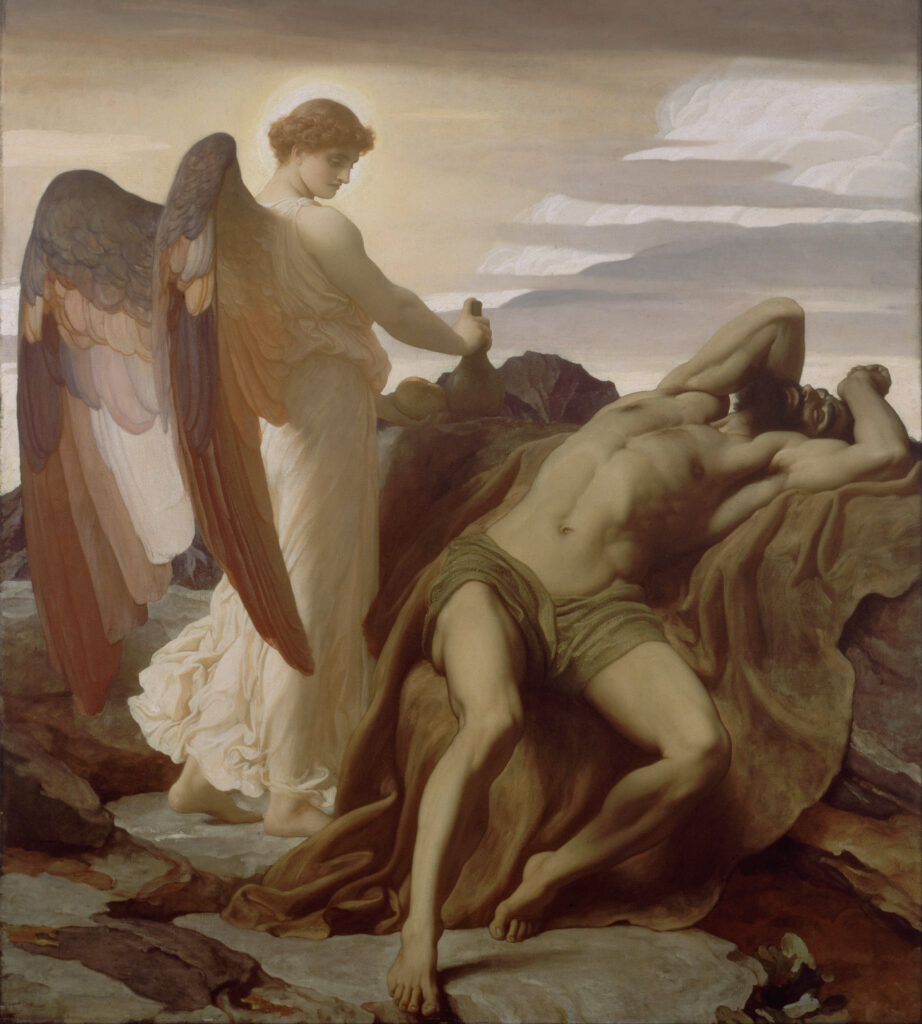
When the Prophet Wanted to Die
The man who called down fire from heaven wanted to die. That sentence should stop every Christian who has ever been told that depression is a faith problem. In 1 Kings 18, Elijah stands on Mount Carmel, outnumbered and outmatched, and watches God consume the sacrifice with fire so violent it licks up the water in the trench. It is one of the greatest displays of divine power in all of Scripture. And one chapter later, the same prophet sits under a broom tree in the wilderness and prays for God to take his life. If you are navigating christian depression mental health and wondering whether something is wrong with your faith, start here. Start with the man who saw the fire and still wanted to die.
This is not a contradiction. This is the Bible being honest about what it costs to live as a finite creature in a broken world with an eternal soul. Elijah was not weak. He was human. And if he could be flattened by exhaustion, isolation, and despair after the greatest spiritual victory of his life, no Christian is exempt.
Read the text carefully. Elijah does not lose his faith. He loses his strength. There is a difference — one the church has been catastrophically bad at recognizing.
“He himself went a day’s journey into the wilderness and came and sat down under a broom tree. And he asked that he might die, saying, ‘It is enough; now, O LORD, take away my life, for I am no better than my fathers.’ And he lay down and slept under a broom tree.”
— 1 Kings 19:4-5 (ESV)
Notice what precipitated this. Jezebel sent a death threat. After the triumph on Carmel, after the prophets of Baal were defeated, Elijah expected the nation to turn. Instead, the queen doubled down. The victory did not produce the result he hoped for. And suddenly the adrenaline was gone, the crowd was gone, and Elijah was alone in the desert talking to God about dying.
If that sounds familiar — the crash after the high, the emptiness after the effort, the feeling that nothing you do actually changes anything — you are not failing. You are in the company of prophets.
“Why Are You Cast Down, O My Soul?”
David asked the same question centuries before modern psychology had a name for it. Psalm 42 is not a hymn of triumph. It is the journal entry of a man caught between what he knows and what he feels — and finding that the gap between the two is wide enough to drown in.
“Why are you cast down, O my soul, and why are you in turmoil within me? Hope in God; for I shall again praise him, my salvation and my God.”
— Psalm 42:5 (ESV)
What David does here is extraordinary. He does not deny the darkness. He does not pretend. He preaches to himself. He takes the truth he knows and speaks it into the emptiness he feels. This is not positive thinking. This is a man gripping the rope of theology while the ground gives way beneath him.
Martyn Lloyd-Jones, in his landmark work Spiritual Depression, built an entire pastoral framework on this verse. His argument was simple and devastating: most Christians spend their lives listening to themselves rather than talking to themselves. They listen to their feelings narrate reality — “God has abandoned you, nothing will change, you are alone” — instead of interrupting that narration with what Scripture actually says.
This is not a formula. Lloyd-Jones was careful about that. He did not promise that preaching truth to your soul would make the depression vanish by Tuesday. What he said was that it keeps you tethered. It gives you something to hold when your hands are too tired to reach for anything else.
But here’s what nobody tells you.
Sometimes even the preaching feels hollow. Sometimes you open your Bible and the words sit on the page like stones. Sometimes you pray and the ceiling is all you hear. David knew this. The Psalms of lament — and there are more of them than the Psalms of praise — are full of honest cries to a God who seems absent. “The Psalms do not sanitize the inner life. They expose it.”
Free Resource
Theology of Suffering: A Reading Guide
Walk through the Bible’s most honest passages on pain, darkness, and the God who meets you there.
Depression Is Not a Sign of Weak Faith
This needs to be said plainly, because the church has done incalculable damage with the opposite message: depression is not a sin. It is not evidence that you are far from God. It is not proof that your prayer life is deficient. Some of the most faithful men and women in the history of Christianity have walked through sustained, devastating darkness.
Charles Spurgeon — the Prince of Preachers, the man who filled the Metropolitan Tabernacle with thousands every Sunday — battled depression his entire ministry. He wrote about it openly, at a time when doing so cost him reputation. “I am the subject of depressions of spirit so fearful that I hope none of you ever get to such extremes of wretchedness as I go to,” he told his students. This was not a man with a weak prayer life. This was a man with a thorn he carried to his grave.
And this is where the church has often failed.
The toxic idea that depression lifts if you just pray harder, read more, serve more — this is not theology. It is cruelty dressed in Bible verses. It takes a person who is already drowning and tells them the water is their fault. It reduces the complexity of the human person — body, mind, soul, all interwoven — to a single spiritual variable. And it contradicts the very Bible it claims to uphold.
Depression has biological dimensions. Neurochemistry is real. Hormonal imbalances are real. Sleep deprivation, chronic illness, genetic predisposition — these are not spiritual failures. They are features of living in a body that is groaning for redemption (Romans 8:23). Depression also has circumstantial dimensions — grief, loss, trauma, sustained stress, isolation. And yes, it can have spiritual dimensions too. But even then, the answer is not shame. The answer is never shame.
John Owen, the great Puritan theologian, wrote extensively about the inner struggles of the believer. He understood that spiritual darkness was not the absence of God but often the means by which God deepens a soul’s dependence on Him. The night does not mean God has left the room. Sometimes it means He is doing a work that only the dark can accomplish.
What God Did for Elijah
Go back to the broom tree. Elijah has asked to die. He is exhausted, alone, and convinced that he is the last faithful person on earth. And now watch what God does. Because what God does not do is as important as what He does.
God does not rebuke him. Read 1 Kings 19 as many times as you need to let that sink in. The prophet has just fled his post, accused God’s plan of failing, and asked for death. And God does not say a single corrective word. Not one.
Instead, God sends an angel. And the angel brings bread and water.
Let me say something you may need to hear.
God’s first response to Elijah’s depression was not a sermon. It was a meal. It was not a Bible study. It was sleep. The God of the universe, who could have thundered correction from the heavens, looked at His broken prophet and said, essentially: eat something, and rest. Twice. The angel came back a second time because the journey ahead was too much for Elijah in his current state.
Key Insight: God’s response to Elijah’s depression was not a rebuke. It was bread, water, sleep, and a still, small voice. Sometimes the most spiritual thing you can do is rest.
Only after Elijah had eaten and slept — only after the physical needs were addressed — did God meet him on Mount Horeb. And even then, the meeting was not what Elijah expected.
“And behold, the LORD passed by, and a great and strong wind tore the mountains and broke in pieces the rocks before the LORD, but the LORD was not in the wind. And after the wind an earthquake, but the LORD was not in the earthquake. And after the earthquake a fire, but the LORD was not in the fire. And after the fire the sound of a low whisper.”
— 1 Kings 19:11-12 (ESV)
God was not in the wind. Not in the earthquake. Not in the fire. God was in the whisper. The same God who answered with fire on Carmel now answered with a still, small voice on Horeb. Because Elijah did not need more fire. He needed presence. He needed to know that God was still there, still speaking, even when everything felt like it had fallen apart.
This is the theology of depression that the church needs to recover. God meets the depressed soul not with volume but with nearness. Not with spectacle but with sustenance. Job learned this in the ash heap. David learned it in the cave. Elijah learned it under the broom tree. And if you are walking through it now, God is not asking you to perform. He is asking you to let Him feed you.
Trusting God in the Dark
Depression and faith are not opposites. They coexist in the same heart, often in the same hour. Trusting God when you feel drained and alone does not mean the feelings disappear. It means you keep walking even when you cannot see the path. It means you hold the rope even when your hands are numb.
Here are anchors — not formulas, not fixes, but anchors — for the believer walking through darkness.
Stay in community, even when you want to hide. Elijah’s first instinct was to isolate. Depression always wants isolation. It tells you that you are a burden, that nobody understands, that being alone is easier. It is lying. The body of Christ exists for this exact season. You do not need to perform wellness. You need to show up, even broken. Let someone sit with you. Let someone pray for you when you cannot pray for yourself.
Stay in Scripture, even when it feels like reading a phone book. The Word of God is living and active regardless of your emotional experience of it (Hebrews 4:12). There will be seasons when the Bible feels alive and seasons when it feels like dead letters. Read it anyway. Not as a transaction — “I’ll read, and God will fix me” — but as an act of trust. The light shines in the darkness, and the darkness has not overcome it, even when you cannot see the light.
Seek professional help without shame. Therapy is not a failure of faith. Medication is not a crutch. They are means of common grace — gifts from God mediated through human skill and scientific understanding. A.W. Tozer, in The Knowledge of the Holy, argued that God’s sovereignty extends over all things, including the knowledge He gives to physicians and counselors. You would not refuse antibiotics for an infection and call it faith. Do not refuse treatment for depression and call it trust.
Pray, even when it feels hollow. Some of the most honest prayers in Scripture are cries of desperation, not declarations of confidence. “How long, O LORD? Will you forget me forever?” (Psalm 13:1). That is a prayer. That counts. God is not waiting for polished prayers. He is waiting for honest ones. If all you can manage is “Help,” that is enough.
Remember that God’s sovereignty does not depend on your feelings about it. The sun does not stop existing because clouds cover it. God’s faithfulness does not evaporate because you cannot feel it. Your salvation is secured by Christ’s work, not by your emotional experience of Christ’s work. On the days when you feel nothing, you are no less held than on the days when you feel everything.
A Word to Those Walking Through It Now
If you are reading this in the middle of it — not as a theological exercise but because the weight on your chest is real and the darkness is not a metaphor — I want to say something directly.
You are not failing. You are fighting. And the fact that you are still here, still reading, still reaching for something to hold onto, is evidence of a faith that is stronger than you think it is. Depression tells you that you are weak. But the person who keeps walking when every step feels like lead is not weak. That is endurance. That is the kind of faith Hebrews 11 is talking about — the substance of things hoped for, the evidence of things not seen.
You do not need to feel God’s presence for it to be real. You do not need to understand His plan for it to be good. You do not need to produce spiritual results to be valuable to Him. The God who fed Elijah under the broom tree has not forgotten where you are.
And here is the part that Elijah’s story teaches us that we almost always miss: after the bread, the sleep, the whisper, and the conversation on Horeb — God gave Elijah a companion. He sent him to anoint Elisha. God’s answer to Elijah’s loneliness was not a lecture about gratitude. It was a person. If you are isolated, that is not God’s design for your suffering. Reach out. Let someone walk with you.
The fire on Carmel was spectacular. But God met Elijah in the whisper. Sometimes He meets us there too — not in the earthquake of revival, but in the quiet of getting through one more day. You are not failing. You are fighting. And the God who fed Elijah under the broom tree has not forgotten where you are.
If you or someone you know is in crisis:
- 988 Suicide & Crisis Lifeline: Call or text 988
- Crisis Text Line: Text HOME to 741741
- CCEF (Christian Counseling): ccef.org
Frequently Asked Questions
Is depression a sin or a sign of weak faith?
No. Depression is not a sin, and it is not evidence of weak faith. The Bible records multiple godly figures who experienced deep despair — Elijah, David, Jeremiah, and arguably Jesus Himself in the Garden of Gethsemane, where He told His disciples that His soul was “very sorrowful, even to death” (Matthew 26:38). Depression has biological, circumstantial, and spiritual dimensions. Reducing it to a single spiritual cause is not only bad theology — it is pastorally destructive. Spurgeon, one of the greatest preachers in church history, suffered from severe depression throughout his life and ministry. Faith and depression coexist in the same heart, often simultaneously.
Should Christians take medication for depression?
Yes, when appropriate and under medical guidance. Medication for depression is a means of common grace — God working through human knowledge and medical science to address a real physiological condition. The same God who fed Elijah bread and water in the wilderness works through the means He has provided in the modern world. Refusing medical treatment is not an act of faith any more than refusing to eat is an act of fasting. Christians should pursue treatment — including therapy, medication, or both — without guilt or shame, while also anchoring their hope in Christ, who is the ultimate healer of body and soul.
What does the Bible say about mental health?
The Bible does not use the modern clinical term “mental health,” but it speaks extensively to the inner life of the human person. The Psalms of lament (Psalms 6, 13, 22, 42, 88) are raw expressions of anguish, despair, and the feeling of God’s absence. Elijah’s collapse in 1 Kings 19 and Jeremiah’s grief throughout his prophetic ministry both depict sustained emotional and psychological suffering. The Bible’s consistent message is not “don’t feel this” but rather “bring this to God.” Scripture validates the reality of inner darkness while pointing the sufferer toward the God who is present even when He feels absent. The biblical model integrates body, mind, and soul — which means caring for mental health is not separate from caring for spiritual health. They are dimensions of the same person.