
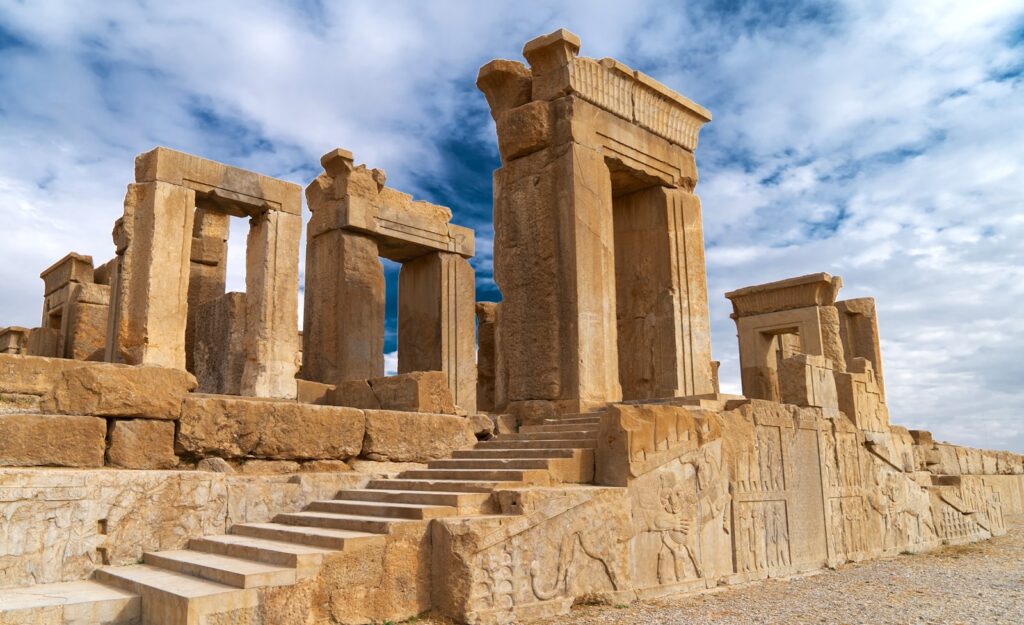
Iran and Israel: 2,500 Years of History — From Cyrus to the Ring of Fire
Introduction: The Longest Relationship in the Middle East
No relationship in the Middle East is as long, as complex, or as biblically significant as the one between Iran and Israel.
It begins in 539 BC, when a Persian king named Cyrus conquered Babylon and issued a decree that freed the Jewish exiles — making him the only Gentile ruler in the Bible called God’s “anointed” (māšîaḥ). It continues through Esther’s rescue of the Jewish people in the Persian court, through centuries of coexistence, through a surprising modern alliance under the Shah, and into the present confrontation where Iran’s supreme leader calls Israel a “cancerous tumor” that must be removed.
2,500 years. From liberator to enemy. From anointed to adversary.
This is the story of how the nation that freed Israel became the nation that seeks to destroy it — and what the Bible says about how it ends.
Chapter 1: The Liberator (539-330 BC)
Cyrus the Great: God’s Anointed Pagan
In 539 BC, Cyrus II of Persia conquered the Neo-Babylonian Empire — the power that had destroyed Jerusalem, razed Solomon’s Temple, and taken the Jewish people into 70 years of exile. Cyrus did something no conqueror before him had done: he issued a decree allowing all displaced peoples to return to their homelands and rebuild their temples.
The Cyrus Cylinder — a clay document discovered in 1879 and now housed in the British Museum — records this policy of restoration. But the Bible adds a dimension that no archaeological artifact captures:
“Thus says the LORD to his anointed, to Cyrus, whose right hand I have grasped, to subdue nations before him… I call you by your name, I name you, though you do not know me.” (Isaiah 45:1, 4)
God called Cyrus by name 150 years before he was born — through the prophet Isaiah, who ministered around 700 BC. Cyrus, a polytheist who worshiped Ahura Mazda, became the instrument of Yahweh’s purposes without knowing the God he served.
The result: the Jewish people returned. The Temple was rebuilt. The covenant community was restored. Ezra and Nehemiah led reconstruction efforts under Persian imperial authorization and funding.
The Persian Empire was the environment in which Judaism survived.
Esther: Salvation in the Persian Court
The book of Esther takes place entirely within the Persian Empire — in the royal court at Susa, the ancient Elamite capital. When the Persian official Haman plotted genocide against the Jewish people, Queen Esther risked her life to intervene.
The result: deliverance. The feast of Purim celebrates the survival of the Jewish people within the Persian world.
The pattern: Persia could have been the place where Judaism was extinguished. Instead, God used the Persian system — its laws, its queen, its court politics — to preserve His people.
Nehemiah: Rebuilding Under Persian Authority
Nehemiah served as cupbearer to the Persian King Artaxerxes I — one of the most trusted positions in the ancient court. When Nehemiah received news that Jerusalem’s walls lay in ruins, he asked the Persian king for permission and resources to rebuild.
Artaxerxes granted both. He provided Nehemiah with letters of safe passage, timber from royal forests, and military escorts. The walls of Jerusalem were rebuilt in 52 days — under Persian imperial protection.
Summary of the First Period: For 200 years (539-330 BC), the Persian Empire was Israel’s protector, patron, and political framework. Without Persia, there would be no Second Temple Judaism, no Pharisees or Sadducees, no synagogue system, no rabbinic tradition — and arguably, no Judaism as we know it.
Chapter 2: The Long Middle (330 BC-1948 AD)
Alexander to Islam (330 BC-651 AD)
When Alexander the Great conquered the Persian Empire in 330 BC, the direct Persian-Jewish political relationship ended. For the next thousand years, both regions passed through successive empires — Greek, Parthian, Roman, Sassanid — with varying degrees of contact.
Under the Parthian Empire (247 BC-224 AD), a significant Jewish community thrived in Mesopotamia and western Iran. The Babylonian Talmud — the most authoritative compilation of Jewish law — was composed in this region under Parthian and later Sassanid rule. Jewish academies in Sura and Pumbedita became the intellectual centers of world Judaism.
At Pentecost (Acts 2:9), Luke records that “Parthians and Medes and Elamites” were among those who heard the gospel proclaimed in Jerusalem. These were Jews from the Persian world — descendants of those who had never returned from exile. The gospel first reached Iranian soil through Jewish diaspora communities.
The Sassanid Empire (224-651 AD) maintained a complex relationship with its Jewish population — periods of tolerance alternating with persecution. Jewish communities existed throughout the empire, particularly in major cities like Isfahan, Hamadan (ancient Ecbatana), and Susa.
The Islamic Conquest and After (651 AD-1900s)
The Arab Muslim conquest of Persia in 651 AD transformed the relationship entirely. Iran became Islamic — first Sunni, then predominantly Shia after the Safavid conversion in the 16th century.
Jewish communities persisted in Iran throughout Islamic rule, but as dhimmis — protected but subordinate minorities. They survived by adapting: speaking Persian, participating in commerce, maintaining synagogues, and navigating the complex social dynamics of minority life under Islamic law.
By the early 20th century, an estimated 100,000-150,000 Jews lived in Iran — the largest Jewish community in the Muslim Middle East outside of the Ottoman Empire.
Chapter 3: The Unlikely Alliance (1948-1979)
Israel’s Founding and Iran’s Recognition
When Israel declared independence on May 14, 1948, Iran — then under the Pahlavi monarchy — was the second Muslim-majority country to recognize the Jewish state (after Turkey).
This was not merely diplomatic courtesy. The Shah pursued a strategic alliance with Israel based on shared interests:
The Periphery Doctrine: Both Iran and Israel faced hostile Arab neighbors. Israel was surrounded by Egypt, Syria, Jordan, and Iraq. Iran felt threatened by Arab nationalism, particularly Nasser’s Egypt and later Saddam’s Iraq. The logic was simple: the enemy of my enemy is my friend.
Intelligence cooperation: Israel’s Mossad and Iran’s SAVAK developed a close intelligence-sharing relationship. Mossad reportedly helped train SAVAK officers. SAVAK shared intelligence on Arab military capabilities.
Military sales: Israel sold weapons and military technology to Iran. Iran provided Israel with oil — critical for a nation surrounded by Arab oil producers who enforced a petroleum embargo.
Economic ties: Trade flourished. Israeli agricultural experts helped develop Iran’s farming sector. Iranian oil flowed to Israeli refineries. Bilateral trade reached hundreds of millions of dollars.
Cultural exchange: El Al flew direct flights between Tel Aviv and Tehran. Iranian Jews traveled freely between the countries. An estimated 80,000 Jews lived in Iran in the 1970s, enjoying relative freedom under the Shah’s secular monarchy.
The alliance was real, substantial, and mutually beneficial. It was also built on a foundation that would collapse in a single year.
Chapter 4: The Rupture (1979)
The Revolution’s First Target
When Khomeini seized power in February 1979, one of his first foreign policy actions was severing ties with Israel. He declared:
“Israel must be wiped off the map.”
(The exact Farsi phrase — “Esrā’il bāyad az safhe-ye rūzgār maḥv shavad” — has been debated in translation, but the intent was unambiguous: Israel’s existence was illegitimate and its destruction was a religious obligation.)
Khomeini handed the Israeli Embassy in Tehran to Yasser Arafat and the PLO — a symbolic act that signaled the revolution’s priorities. Iran would now be Israel’s most committed ideological enemy.
Within months:
– Diplomatic relations were severed
– All economic agreements were canceled
– Iranian Jews faced new pressures (though the community was technically allowed to remain as a “protected” minority)
– “Death to Israel” became a standard chant at Friday prayers, state rallies, and military events
Why the Reversal?
The reversal was ideological, not strategic. Strategically, Iran and Israel still shared enemies — Iraq invaded Iran in 1980 with Arab support. An alliance would have served Iranian interests.
But Khomeini was not operating by strategic logic. He was operating by theological conviction:
- Jerusalem (al-Quds) is sacred to Islam. Khomeini believed liberating Jerusalem from “Zionist occupation” was a religious duty.
- Israel represents Western colonialism. In Khomeini’s framework, Israel was an illegitimate outpost of American imperialism in the Muslim world.
- Supporting the Palestinian cause unified the Muslim world behind Iran’s revolution — bridging the Sunni-Shia divide by championing a cause that all Muslims could support.
- Opposing Israel gave Iran revolutionary credibility. It was the clearest way to distinguish the Islamic Republic from the Shah’s Western-aligned monarchy.
The IRGC’s elite external operations unit was named the Quds Force — literally “Jerusalem Force.” The destruction of Israel was not a secondary objective. It was written into the institution’s name.
Chapter 5: The Cold War (1979-2023)
Proxy Warfare and Encirclement
For 44 years after the revolution, Iran and Israel fought an undeclared war — through proxies, through covert operations, through intelligence campaigns, but almost never directly.
Iran’s strategy: Build a ring of hostile forces around Israel using Hezbollah (Lebanon), Hamas (Gaza), Islamic Jihad, Iraqi militias, Houthis (Yemen), and Iranian forces in Syria. Force Israel to fight on every front simultaneously.
Israel’s strategy: Intelligence penetration of Iran’s nuclear program, assassination of Iranian nuclear scientists, cyberattacks (Stuxnet), strikes on Iranian assets in Syria, and diplomatic isolation through the Abraham Accords.
Key milestones:
- 1982: Iran helped create Hezbollah in Lebanon — which grew into Israel’s most dangerous non-state adversary.
- 1994: The AMIA bombing in Buenos Aires — a Hezbollah/Iran operation that killed 85 people at a Jewish community center.
- 2006: The Second Lebanon War — Israel vs. Hezbollah, which survived the conflict and rearmed massively with Iranian support.
- 2010: The Stuxnet cyberattack — widely attributed to the U.S. and Israel — destroyed approximately 1,000 Iranian nuclear centrifuges.
- 2012-2020: Israel assassinated multiple Iranian nuclear scientists inside Iran.
- 2020: The U.S. killed Qasem Soleimani, the architect of Iran’s proxy strategy.
Throughout this period, Iran and Israel never exchanged direct military blows. They fought through shadows, proxies, and cyberspace.
That changed in 2024.
Chapter 6: Direct Confrontation (2024-Present)
The Walls Come Down
October 7, 2023 shattered the shadow war paradigm. Hamas — Iran’s proxy — massacred 1,200 Israelis. Israel’s response was unprecedented in scale and scope.
By late 2024, Israel had:
– Devastated Hamas’s military infrastructure in Gaza
– Killed Hezbollah’s Nasrallah and much of its leadership
– Struck Iranian assets across Syria
– Degraded the proxy network that Iran had spent decades building
April 2024: Iran launched its first-ever direct military attack on Israel — over 300 missiles and drones. The vast majority were intercepted by Israeli, American, British, Jordanian, and Saudi defenses.
October 2024: Iran struck again with ballistic missiles. Again, largely intercepted.
The ODNI’s 2025 Annual Threat Assessment notes that Iran “possesses the largest missile force in the Middle East” and has become “a key military supplier to Russia,” receiving in exchange “military and technical support to advance Iranian weapons, intelligence, and cyber capabilities.”
The shadow war has ended. Iran and Israel are now in open confrontation — the first direct military exchanges between the two nations in 2,500 years of shared history.
Biblical Perspective: The Arc of a Relationship
From Anointed to Adversary
The Bible traces the full arc of the Persia-Israel relationship:
Genesis 10: Elam (ancient Iran) appears in the Table of Nations as a son of Shem — making the Elamites/Persians Semitic cousins of the Israelites.
Isaiah 45: God calls Cyrus His anointed — the highest honor given to any Gentile ruler in Scripture.
Ezra-Nehemiah: Persian kings fund and protect the rebuilding of Jerusalem and the Temple.
Esther: God uses the Persian court to save His people from annihilation.
Jeremiah 49: God pronounces judgment on Elam — but promises restoration “in the latter days.”
Ezekiel 38: Persia appears as part of the coalition that will one day attack Israel — and be destroyed by divine intervention.
Acts 2: Elamites hear the gospel at Pentecost — the first time the good news reaches Iranian ears.
The trajectory is clear: Persia begins as Israel’s liberator and ends as Israel’s adversary. But the story does not end with adversity. It ends with judgment, restoration, and the gospel.
The Ezekiel Question
Ezekiel 38:5 lists Persia (Hebrew: Pāras) as part of the Gog/Magog coalition that will attack Israel “in the latter days.” The coalition includes nations from every direction — north (Gomer, Beth-togarmah), south (Cush), west (Put), and east (Persia).
The strategic architecture of Iran’s modern proxy network — surrounding Israel from every direction — mirrors this prophetic geography with remarkable precision. Whether the current confrontation is a precursor to Ezekiel’s vision or a separate historical episode, the alignment is difficult to dismiss.
What is certain: Ezekiel’s prophecy ends not with Israel’s defeat, but with God’s intervention:
“I will rain upon him and his hordes and the many peoples who are with him torrential rains and hailstones, fire and sulfur.” (Ezekiel 38:22)
The coalition fails. Not because Israel is stronger, but because God fights for His people.
The Restoration Promise
Jeremiah 49:39 — the final verse of the oracle against Elam — promises:
“But in the latter days I will restore the fortunes of Elam, declares the LORD.”
This means the story of Iran and Israel does not end in conflict. It ends in restoration. God’s purpose for Iran is not permanent destruction but ultimate redemption.
The underground church movement in Iran — hundreds of thousands of Iranians coming to faith in Christ — may be the beginning of this restoration. The nation that became Israel’s adversary is simultaneously becoming a nation where the God of Israel is worshiped in homes, in secret gatherings, and in hearts that the Ayatollahs cannot reach.
Conclusion: 2,500 Years and Counting
The Iran-Israel story is the longest continuous geopolitical relationship in the Middle East. It has passed through every phase: liberation, alliance, betrayal, enmity, and now open confrontation.
But the God who orchestrated the first chapter — using Cyrus to free His people — is still writing the story. He has not abandoned Iran to its current regime any more than He abandoned Israel to Babylon.
The timeline:
– 539 BC: Cyrus frees the Jews. Persia is the liberator.
– 480 BC: Esther saves the Jews. Persia is the stage of deliverance.
– 445 BC: Nehemiah rebuilds Jerusalem. Persia is the patron.
– AD 33: Elamites hear the gospel. Persia receives the good news.
– 1948: Iran recognizes Israel. The modern alliance begins.
– 1979: The revolution reverses everything. Iran becomes the enemy.
– 2024: Iran attacks Israel directly. The shadow war ends.
– The latter days: God restores the fortunes of Elam.
We do not know what the next chapter holds. But we know who writes it.
“Remember the former things of old; for I am God, and there is no other; I am God, and there is none like me, declaring the end from the beginning and from ancient times things not yet done, saying, ‘My counsel shall stand, and I will accomplish all my purpose.’” (Isaiah 46:9-10)
Further Reading
- Iran in the Bible: A Complete Guide — The full biblical story of Iran from Genesis to Revelation
- When Persia Freed the Jews: Cyrus the Great — The liberator in detail
- What the Bible Says Will Happen to Iran: Jeremiah 49 — Judgment and restoration
- Will Iran Attack Israel? Ezekiel 38 — The prophetic coalition
- Soleimani’s Master Plan — The modern encirclement strategy
- The 1979 Revolution: What Actually Happened — The rupture
Sources
- Congressional Research Service, Iran: Background and U.S. Policy, Updated May 2025.
- Office of the Director of National Intelligence, 2025 Annual Threat Assessment.
- Defense Intelligence Agency, Iran Military Power, November 2019.
- CIA FOIA Electronic Reading Room, Khomeini’s Iran.
- U.S. Department of State, State Sponsors of Terrorism.
- The British Museum, The Cyrus Cylinder, Accession no. 90920.