
The Wedding, the Whip, and the World Behind John 2 — The Historical Context of John 2
You think you know this story. A wedding runs out of wine. Jesus fixes it. Then He walks into the temple and flips tables. You have seen the paintings — a serene, blue-eyed Jesus gesturing over water jars, then a wild-haired Jesus swinging a whip while doves scatter. Two scenes, two moods, one chapter. You have read it dozens of times. You have heard sermons on it. You think you understand.
You do not.
The problem is not intelligence. The problem is distance. Two thousand years of cultural, economic, and religious change have stripped these scenes of their original voltage. A first-century Galilean hearing that the wine ran out at a wedding would have felt a visceral shock that no modern reader experiences. A Jewish pilgrim watching a man overturn the money changers’ tables in the Court of the Gentiles during Passover week would have understood — instantly, in his bones — that this was either the act of a prophet or the act of a dead man. Probably both.
To read John 2 as it was written to be read, you need to reconstruct the world it was written into. You need to know what a Galilean wedding actually looked like — not a two-hour ceremony with a DJ and a cash bar, but a week-long communal event where running out of wine could haunt a family for a generation. You need to understand why stone jars mattered more than clay pots, why Tyrian shekels were the only currency the temple would accept, and why a provincial carpenter walking into the most magnificent religious structure on earth and claiming it as “My Father’s house” was either the most audacious act of insanity in recorded history or the most terrifying act of divine authority.
What follows is an attempt to close the gap — to put you inside the world of John 2 so thoroughly that you can smell the livestock in the Court of the Gentiles and feel the social panic of a host whose wine has run dry.
A Galilean Wedding: Seven Days, One Reputation
The Shape of the Celebration
Modern Western weddings are ceremonies. First-century Galilean weddings were events — multi-day, village-wide celebrations that consumed the social and economic resources of entire families. The Mishnah records that wedding festivities for a virgin typically lasted seven days, while a widow’s wedding feast could last three.1 During those seven days, the groom’s family was responsible for feeding and providing wine for every guest. There were no invitations with RSVP cards. In a small village like Cana, the entire community would attend, and hospitality obligations were absolute.
MacArthur notes that “a wedding was a major social event in first-century Palestine, and the ensuing celebration could last as long as a week,” marking “the culmination of the betrothal period, which often lasted for several months” during which the couple was “considered legally man and wife” but did not yet live together (Daily Readings From the Life of Christ, p.280).
Strack and Billerbeck document the extended nature of these celebrations in their rabbinic parallels, noting that “if someone borrows an undergarment from someone else… in order to go into the wedding house again… he borrows it for at least seven days,” with some rabbis extending the social obligations to two full weeks (Commentary on the New Testament From the Talmud and Midrash, p.278). The entire community organized its life around such events.
The celebration followed a well-established pattern. The groom’s procession to the bride’s home was a public spectacle — torchlit if it occurred in the evening, accompanied by musicians, friends, and well-wishers. The bride, veiled and adorned, would be escorted from her father’s house to the groom’s home or his family’s home, where the wedding feast would take place. Blessings were pronounced. A marriage contract — the “ketubah”Hebrew“כְּתֻבָּה”“ketubah”“marriage — was signed, specifying the bride price and the groom’s obligations. Then the feasting began, and it did not stop for days.
Wine was not a luxury at these feasts. It was the essential lubricant of celebration, generosity, and communal joy. The Hebrew Scriptures themselves celebrated wine as a gift from God: “Wine that makes glad the heart of man” (Psalm 104:15). The rabbis taught that “there is no joy without wine” (Pesahim 109a). At a wedding, wine was the tangible proof that the host could provide, that the family was honorable, that the celebration was genuine. Every cup poured was a statement about the family’s standing in the community.
The Catastrophe of Running Out
When John writes that “they ran out of wine” (John 2:3), he is describing a social catastrophe. This was not an inconvenience. It was a humiliation — a public failure of hospitality that would brand the family with shame for years, possibly generations. In a small village where everyone knew everyone, where reputation was the primary social currency, running out of wine at your son’s wedding was the kind of failure people remembered.
Some scholars have suggested the family could even face legal consequences. The Talmud records debates about whether a host who failed to provide adequate food and drink for wedding guests could be held liable for breach of hospitality obligations.2 Whether or not a lawsuit was technically possible, the social judgment was certain. The whispers would follow this family: They could not provide. They invited more guests than they could serve. They shamed their son on his wedding day.
This is the crisis Mary brings to Jesus. Not a minor logistical hiccup. A family-destroying social disaster unfolding in real time.
The Master of the Feast
The “architriklinos”Greek“ἀρχιτρίκλινος”“architriklinos”“noun,“master was a figure with real authority at the celebration. The title literally means “ruler of the three couches” — a reference to the triclinium dining arrangement common in the Greco-Roman world, where guests reclined on three couches arranged in a U-shape around a central table. The architriklinos was responsible for the ordering of the feast: the quality and sequence of the food, the mixing and serving of wine, the pacing of the entertainment. He was part wedding coordinator, part sommelier, part master of ceremonies.
As Robin Margaret Jensen observes, “the story of Jesus arriving at a marriage feast and turning water into wine is the first miracle in the Gospel of John and a key, initial event of Christ’s epiphany,” and even the earliest Christian writers recognized its layered significance (Baptismal Imagery in Early Christianity, p.221).
His verdict on the wine Jesus produced — “You have kept the good wine until now!” (John 2:10) — was not a casual compliment. It was a professional judgment from the person whose entire role was to evaluate and manage the quality of what was served. When he declared the wine superior, he was speaking with the authority of his position. And his observation about the common practice — serve the best wine first, then the inferior after guests have drunk freely — reveals a pragmatic understanding of human nature that any caterer today would recognize. Palates dull. Standards drop. Serve the cheap stuff last. Jesus reversed the pattern entirely, producing wine of a quality that stunned the expert. The abundance was approximately 120 to 180 gallons — far more than any wedding could consume. The Anchor Bible Dictionary notes that in Jewish tradition, as in the broader Mediterranean world, wine carried deep theological freight: “the ‘cup of immortality’ (8:5; 15:5) refers to a beverage that guarantees eternal life in heaven to those who drink it along with the ‘bread of life’” (Freedman, The Anchor Bible Dictionary, p.5954). The generosity was as shocking as the quality.
First-century Galilean weddings were week-long communal celebrations where the host family’s honor depended on providing generously for every guest. Running out of wine was not a minor embarrassment but a devastating social catastrophe that could haunt a family for generations. The master of the feast held real authority over the celebration, and his verdict on the quality of Jesus’ wine was a professional judgment, not a casual remark.
Cana of Galilee: A Village That Almost Disappeared
The Location Debate
Where was Cana? The question sounds simple. It is not. Two sites have competed for the identification for centuries, and the debate reveals how much archaeology matters for reading the Gospels.
The traditional site, venerated since the Crusader period, is Kafr Kanna — a town about four miles northeast of Nazareth, sitting along a major road. Its claim rests primarily on tradition and accessibility. Byzantine-era pilgrims visited it, churches were built there, and the site became embedded in Christian tourism. Today, the town features two rival “Wedding Churches” (one Franciscan, one Greek Orthodox), both claiming to mark the exact location of the miracle. The Franciscan church even displays a stone jar said to be one of the originals — though archaeologists are uniformly skeptical.
The scholarly consensus, however, has increasingly shifted toward Khirbet Qana — a ruined site about nine miles north of Nazareth, sitting on a hill overlooking the Beit Netofa Valley. Archaeological surveys conducted from 1998 onward by Douglas Edwards of the University of Puget Sound uncovered evidence of a Jewish village from the first century, including ritual baths (“miqva’ot”Hebrew“מִקְוָאוֹת”“miqva’ot”“ritual), stone vessel fragments, and domestic structures consistent with a small agrarian community.3 Crucially, a cave beneath the village was venerated by early Christians as the site of the miracle — complete with crosses, inscriptions, and evidence of pilgrim activity dating to the fifth and sixth centuries. This suggests that before the tradition shifted to Kafr Kanna (likely for the convenience of pilgrims traveling established routes), the earlier tradition pointed to Khirbet Qana.
Life in a Small Galilean Village
Whichever site is correct, the social reality was the same. Cana was a small, unremarkable village — perhaps 200 to 500 inhabitants, living in simple stone houses, farming the surrounding hillsides, raising livestock, pressing olives and grapes. It was not a center of learning, commerce, or political power. It was the kind of place people passed through on their way to somewhere else.
Nathanael came from Cana (John 21:2). That Jesus and His mother were both present at this particular wedding suggests family connections — possibly relatives of the bride or groom. In a village this small, nearly everyone was related to or known by everyone else. A wedding was the entire village’s affair. The shame of failure would be felt by the whole community, not just one family.
The distance between Cana (at Khirbet Qana) and Nazareth — roughly nine miles — meant a walk of three to four hours on foot. Jesus grew up within easy walking distance of this village. He likely knew these people. He attended their wedding not as a visiting dignitary but as a neighbor, a family friend, a member of the community. The incarnate God did not begin His public ministry with a royal announcement in the capital. He began it at a neighbor’s wedding in a village too small for the history books.
Cana was a small, unremarkable Galilean village — likely the archaeological site of Khirbet Qana, about nine miles from Nazareth. Jesus attended this wedding not as a visiting dignitary but as a neighbor and family friend. The incarnate Creator began His public ministry not in the halls of power but at a village party in a town that barely registered on any map.
Stone Jars and the Purity System
Why Stone, Not Clay
John notes a detail that modern readers pass over without a second thought: the water jars were made of stone. “Now there were set there six waterpots of stone, according to the manner of purification of the Jews, containing twenty or thirty gallons apiece” (John 2:6). The material matters enormously.
Under Jewish purity law, earthenware vessels that came into contact with ritual impurity had to be destroyed. They could not be cleansed. Clay is porous — it absorbs whatever it touches, and the rabbis understood this instinctively. Once contaminated, a clay pot was finished. The Mishnah devotes an entire tractate — Kelim (“Vessels”) — to the elaborate regulations governing which materials could contract impurity and which could not.
Stone, however, was different. The Mishnah explicitly states that stone vessels cannot contract ritual impurity (Kelim 10:1). Stone is non-porous. It does not absorb. It can be used, cleaned, and reused indefinitely without ever becoming ritually unclean. This made stone vessels the preferred containers for water used in ceremonial purification — the ritual handwashing (“netilatHebrew“נְטִילַת“netilat“ritual) that observant Jews performed before meals and at various other times throughout the day.
Archaeological excavations across Galilee and Judea have confirmed the widespread use of stone vessels in the first century. Thousands of stone vessel fragments have been recovered from sites throughout the region, and stone vessel production workshops have been identified at several locations, including one near Jerusalem.4 The prevalence of these vessels is one of the most reliable archaeological markers of Jewish settlement. Where you find stone vessels, you find Jews who cared about purity.
The Purification System
The six stone jars at Cana were not drinking vessels. They were purification containers — part of the elaborate system of ritual purity that structured daily Jewish life, particularly for those who observed the Pharisaic traditions. Before eating, observant Jews poured water over their hands in a specific manner. This was not about hygiene. It was about holiness — maintaining the ritual boundaries between clean and unclean that the Torah prescribed and that the oral tradition had expanded into a comprehensive system governing nearly every aspect of daily life.
The jars at this wedding, holding twenty to thirty gallons each, represented a significant investment. Stone vessels were expensive to produce — quarried, carved, and finished by specialized craftsmen. Their presence at a village wedding indicates that even in rural Galilee, purity observance was taken seriously. These jars were not decorative. They were functional. They represented the family’s commitment to keeping the commandments as the tradition understood them.
The Holman Illustrated Bible Dictionary clarifies that the New Testament carefully distinguishes between two Greek words for temple: “hieron (temple area) and naos (sanctuary itself),” reflecting the layered holiness of the sacred precinct (Draper, Holman Illustrated Bible Dictionary, p.1581). This same attention to precise detail characterizes John’s account of the stone vessels at Cana. John mentions the six jars not as incidental detail but as theological setup. Six is the number of incompleteness in Jewish symbolic thinking — one short of the perfect seven. Six jars of purification water represent the old covenant’s system of ritual cleansing: real, God-given, but incomplete. What Jesus does with these jars — transforming their contents from the water of ceremonial purification into the wine of messianic celebration — is a parable acted out in stone and liquid. The old system, with all its careful regulations and sincere observance, was pointing toward something better. The water of purification becomes the wine of the kingdom.
Stone vessels were used for Jewish purification rituals because, unlike clay, stone could not contract ritual impurity under Jewish law. The six stone jars at Cana were expensive, specialized containers for ceremonial handwashing. John highlights their material, number, and purpose because they symbolize the old covenant’s purification system — real and God-given but incomplete — now being transformed into something radically new.
The Jerusalem Temple: Herod’s Colossus
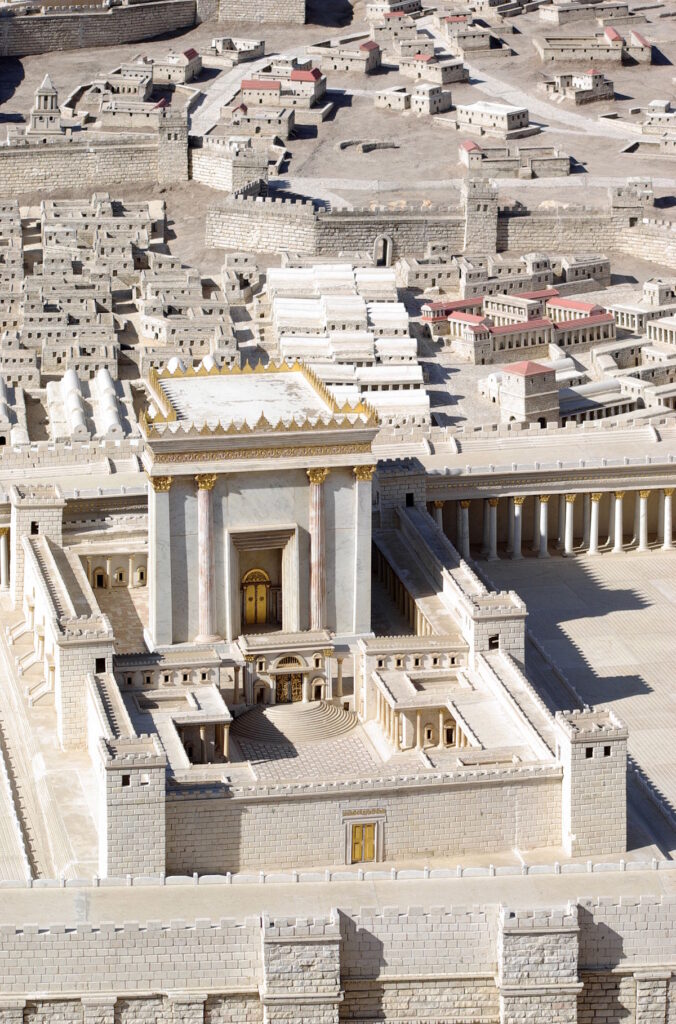
The Most Magnificent Building in the Ancient World
To understand the temple scene in John 2, you must first understand the temple itself. And the temple Herod the Great built was, by any standard, one of the most staggering architectural achievements in human history.
Herod began his massive renovation project around 20-19 BC.5 The Second Temple, rebuilt by Zerubbabel after the Babylonian exile, was a modest structure that had stood for nearly five centuries. Herod’s ambition was to transform it into a monument that would rival anything in Rome, Athens, or Alexandria — and to secure his legacy as the builder-king of the Jewish people, despite the fact that his Idumean ancestry and Roman allegiance made him perpetually suspect in Jewish eyes.
The scale was almost incomprehensible. The temple platform — the enormous plaza on which the entire complex sat — measured approximately 1,600 feet from north to south and 900 feet from east to west, encompassing roughly 36 acres. This was the largest religious precinct in the ancient world. To create this platform, Herod’s engineers extended the natural hill of Mount Moriah with massive retaining walls built from limestone blocks, some weighing hundreds of tons. The largest stone discovered in the Western Wall foundations measures approximately 44 feet long, 11 feet high, and 16 feet deep, weighing an estimated 570 tons. Moving and placing stones of this size with first-century technology remains an engineering mystery that modern scholars debate.
The sanctuary building itself — the “naos”Greek“ναός”“naos”“noun,“inner — rose approximately 150 feet high, clad in white marble and gold plating that blazed in the Mediterranean sun. Josephus describes the effect: “The outward face of the temple in its front wanted nothing that was likely to surprise either men’s minds or their eyes, for it was covered all over with plates of gold of great weight, and at the first rising of the sun, reflected back a very fiery splendor, and made those who forced themselves to look upon it to turn their eyes away, just as they would have turned them away from the sun’s own rays. But this temple appeared to strangers, when they were coming to it at a distance, like a mountain covered with snow, for as to those parts of it that were not gilt, they were exceeding white.”6
A mountain of snow crowned with fire. That is what pilgrims saw as they approached Jerusalem from any direction. The temple dominated the skyline. It dominated the economy. It dominated the imagination.
The Courts: Layers of Holiness
The temple complex was organized as a series of concentric courts, each more restricted and more holy than the one before — a physical architecture of ascending holiness that reflected the theological conviction that the closer you came to God’s presence, the fewer people were permitted to approach.
The Court of the Gentiles was the outermost court — the massive open plaza that any person, regardless of nationality or religion, could enter. It was paved with polished stone, lined with covered colonnades, and designed to accommodate the massive crowds that flooded Jerusalem during the pilgrimage festivals. This was where Gentile “God-fearers” — non-Jews attracted to the God of Israel — could come to pray and worship. Isaiah had prophesied that the temple would be “a house of prayer for all nations” (Isaiah 56:7), and the Court of the Gentiles was the architectural fulfillment of that promise.
A low stone balustrade — the “soreg”Greek“σωρέγ”“soreg”“dividing — separated the Court of the Gentiles from the inner courts. Posted at intervals along this barrier were inscriptions in Greek and Latin warning Gentiles against proceeding further. Two of these inscription stones have been discovered by archaeologists, and the text is chilling: “No foreigner is to go beyond the balustrade and the plaza of the temple zone. Whoever is caught doing so will have himself to blame for his death which will follow.”7 This was not a polite suggestion. It was a death sentence, enforced with Roman permission.
Beyond the barrier lay the Court of Women — open to all Jewish men and women but no further for women. Then the Court of Israel — open to ritually pure Jewish men. Then the Court of the Priests, surrounding the altar of burnt offering, where only priests could serve. And finally the sanctuary itself, containing the Holy Place (with the menorah, the table of showbread, and the altar of incense) and the Holy of Holies — the empty, dark, silent room where God’s presence dwelt, entered once a year by the high priest on the Day of Atonement.
Each step inward was a step toward holiness. Each boundary said the same thing: God is near, but God is holy, and sinful human beings cannot approach Him casually.
The Royal Portico
Along the southern wall of the temple platform stretched the Royal Portico — a massive basilica-style colonnade that Josephus described as “more noteworthy than any under the sun” (Antiquities 15.411-416). It consisted of four rows of columns — 162 columns total, each 27 feet high and so thick that three men linking arms could barely encircle one. The central nave rose higher than the side aisles, creating a cathedral-like interior space.
This was not primarily a worship space. Walvoord and Zuck note that “the high priest Caiaphas had authorized a market (probably a recent economic innovation) for the sale of ritually pure items necessary for temple sacrifice: wine, oil, salt, approved sacrificial animals and birds” (The Bible Knowledge Commentary: Gospels, p.135). The Royal Portico was the commercial and judicial hub of the temple complex. It was here — or in the adjacent areas of the Court of the Gentiles — that the money changers set up their tables and the animal sellers established their stalls. It was also where the Sanhedrin may have held some of its sessions and where scribes and teachers of the law engaged in public instruction. The Royal Portico was, in effect, the Wall Street and Supreme Court of Jewish society, combined with a commercial market, all operating within the sacred precincts of the temple.
The Antonia Fortress
Overlooking the temple courts from the northwest corner stood the Antonia Fortress — a massive military installation built by Herod and named for his patron Mark Antony. The fortress was connected to the temple courts by staircases, allowing Roman soldiers to descend rapidly into the temple area at the first sign of disturbance. During the pilgrimage festivals, when nationalist fervor ran high and the population of Jerusalem swelled to many times its normal size, the Roman garrison was reinforced with additional troops stationed in the fortress.
This meant that every act of worship in the temple occurred under Roman surveillance. The soldiers could see into the courts. They could hear the crowds. They could intervene in minutes. The Antonia Fortress was a permanent reminder that the God of Israel might dwell in this temple, but Rome controlled the ground on which it stood.
When Jesus fashioned a whip and began driving out the livestock and overturning tables, Roman soldiers in the Antonia were watching. The fact that they did not intervene suggests either that the disturbance was brief and contained, or that they regarded it as an internal Jewish religious matter. But the potential for catastrophe was real. A riot in the temple during Passover, with a Roman garrison armed and ready on the overlooking fortress — the results could have been lethal.
Herod’s temple renovation, begun around 20 BC and still unfinished during Jesus’ ministry, created the largest and most magnificent religious complex in the ancient world. The temple platform covered 36 acres, the sanctuary blazed with gold and white marble, and a series of concentric courts enforced escalating levels of holiness and restriction. The Antonia Fortress overlooked it all, ensuring that Roman soldiers could monitor and intervene in every act of Jewish worship.
Temple Commerce: The Bazaars of Annas
A System of Sacred Exploitation
The commercial operation Jesus confronted in John 2 was not a few roadside vendors hawking lambs. It was a sophisticated, monopolistic enterprise that generated enormous revenue for the temple treasury and, by all accounts, for the families that controlled it.
The system worked like this. Jewish law required that sacrificial animals meet strict standards of physical perfection — no blemish, no defect, no injury (Leviticus 22:17-25). Pilgrims traveling from Galilee, the Diaspora, or the Transjordan often brought their own animals, purchased at local markets. But when they arrived at the temple and submitted their animals for priestly inspection, the inspecting priests frequently found “defects” that disqualified the animal. The pilgrim was then directed to purchase an approved animal from the temple’s own vendors — at a significant markup. The rejected animal, conveniently, could then be resold by the temple vendors to the next arriving pilgrim. It was a system designed to funnel money from the pockets of worshipers into the coffers of the temple aristocracy.
The animals sold corresponded to the economic tiers prescribed by the Torah. Oxen and cattle were the most expensive sacrificial offerings, brought by the wealthy. Sheep and goats represented the middle tier. Doves were the offering of the poor — the sacrifice prescribed for those who could not afford a lamb (Leviticus 5:7; 12:8). Luke records that Mary and Joseph offered “a pair of turtledoves or two young pigeons” at Jesus’ presentation in the temple (Luke 2:24), indicating their economic status. The dove sellers served the most vulnerable worshipers — a detail that illuminates Jesus’ gentler treatment of them during the cleansing. He drove out the cattle and sheep with the whip but told the dove sellers to “Take these things away” — a command, not a violent action, reflecting pastoral sensitivity toward those who served the poor.
The House of Annas
Historical sources point to one family as the primary beneficiary of this commercial system: the house of Annas. Annas (Hebrew: Hanan ben Seth) served as high priest from AD 6 to 15. After his deposition by the Roman prefect Valerius Gratus, five of his sons and his son-in-law Joseph Caiaphas held the high priesthood in succession.8 This priestly dynasty controlled the temple’s financial operations with an iron grip.
The Talmud preserves a remarkable folk lament that captures popular sentiment about this family: “Woe to me because of the house of Boethus! Woe to me because of their clubs! Woe to me because of the house of Annas! Woe to me because of their serpent’s hiss! Woe to me because of the house of Kathros! Woe to me because of their pens! Woe to me because of the house of Ishmael ben Phiabi! Woe to me because of their fists! For they are the high priests, and their sons are the treasurers, and their sons-in-law are the temple officers, and their servants beat the people with staves” (Pesahim 57a).9
The “bazaars of the sons of Annas” — chanuyot shel benei Hanan — became a byword for priestly corruption. Originally, the commercial operations had been located outside the temple complex, across the Kidron Valley on the slopes of the Mount of Olives. At some point — likely during the tenure of Annas or his immediate successors — the markets were moved inside the Court of the Gentiles itself. The justification was surely practical: convenience for pilgrims, efficiency of operations, proximity to the inspecting priests. The effect was the desecration of the only space in the temple where Gentiles were permitted to worship.
R.C. Sproul captured the scene vividly: imagine coming to church on Sunday morning to pray, and all you hear is the bleating of sheep, the lowing of cattle, the cooing of doves, and the clatter of coins on counting tables. The air smells not of incense but of animal waste. The sound is not worship but commerce. “The sacred grounds that had been reserved for a posture of worship became chaotic.” That is what the Court of the Gentiles had become.
The temple’s commercial system was a monopolistic enterprise controlled by the family of Annas, the former high priest. Pilgrims’ animals were routinely rejected by inspecting priests, forcing worshipers to buy approved animals at inflated prices from temple vendors. The Talmud itself preserved popular laments against the corruption of these priestly families. Originally located outside the temple on the Mount of Olives, the markets were eventually moved into the Court of the Gentiles — the only space where non-Jews could worship — transforming a house of prayer into an emporium.
Money Changing: The Tyranny of the Tyrian Shekel
The Temple Tax
Every adult Jewish male was required to pay an annual temple tax of one-half shekel (Exodus 30:13). This was not a voluntary contribution. It was a mandatory assessment — a standing obligation that applied to Jews everywhere, whether they lived in Jerusalem or in the farthest reaches of the Diaspora. The tax supported the daily operations of the temple: the tamid sacrifices, the priestly wages, the maintenance of the facilities, the provision of incense and oil.
The Mishnah specifies that the half-shekel collection began on the first of Adar (roughly February-March), with tables set up in the provinces on the fifteenth of Adar and in the temple itself on the twenty-fifth (Shekalim 1:1, 1:3). By Passover, everyone was expected to have paid.
But not just any coin would do.
Why Tyrian Shekels
The temple authorities required that the tax be paid in Tyrian shekels — silver coins minted in the Phoenician city of Tyre. MacArthur emphasizes that “other foreign coinage was likewise unacceptable for temple offerings, either because it was minted from impure metal or because imagery stamped on it made the coins unacceptable for an act of worship. Therefore only one particular kind of half-shekel coin could be used” (The Jesus You Can’t Ignore, p.30). The reason was practical: Tyrian shekels had the highest and most consistent silver content of any coinage circulating in the eastern Mediterranean, approximately 94 percent pure silver. Roman coins, by contrast, had a lower silver content, and their value fluctuated. The half-shekel Tyrian coin was a known, trusted standard — the gold standard (or rather, silver standard) of ancient currency.
But there was an irony that would not have been lost on observant Jews. The Tyrian shekel bore the image of Melqart — the Phoenician god associated with Baal — on one side and an eagle on the other. The coin that the temple demanded as its official currency carried a pagan deity on its face. Roman coinage was rejected because it bore the image of Caesar and was considered idolatrous. Yet the prescribed alternative featured a Phoenician god. The temple authorities apparently judged that the purity of the silver mattered more than the image on the coin — a pragmatic compromise that must have troubled at least some theologically minded worshipers.10
The Markup
Philip Harland documents that “the yearly temple contribution or first-fruits offering, which was based on a passage in Exodus (20:11-16), was a half-shekel (= 2 drachmas or 2 denarii in the first century) that was, in theory, paid by male Israelites who were more than 20 years old,” and that “the Tyrian shekel – often used by those who actually made the trip to Jerusalem in order to pay the temple contribution” – was the coin of choice for this transaction (Group Survival in the Ancient Mediterranean, p.148).
The money changers — “kollybistai”Greek“κολλυβισταί”“kollybistai”“noun,“money — provided a necessary service. Most pilgrims arrived with local currency: Roman denarii, Greek drachmas, or various provincial coins. These had to be exchanged for the required Tyrian shekels. The money changers performed this exchange and charged a commission — the “kolbon”Hebrew“קֹלְבּוֹן”“kolbon”“surcharge, — estimated at approximately 4 to 8 percent per transaction, though some sources suggest it could run as high as 12 percent.
For a wealthy pilgrim, this was a minor expense. For a poor farmer who had scraped together just enough to pay the temple tax, the surcharge was a meaningful financial burden. And the money changers operated within a system that offered no competition — the exchange rate was set by the temple authorities, and there was no alternative provider. It was a captive market, and the captives were worshipers.
When Jesus “poured out the changers’ money and overturned the tables” (John 2:15), He was dismantling this system — physically, visibly, dramatically. The coins that rolled across the stone floor of the Court of the Gentiles represented not just currency but a corrupt economy that extracted wealth from the faithful in the name of God.
The annual half-shekel temple tax had to be paid in Tyrian shekels — the only coin with sufficiently pure silver content, despite its ironic depiction of a pagan god. Money changers charged a commission of up to 12 percent on each exchange, operating within a monopolistic system that offered worshipers no alternatives. The entire operation extracted wealth from the faithful in the name of sacred obligation.
Passover in the First Century: A Nation on Fire
The Three Pilgrimage Festivals
Jewish law required every adult male to appear before the Lord in Jerusalem three times each year for three pilgrimage festivals: Passover (Pesach), Pentecost (Shavuot), and Tabernacles (Sukkot) (Deuteronomy 16:16). These festivals were not optional. They were commandments — divine obligations tied to Israel’s agricultural calendar and her sacred history. Passover commemorated the exodus from Egypt. Pentecost celebrated the firstfruits of the wheat harvest and the giving of the Torah at Sinai. Tabernacles recalled the wilderness wandering and the provision of God.
Of the three, Passover was the most emotionally and politically charged. It was the festival of liberation — the annual re-enactment and remembrance of the night God delivered His people from slavery. In a nation currently living under Roman occupation, the Passover story was not merely historical. It was aspirational. Every Seder table, every retelling of the Exodus narrative, every recitation of “Next year in Jerusalem” carried an implicit question: If God delivered us from Pharaoh, will He not deliver us from Caesar?
The Population Surge
Josephus provides various estimates of the Passover crowd in Jerusalem, and while his numbers are almost certainly inflated, even conservative estimates are staggering. In one passage, he claims that 2.7 million pilgrims gathered for Passover, based on a census of sacrificial lambs (Jewish War 6.420-427). Modern historians consider this figure wildly exaggerated — Jerusalem’s water supply, available lodging, and physical infrastructure could not have supported such a number. Scholarly estimates typically range from 180,000 to 500,000 pilgrims, swelling Jerusalem’s normal population of approximately 40,000 to as much as ten times its usual size.11
Even at the lower estimates, the transformation was dramatic. Pilgrims poured in from every direction — from Galilee in the north, from the Diaspora communities in Egypt, Syria, Asia Minor, and Rome, from the Transjordan and the Decapolis. They camped on the hillsides surrounding the city. They filled every available room, every courtyard, every open space. The narrow streets of Jerusalem became impassable. The noise was overwhelming. The smells — human, animal, culinary — were intense. And the Roman garrison, reinforced from Caesarea for the occasion, watched it all with weapons ready.
The Paschal Lamb
At the heart of Passover was the slaughter of the paschal lamb. On the afternoon of the fourteenth of Nisan, families or groups of at least ten people brought their lambs to the temple. The Mishnah describes the procedure in meticulous detail (Pesahim 5:5-10): the lambs were slaughtered in the temple court, their blood caught in gold and silver basins by priests standing in rows, passed from hand to hand until the blood was dashed against the base of the altar. The lambs were then skinned, their fat burned on the altar, and the carcasses returned to the families for roasting.
The scale was industrial. If even the conservative estimate of 30,000 to 40,000 lambs were slaughtered in a single afternoon (as opposed to Josephus’s quarter-million), the logistics were staggering. Levites sang the Hallel psalms (Psalms 113-118) while the slaughter proceeded. The blood ran in rivers through channels cut into the courtyard floor, flowing into the Kidron Valley below. The air was thick with smoke from the altar fires. The sounds — the bleating of the lambs, the chanting of the psalms, the murmur of thousands of voices — filled the temple mount.
Ceslas Spicq explains the theological stakes: in the Johannine framework, God’s miraculous acts serve as “proof that a message is truly from God,” and thus “the persistent demand of Jesus’ contemporaries” to “see a sign” (John 2:18; 6:30) reflects the ancient expectation that divine messengers authenticate themselves through visible deeds (Theological Lexicon of the New Testament, vol. 3, p.591).
This was the scene that awaited Jesus when He “went up to Jerusalem” for the Passover in John 2:13. John the Baptist had already identified Him as “hoGreek“ὁ“ho“noun“the (John 1:29). Now the Lamb enters the place where lambs are slaughtered by the tens of thousands. The typology is unmistakable. He walks into the temple not as a pilgrim bringing his sacrifice but as the sacrifice itself — though this will not become clear until the final Passover, three years later, when He is crucified at the precise hour the paschal lambs begin to die.
Passover was the most politically and emotionally charged of the three pilgrimage festivals, commemorating Israel’s liberation from Egypt in a nation currently under Roman occupation. Jerusalem’s population swelled to as much as ten times its normal size. Tens of thousands of lambs were slaughtered in a single afternoon, their blood running in channels through the temple courtyard. When Jesus — already identified as the Lamb of God — entered this scene, He entered as the ultimate fulfillment of everything the festival represented.
The Forty-Six Years: Dating the Temple and the Ministry
The Chronological Anchor
When the Jewish leaders responded to Jesus’ enigmatic statement about destroying and raising the temple in three days, they offered what may be the most valuable chronological marker in the Gospels: “It has taken forty-six years to build this temple” (John 2:20). This number, combined with what we know from Josephus about Herod’s building program, allows us to date this first Passover of Jesus’ public ministry with reasonable precision.
Josephus records that Herod announced his plans to rebuild the temple in the eighteenth year of his reign (Antiquities 15.380). Dating Herod’s reign is itself a complex problem, as ancient sources use different reference points. Most scholars place the beginning of the temple project at 20-19 BC, with construction on the main sanctuary beginning in approximately 19 BC. The sanctuary building itself was completed relatively quickly — Josephus says eighteen months for the sanctuary proper, eight years for the surrounding courts and cloisters (Antiquities 15.420-421). But finishing work continued for decades. New areas were added. Decorative elements were installed. The project was ongoing.
If we count forty-six years from 20-19 BC, we arrive at approximately AD 27-28 for this Passover encounter. This aligns well with other chronological data in the Gospels. Luke 3:1-2 places the beginning of John the Baptist’s ministry in the fifteenth year of Tiberius Caesar, which is typically calculated as AD 28-29 (depending on the method of reckoning). Jesus’ own ministry began shortly after John’s. A Passover in AD 27 or 28, near the start of Jesus’ public work, fits the available evidence.
This chronological precision serves John’s purpose at multiple levels. First, it demonstrates historical accuracy — the kind of specific, verifiable detail that an eyewitness or someone working from eyewitness testimony would include. Second, it establishes the framework for Jesus’ approximately three-year ministry, since John mentions three Passovers (2:13; 6:4; 11:55). And third, it underscores the sheer magnitude of what the Jewish leaders could not comprehend: they had spent forty-six years and counting on a building project that would be destroyed by Rome in AD 70, while Jesus offered a temple — His own body — that would be destroyed and rebuilt in three days, and would stand forever.
The temple renovation would not be completed until AD 64, under the procurator Albinus (Antiquities 20.219). The workers who celebrated its completion had precisely six years to admire their work before Titus’s legions burned it to the ground. The temple Jesus spoke of — His risen body — has endured for two millennia and will endure eternally. As Sproul put it: “Don’t you realize that the temple has already been rebuilt? Christ is the temple. And the rebuilding of the temple took place on the day of resurrection.”
The Jewish leaders’ reference to forty-six years of temple construction provides a crucial chronological anchor, dating this Passover encounter to approximately AD 27-28. This aligns with other Gospel chronology and establishes the framework for Jesus’ three-year ministry. The irony is devastating: the temple they spent decades building would be destroyed by Rome in AD 70. The temple Jesus spoke of — His body — was destroyed and rebuilt in three days and will endure forever.
Prophetic Precedent: God Has Done This Before
The Prophets Saw It Coming
Jesus’ cleansing of the temple was not an improvised act. It was the fulfillment of centuries of prophetic warning. The Old Testament prophets had repeatedly confronted the corruption of Israel’s worship, and their language thunders behind every swing of Jesus’ whip.
Malachi 3:1-3 provides the most direct prophetic backdrop: “Behold, I send My messenger, and he will prepare the way before Me. And the Lord, whom you seek, will suddenly come to His temple, even the Messenger of the covenant, in whom you delight. Behold, He is coming, says the LORD of hosts. But who can endure the day of His coming? And who can stand when He appears? For He is like a refiner’s fire and like launderers’ soap. He will sit as a refiner and a purifier of silver; He will purify the sons of Levi, and purge them as gold and silver, that they may offer to the LORD an offering in righteousness.”
Read that slowly. “The Lord, whom you seek, will suddenly come to His temple.” John the Baptist was the messenger who prepared the way. Jesus was the Lord who suddenly came. And what did He do when He arrived? Exactly what Malachi predicted — He purified. He refined. He purged the sons of Levi (the priestly tribe that administered the temple) by driving out the corrupt commercial system they had established in the sacred courts. The Jewish leaders who demanded a sign from Jesus (John 2:18) failed to recognize that the cleansing itself was the sign. Malachi had told them precisely what to expect, and it was happening before their eyes.
Jeremiah 7:1-15 — the “Temple Sermon” — provides another prophetic foundation. Jeremiah stood at the gate of the temple and declared: “Do not trust in these lying words, saying, ‘The temple of the LORD, the temple of the LORD, the temple of the LORD are these’… Has this house, which is called by My name, become a den of robbers in your eyes? Behold, I, even I, have seen it, says the LORD” (Jeremiah 7:4, 11). Jeremiah warned that the mere existence of the temple would not protect a people whose worship had become corrupt and whose lives violated the covenant. God had destroyed Shiloh — the earlier sanctuary where the ark had rested — and He would do the same to the Jerusalem temple if His people did not repent.
Jesus echoed Jeremiah’s language in the Synoptic accounts of the temple cleansing: “It is written, ‘My house shall be called a house of prayer,’ but you have made it ‘a den of robbers’” (Matthew 21:13). In John’s account, the language is slightly different — “Do not make My Father’s house a house of merchandise” (John 2:16) — but the prophetic framework is identical. The temple had been commandeered for purposes that violated its consecration. The Lord of the temple had come to reclaim it.
Ezekiel 10-11 describes the most terrifying event in the Old Testament’s prophetic literature: the departure of God’s glory from the temple. Ezekiel, writing during the Babylonian exile, received a vision in which the “kavod”Hebrew“כָּבוֹד”“kavod”“glory, — the visible manifestation of God’s presence — rose from the cherubim above the ark of the covenant, moved to the threshold of the temple, paused at the east gate, and then departed from the city altogether, ascending to the Mount of Olives (Ezekiel 10:4, 18-19; 11:22-23). God’s glory left the building. The temple remained standing, its rituals continued, its priests still served — but the presence was gone. The shell remained. The life had departed.
This vision haunted Jewish theology for centuries. When had the glory returned? The Second Temple, rebuilt by Zerubbabel, was a modest structure that by all accounts lacked several features of Solomon’s original temple, including the ark of the covenant, the Urim and Thummim, and — most critically — the visible manifestation of God’s glory. The rabbis debated whether the Shekinah (the dwelling presence of God) had ever returned to the Second Temple. Some maintained that it had; others were less certain.
When Jesus entered the temple and called it “My Father’s house,” He was making an implicit claim more staggering than the cleansing itself. If He was who John’s Gospel claims He is — the Word who was with God and was God, the one in whom “the fullness of the Godhead dwells bodily” (Colossians 2:9) — then His entrance into the temple was the return of the glory. God’s presence, which Ezekiel had seen departing six centuries earlier, was walking back into the sacred precincts in the body of a Galilean carpenter. The glory had returned — not as a cloud above the ark but as a man with calloused hands and a whip of cords.
Zechariah 14:20-21 looks forward to the eschatological day when holiness would permeate everything — even the most ordinary objects: “In that day ‘HOLINESS TO THE LORD’ shall be engraved on the bells of the horses. The pots in the LORD’s house shall be like the bowls before the altar… In that day there shall no longer be a ”kena’ani”Hebrew”כְּנַעֲנִי””kena’ani””Canaanite, in the house of the LORD of hosts.” The word kena’ani can mean either “Canaanite” or “merchant” — and most scholars read it here as “merchant” or “trader.” Zechariah prophesied a day when no merchant would operate in the Lord’s house. When Jesus drove out the merchants, He was enacting Zechariah’s eschatological vision in the present tense.
Jesus’ temple cleansing did not occur in a prophetic vacuum. Malachi foretold the Lord’s sudden arrival at His temple to purify the priesthood. Jeremiah denounced the temple as a den of robbers. Ezekiel recorded the departure of God’s glory from the temple. Zechariah prophesied a day when no merchant would stand in the Lord’s house. Jesus’ cleansing fulfilled these prophecies simultaneously. The Jewish leaders who demanded a sign failed to recognize that the cleansing itself was the sign Malachi had promised centuries earlier.
The Danger of What Jesus Did
A Man With No Credentials
Modern readers tend to romanticize the temple cleansing. We picture a noble act of righteous protest, like a reformer nailing theses to a church door. But in its original context, what Jesus did was extraordinarily dangerous — not as a metaphor, but as a practical reality that could have gotten Him killed on the spot.
Jesus held no priestly office. He was not a Levite. He had no official standing in the temple hierarchy. He was a layman from Galilee — a region viewed with suspicion by the Jerusalem establishment. He had no army, no political backing, no institutional authority. And He walked into the most sensitive religious and commercial space in the Jewish world, during the most volatile week of the Jewish year, and single-handedly disrupted operations that were controlled by the most powerful family in the nation.
As the Theological Dictionary of the New Testament observes, in the Fourth Gospel semeion is “a key one in theological interpretation,” and the relationship between Jesus’ erga (works) and His semeia (signs) is that “the erga are semeia as God’s own erga” – Jesus performs them “only when his hour comes (2:4), but he knows this hour (13:1)” (Kittel, TDNT, p.590). The authorities’ demand for a sign missed the fact that the cleansing itself was a sign.
Calvin marveled at the scene: “Here we see the divine power of Christ shining forth, that a single man could put to flight a great multitude of people, as if he had been furnished with an armed force.” The fact that no one stopped Him — that the temple guards did not intervene, that the money changers did not fight back, that the animal sellers did not resist — is itself remarkable. MacArthur captures the scene: “There must have been great tumult all around, but in the midst of it, Jesus appears unruffled – fierce in His anger, perhaps, but resolute, single-minded, stoic, and wholly composed. He is the very picture of self-control. (This is truly righteous indignation, not a violent temper that has gotten out of hand.)” (The Jesus You Can’t Ignore, p.26). Jesus possessed no weapon but a hastily braided whip of rope. His authority was not institutional but personal. Something about His presence, His bearing, His moral authority was so overwhelming that a crowd of merchants, guards, and religious officials simply gave way.
But the response that followed — “What sign do You show to us, since You do these things?” (John 2:18) — reveals the underlying tension. The authorities were not persuaded. They were calculating. They demanded credentials. They wanted to know by what authority this unauthorized Galilean had disrupted their lucrative operation. The question was not idle curiosity. It was the opening move in what would become a three-year campaign to destroy Him. The cleansing of the temple did not endear Jesus to the religious establishment. It put a target on His back.
Two Cleansings or One?
A significant debate in New Testament scholarship concerns whether Jesus cleansed the temple once or twice. The Synoptic Gospels (Matthew 21, Mark 11, Luke 19) all place the temple cleansing during the final week of Jesus’ ministry, just days before His crucifixion. John places it at the very beginning, during the first Passover of His public ministry.
Several explanations have been offered. Walvoord and Zuck argue that “probably there were two cleansings, for there are differences in the narrations. John was undoubtedly aware of the Synoptics, and he supplemented them. The first cleansing caught the people by surprise. The second cleansing, about three years later, was one of the immediate causes of His death” (The Bible Knowledge Commentary: Gospels, p.233). Some scholars argue that John rearranged the chronology for theological reasons, placing the cleansing early to establish Jesus’ authority and introduce the temple theme that runs throughout his Gospel. Others, following a long tradition in church history, argue that Jesus cleansed the temple twice — once at the beginning of His ministry (recorded by John) and once at the end (recorded by the Synoptics). As Sproul noted, the idea that the money changers returned to business after the first cleansing is not hard to believe: “How long do you think after Jesus did that that those tables were right side up and the money changers were back in business?”
The two-cleansing view has several points in its favor. John’s account includes specific chronological markers — “the Passover of the Jews was at hand” (2:13), the reference to “forty-six years” (2:20) — that suggest a precise historical context early in Jesus’ ministry. The Synoptic cleansing occurs in a different context, with different emphasis: Jesus quotes Isaiah 56:7 and Jeremiah 7:11 in the Synoptics but not in John. John’s Jesus says “Do not make My Father’s house a house of merchandise” (2:16), while the Synoptic Jesus says “My house shall be called a house of prayer… you have made it a den of robbers” (Matthew 21:13). The language is related but distinct. The detail and emphasis differ enough to suggest two separate events.
Whether one cleansing or two, the historical reality is the same: Jesus claimed authority over the temple that no one had given Him, exercised that authority with physical force, and did so in full view of both the religious establishment and the Roman garrison. It was an act of breathtaking courage, prophetic conviction, and divine authority. And it was, by any calculation of political reality, an act that would eventually cost Him His life.
Jesus’ temple cleansing was not a metaphorical protest. It was a physically dangerous act — an unauthorized disruption of a lucrative commercial operation controlled by the most powerful family in the nation, carried out during the most volatile week of the year, under the direct surveillance of a Roman garrison. The religious authorities’ demand for a sign was not idle curiosity but the opening move in a campaign to destroy Him.
Closing the Gap
Two scenes. One chapter. And between them, a world that most modern readers never see.
The wedding at Cana was not a charming anecdote about Jesus doing a favor for a friend. It was a crisis of family honor in a shame culture where reputation was everything — resolved by the quiet intervention of the Creator who poured out abundance where human provision had failed. The stone jars were not random props. They were artifacts of a comprehensive purity system that Jesus was about to fulfill and transcend. The wine was not a party trick. It was the eschatological sign the prophets had promised — the abundance of the messianic age breaking into history in a village too small for the maps.
The temple cleansing was not an angry outburst by a man who lost His temper. It was the fulfillment of Malachi’s prophecy, the enactment of Zechariah’s vision, the echo of Jeremiah’s warning, and the return of the glory that Ezekiel had seen departing. It was carried out with deliberate intention, prophetic authority, and physical courage in one of the most dangerous places on earth during the most volatile week of the year. The coins that scattered across the stone floor represented not just money but a corrupt system that had turned worship into commerce and the house of God into a marketplace. The man who scattered them held no office, bore no title, carried no weapon but a rope whip — and every merchant, guard, and priest gave way before His presence.
As the Anchor Bible Dictionary summarizes the Johannine perspective, “there are those who see Jesus’ miracles for what they are, signs identifying him as the life and light of the world, the bread from heaven, the one sent by the Father (2:11; 6:69; 9:38; 11:41-42) to do his works (5:36; 10:25)” (Freedman, The Anchor Bible Dictionary, p.6062). The signs at Cana and the temple were never mere spectacles – they were invitations to perceive who Jesus truly was.
The people who first witnessed these events did not need a historical-context article to understand them. They lived in the context. They knew the shame of a failed wedding, the smell of the temple markets, the weight of the half-shekel tax, the sound of ten thousand lambs dying on Passover afternoon. They knew — in a way we must work to recover — that what Jesus did at Cana was a sign of messianic abundance, and what He did at the temple was a claim of divine authority so radical that it could only end in either enthronement or execution.
It ended in both.
Sources cited: Flavius Josephus, Antiquities of the Jews and Jewish War; Mishnah (Ketubot, Kelim, Shekalim, Pesahim); Babylonian Talmud (Pesahim 57a); Kenneth E. Bailey, Jesus Through Middle Eastern Eyes; D.A. Carson, The Gospel According to John (PNTC); Craig S. Keener, The Gospel of John: A Commentary; Joachim Jeremias, Jerusalem in the Time of Jesus; Yitzhak Magen, The Stone Vessel Industry in the Second Temple Period; Yaakov Meshorer, A Treasury of Jewish Coins; Douglas R. Edwards, “Khirbet Qana: From Jewish Village to Christian Pilgrim Site”; R.C. Sproul, “Cleansing of the Temple” (sermon on John 2:12-25); John Calvin, Commentary on the Gospel According to John; Hermann Strack and Paul Billerbeck, Commentary on the New Testament From the Talmud and Midrash; Robin Margaret Jensen, Baptismal Imagery in Early Christianity; David Noel Freedman, ed., The Anchor Bible Dictionary; Gerhard Kittel and Gerhard Friedrich, eds., Theological Dictionary of the New Testament (TDNT); Ceslas Spicq, Theological Lexicon of the New Testament; John F. Walvoord and Roy B. Zuck, The Bible Knowledge Commentary: Gospels; John MacArthur, The Jesus You Can’t Ignore; Philip A. Harland, Group Survival in the Ancient Mediterranean; Charles W. Draper, ed., Holman Illustrated Bible Dictionary.
This article is part of our John 2 Deep Dive series. For a verse-by-verse exegesis, see John 2: Water, Wine, and the Wrath of Holy Love. For a study of the Greek vocabulary, see Greek Words That Unlock John 2. For the theology of signs, zeal, and the human heart, see Temple, Body, Church: The Theology of John 2.