
Temple, Body, Church: What John 2 Teaches About Signs, Zeal, and the Human Heart
Introduction: A Chapter Hiding a Revolution
Most people read John 2 as two vivid stories — a wedding miracle and a temple tantrum. And if that is all you see, you have missed almost everything.
Beneath the surface narrative, John 2 is conducting a theological revolution. It is dismantling one entire religious system and erecting another in its place. It is redefining where God lives, how God acts, what faith means, and what is wrong with the human heart. It does all of this in twenty-five verses, without raising its voice — and most readers walk away thinking it was about wine and furniture.
The problem is not intelligence. The problem is that we read John 2 with modern eyes that see events rather than signs, buildings rather than theology, anger rather than holiness. We read it as narrative when John wrote it as revelation.
This article is a theological deep dive. We are going to trace six major doctrinal themes that run through John 2 like subterranean rivers beneath the narrative surface: the theology of signs, the theology of the temple, the theology of holy zeal, the divine knowledge of Jesus, the theology of the hour, and the sweeping old-to-new-covenant transformation motif that binds them all together. By the end, you should see this chapter the way John intended it — not as two stories about a wedding and a temple, but as one sustained argument about the identity of Jesus Christ and the total renovation of how God relates to His people.
We will draw heavily on the Reformed theological tradition — Calvin, Owen, Edwards, Sproul, MacArthur — not because they invented these ideas but because they recovered them from the text of Scripture after centuries of ecclesiastical accumulation had buried them. What we are doing here is what the Reformers always did: reading the text closely, letting it speak, and following where it leads even when the destination is uncomfortable.
Let us begin with the word John chose to describe what Jesus did at Cana — and what he deliberately refused to call it.
1. The Theology of Signs (Semeia): Miracles That Mean Something
Why John Never Says “Miracle”
Here is something most readers never notice: John’s Gospel never uses the word “miracle.”
The Synoptic Gospels — Matthew, Mark, and Luke — regularly describe Jesus’ supernatural works as “dynamis”Greek“δύναμις”“dynamis”“noun,“power,. A dynamis is an act of raw power. It emphasizes what happened — the sheer force required to heal a paralytic, calm a storm, or raise the dead. The focus is on the event itself.
John uses a different word entirely. He calls them “sēmeion”Greek“σημεῖον”“sēmeion”“noun,“sign,. A sēmeion is not primarily an act of power. It is an act of meaning. Walvoord and Zuck note that “John used the word ‘signs’ (semeion) because he was seeking to draw attention away from the miracles as such and to point up their significance,” adding that a miracle is also a “wonder” (teras), a “power” (dynamis), and a “strange event” (paradoxos) – but John chose the one term that emphasizes meaning over spectacle (The Bible Knowledge Commentary: Gospels, p.232). A sign points beyond itself to something else. A road sign that says “Paris 200 km” is not itself Paris. It exists to direct your attention elsewhere. The moment you stop at the sign and go no further, you have defeated its purpose.
This is John’s entire theology of miracles in a single word choice. The Theological Dictionary of the New Testament confirms that in John’s usage, sēmeion carries a freight of meaning that dynamis does not: the sign “is not just a pointer but an effective expression” of the divine reality it signifies, functioning as “a claim to authority” that demands a verdict from its witnesses (Kittel and Friedrich, Theological Dictionary of the New Testament, Abridged, p.590). Jesus’ works are not spectacles to be admired. They are arrows to be followed. Every sign points beyond itself to the identity and mission of Christ. The water becoming wine is not fundamentally about wine. It is about who has the authority to create, to transform, and to inaugurate a new age. The temple cleansing is not about furniture. It is about who owns the house.
John Calvin grasped this with characteristic precision: “The miracles which God performs are not mere spectacles, but contain a teaching that is useful and for edification. We must therefore attend to the purpose for which they were designed.”1
The Seven Signs: A Deliberate Architecture
John selects exactly seven signs from Jesus’ ministry, a number that signals completeness in Jewish thought:
- Water into wine at Cana (2:1-11)
- Healing the nobleman’s son (4:46-54)
- Healing the man at the Pool of Bethesda (5:1-15)
- Feeding the five thousand (6:1-14)
- Walking on water (6:16-21)
- Healing the man born blind (9:1-41)
- Raising Lazarus from the dead (11:1-44)
Each sign reveals a different facet of Christ’s glory. Taken together, they form a complete portrait: Jesus is the Creator who transforms (sign 1), the Healer who restores from a distance (sign 2), the Sovereign who overrides the Sabbath because He is the Lord of the Sabbath (sign 3), the Bread of Life who feeds the hungry (sign 4), the divine “I AM” who walks on chaos (sign 5), the Light of the World who opens blind eyes (sign 6), and the Resurrection and the Life who reverses death itself (sign 7).
The progression is deliberate. John opens with a relatively private miracle at a wedding and closes with the most public, most undeniable, most terrifying sign of all — calling a four-day-dead man out of a tomb by name. Walvoord and Zuck observe that “Jesus’ first miracle in the Gospel of John was a private one, known only to His disciples, some servants, and probably Jesus’ mother” (The Bible Knowledge Commentary: Gospels, p.232). The signs escalate. The stakes escalate. And the resistance escalates — it is after Lazarus’ resurrection that the Sanhedrin formally decides to kill Jesus (11:53).
But notice: John 2 contains the first and second signs in embryonic form. The wedding at Cana (2:1-11) is the first sign proper — the “beginning of signs.” But the temple exchange in 2:19-22 anticipates the ultimate sign: the death and resurrection of Jesus Himself. Raymond Brown among others has noted a structural parallel between the two episodes: “If water-to-wine points to new life through Christ when ‘his hour has come’ there may be an intended parallel to Jesus’ answer in 2:19, ‘Destroy this temple, and in three days I will raise it up’” (cited in Clines and Gunn, Art and Meaning: Rhetoric in Biblical Literature, JSOT Supplement, p.248). The first sign reveals the Creator who gives superabundant life. The final sign-reference reveals the Redeemer who conquers death. Together they form a complete christological portrait: creation and redemption, abundance and sacrifice, wine and blood.
R.C. Sproul observed that John’s selection of precisely seven signs was “not accidental but architectural. John is building a cathedral of evidence, and each sign is a load-bearing pillar.”2
The Danger of Sign-Faith: Believing the Wrong Thing
Here is where John 2 becomes pastoral dynamite.
At the end of the chapter, John records that “many believed in His name when they saw the signs which He did” (2:23). On the surface, this sounds wonderful. More believers. Mission accomplished. But the very next verse delivers a devastating qualification: “But Jesus did not commit Himself to them, because He knew all men” (2:24).
The Greek wordplay is intentional and untranslatable. The crowd “episteusan”Greek“ἐπίστευσαν”“episteusan”“verb,“believed” in Him, but He did not “episteuen”Greek“ἐπίστευεν”“episteuen”“verb,“entrust” Himself to them. Same verb. Same root. They offered their “faith” to Jesus, and Jesus refused to accept it at face value.
Why? Because their faith was anchored in signs rather than in the person the signs revealed. They wanted the miracle but not the Messiah. They wanted power but not the Person behind the power. They were looking at the road sign and calling it Paris.
This is one of the most neglected warnings in all of Scripture. John distinguishes between at least three kinds of “believing” in his Gospel:
Sign-faith (2:23-25) — belief based on spectacular displays. This is the faith of the crowds who followed Jesus for bread (6:26), who wanted to make Him king after the feeding miracle (6:15), and who later deserted Him when His teaching became difficult (6:66). It is enthusiasm without commitment, admiration without surrender.
Initial faith (2:11) — the disciples at Cana believed, but their faith was deepened by what they saw rather than created by it. They had already responded to Jesus’ call. The sign confirmed and strengthened what was already there.
Saving faith (20:31) — the faith John writes his entire Gospel to produce: “that you may believe that Jesus is the Christ, the Son of God, and that believing you may have life in His name.” This is faith in the person of Christ — His identity, His work, His sufficiency — not faith in His miracles per se.
Jonathan Edwards drew this distinction with surgical precision in his Religious Affections: “There is a difference between having a rational judgment that honey is sweet, and having a sense of its sweetness.”3 You can believe that Jesus performs miracles — even demons believe that (James 2:19) — without ever tasting the sweetness of Christ Himself. Sign-faith is a rational judgment about power. Saving faith is a taste of the Person.
John MacArthur presses this even further: “The most dangerous people in any church are not atheists or skeptics. They are people who have enough religion to be comfortable but not enough Christ to be saved.”4
This is what Jesus saw in the Passover crowds. They believed. But He did not believe in their believing. And the church today is full of the same phenomenon — people who profess Christ based on what He can do for them, who attend as long as the experience is satisfying, who affirm the creed without surrendering the heart. Jesus sees through every one of them, just as He saw through the crowds in Jerusalem. “He knew what was in man.”
John never calls Jesus’ works “miracles” (dynamis). He calls them “signs” (sēmeion) — pointers beyond themselves to Christ’s identity. The seven signs form a complete portrait of who Jesus is, but John 2 warns that sign-dependent faith is not saving faith. Many believed because of the signs, but Jesus did not entrust Himself to their profession. He saw through them. He still does.
2. Temple Theology: From Tabernacle to Body to Church
Where Does God Live?
If you want to understand the entire arc of biblical theology in a single question, here it is: Where does God dwell with His people?
The Bible’s answer to that question changes over time — not because God changes, but because His plan progressively unfolds. And John 2 is the hinge moment. It is where the answer shifts permanently from “in a building” to “in a body” — and eventually, as Paul and Peter will later develop, to “in a people.”
To see what John 2 is really doing, we need to trace the thread from the beginning.
Act One: The Garden
Eden was the first temple. This is not a metaphor. Biblical scholars have increasingly recognized that the Garden of Eden is described in Genesis 2-3 with deliberate temple imagery. The Anchor Bible Dictionary notes that the temple in the ancient Near East was consistently understood as the earthly dwelling-place of the deity, a “micro-cosmos” that replicated the created order and the divine garden (Freedman, The Anchor Bible Dictionary, vol. VI, p.8192).5 God walked with Adam in the cool of the day (Genesis 3:8). The garden faced east — as the tabernacle and temple later would. Cherubim guarded its entrance after the fall — just as golden cherubim later guarded the ark of the covenant. The Hebrew verbs used for Adam’s task — “to tend and keep” the garden (Genesis 2:15) — are the same verbs used for the Levitical priests’ duties in the tabernacle (Numbers 3:7-8).
Eden was the place where God dwelt with humanity, face to face, without barrier. And when sin entered, humanity was expelled from God’s presence. The cherubim and the flaming sword barred the way back. The first “temple” was lost.
Act Two: The Tabernacle
Centuries later, after delivering Israel from Egypt, God gave Moses instructions for a “mishkan”Hebrew“מִשְׁכָּן”“mishkan”“noun,“tabernacle, — a portable tent of meeting. The root of mishkan is “shakan”Hebrew“שָׁכַן”“shakan”“verb”“to, from which later Jewish theology derived the term “Shekinah”Hebrew“שְׁכִינָה”“Shekinah”“noun,“the. The tabernacle was God’s “address” in the midst of Israel — a mobile, temporary dwelling that traveled with the people through the wilderness.
When Moses completed the tabernacle, the glory of the Lord filled it so intensely that Moses himself could not enter (Exodus 40:34-35). God had come to live among His people again — but with barriers. Curtains separated the courts. A thick veil separated the Holy Place from the Most Holy Place. Only the high priest could enter the innermost chamber, and only once a year, and only with blood. The message was clear: God is here, but you cannot approach Him on your own terms. Sin has created a chasm that curtains and blood can only partially bridge.
Act Three: The Stone Temple
Solomon’s temple replaced the portable tabernacle with a permanent structure on Mount Moriah in Jerusalem — the “hekal”Hebrew“הֵיכָל”“hekal”“noun,“temple,. At its dedication, the same phenomenon occurred: “The cloud filled the house of the LORD, so that the priests could not continue ministering because of the cloud; for the glory of the LORD filled the house of the LORD” (1 Kings 8:10-11). God had moved in.
But Solomon himself recognized the inadequacy of any building to contain the infinite God: “But will God indeed dwell on the earth? Behold, heaven and the heaven of heavens cannot contain You. How much less this temple which I have built!” (1 Kings 8:27). The temple was always a concession — a gracious accommodation by an infinite God to a finite people who needed a tangible locus for worship.
Israel’s prophets foresaw a day when the temple system would be transcended. Jeremiah prophesied that the ark of the covenant would no longer be remembered or rebuilt (Jeremiah 3:16). Ezekiel described a new temple from which living water would flow (Ezekiel 47:1-12). Malachi promised that “the Lord, whom you seek, will suddenly come to His temple” (Malachi 3:1) — but when He arrived, He would be “like a refiner’s fire.”
Act Four: The True Temple — Jesus’ Body (John 2:19-21)
And then came John 2:19: “Destroy this temple, and in three days I will raise it up.”
John explains: “But He was speaking of the temple of His body” (2:21).
This is the theological earthquake at the center of the chapter. Jesus is not merely cleansing the existing temple. He is announcing its replacement. His body — the physical, human, crucifiable body of the incarnate Son — is the true “naos”Greek“ναός”“naos”“noun,“temple. Not the hieron (the entire temple complex), but the naos — the innermost sanctuary where God’s presence actually dwelt. Jesus claims that the real Holy of Holies is not behind a curtain in Jerusalem. It is walking through the Court of the Gentiles with a whip in His hand.
The TDNT entry on naos underscores the significance of the term Jesus chose: unlike hieron (the entire temple complex), naos designates “the sanctuary itself” — the inner sanctum where God’s presence dwelt. By applying naos to His own body, Jesus claims that “the divine presence that once filled the inner shrine now resides in His person” (Kittel and Friedrich, Theological Dictionary of the New Testament, Abridged, p.589). The connection to John 1:14 is unmistakable. John had already told us that the Word became flesh and “eskēnōsen”Greek“ἐσκήνωσεν”“eskēnōsen”“verb,“tabernacled, among us. The verb skēnoō deliberately echoes the Hebrew shakan — the root of both mishkan (tabernacle) and Shekinah (God’s dwelling presence). John 1:14 says the Word tabernacled among us. John 2:21 says His body is the temple. The two statements are complementary revelations of the same staggering claim: the locus of God’s presence on earth is no longer a building. It is a person.
Calvin saw the full weight of this: “For the fullness of the Godhead dwells in Christ, so wherever He is, there the spiritual temple of God is also. Therefore He had the right to cleanse the physical temple, precisely because He Himself is the reality to which that building pointed.”6
Act Five: The Church as Temple
But the progression does not stop with Jesus’ physical body. After the resurrection and ascension, the New Testament extends the temple metaphor to the church — the body of Christ on earth:
Paul writes to the Corinthians: “Do you not know that you are the temple of God and that the Spirit of God dwells in you?” (1 Corinthians 3:16). And again, individually: “Do you not know that your body is the temple of the Holy Spirit who is in you?” (1 Corinthians 6:19).
Paul tells the Ephesians that the church is “built on the foundation of the apostles and prophets, Jesus Christ Himself being the chief cornerstone, in whom the whole building, being fitted together, grows into a holy temple in the Lord, in whom you also are being built together for a dwelling place of God in the Spirit” (Ephesians 2:20-22).
Peter writes: “You also, as living stones, are being built up a spiritual house, a holy priesthood, to offer up spiritual sacrifices acceptable to God through Jesus Christ” (1 Peter 2:5).
The five-act drama is complete:
| Stage | Dwelling Place | Duration | Key Feature |
|---|---|---|---|
| Eden | The Garden | Until the Fall | Unmediated presence |
| Tabernacle | A tent in the wilderness | ~480 years | Portable, veiled, sacrifice-dependent |
| Stone Temple | Mount Moriah, Jerusalem | ~1,000 years | Permanent but still veiled, still exclusive |
| Christ’s Body | The Incarnation | His earthly life → eternal | The veil is His flesh (Heb 10:20) |
| The Church | Believers indwelt by the Spirit | Pentecost → consummation | Corporate and individual dwelling |
Each stage brings God closer. Garden — He walks nearby. Tabernacle — He lives in the camp. Temple — He has a permanent address. Christ — He becomes human. Church — He lives inside His people. The trajectory is relentless intimacy.
Why the Physical Temple Had to Go
In AD 70, the Roman general Titus destroyed Herod’s temple. Not one stone was left upon another, exactly as Jesus had prophesied (Matthew 24:2). The temple that had taken forty-six years to build — and was still under construction at the time of John 2 — was reduced to rubble in a matter of weeks. The Anchor Bible Dictionary notes that the peaceful conditions of the pax Romana had strengthened ties between Judea and the Diaspora, with pilgrimages to the Holy City swelling the temple economy to enormous proportions, making the destruction all the more devastating to the Jewish world (Freedman, The Anchor Bible Dictionary, vol. III, p.3531).
From a purely historical perspective, this was a catastrophe for Judaism. The entire sacrificial system ended. The priesthood lost its function. The central institution of Jewish religious life was obliterated.
From a theological perspective, the destruction was inevitable. The temple had already been replaced. Jesus had risen. The Spirit had been poured out at Pentecost. The church — the living temple — was spreading across the Roman Empire. The physical building had become a shadow after the substance had arrived. As the author of Hebrews argues at length, the old covenant system was “becoming obsolete and growing old” and was “ready to vanish away” (Hebrews 8:13). AD 70 was the final vanishing.
John Owen, the great Puritan theologian, wrote with characteristic depth on this theme: “The temple was the great pledge of God’s presence. When it was destroyed, it was not that God had abandoned His people, but that He had so thoroughly come to dwell with them in Christ and by the Spirit that the old pledge was no longer needed. You do not cling to the engagement ring after the wedding.”7
What This Means for Worship Today
The implications are seismic and largely unabsorbed by the modern church.
If the temple has been replaced by Christ and His people, then no building on earth is sacred. No church building is “the house of God” in the way the Jerusalem temple was. A cathedral is not holier than a living room. A sanctuary is not more sacred than a kitchen table where believers gather to pray. The building is a tool, a convenience, a shelter from the rain. The temple is the people.
This is not to disparage church architecture or the beauty of purpose-built worship spaces. It is to insist, with the Reformers, that the presence of God is not localized in structures but in the gathered assembly of believers in whom the Spirit dwells. Calvin was relentless on this point: “God does not dwell in temples made with hands… Those who attach the presence of God to temples and earthly elements substitute idols in the place of God.”8
John 2 marks the decisive transition from building to body. Jesus identifies His own flesh as the true temple — the dwelling place of God among humanity. This continues a five-stage trajectory from Eden to tabernacle to stone temple to Christ’s body to the indwelt church. Each stage brings God closer to His people. The destruction of the physical temple in AD 70 was not a tragedy but a confirmation: the shadow had given way to the substance.
3. The Theology of Holy Zeal: On Being Angry Like God
A Word the Church Has Forgotten
When was the last time you heard a sermon on holy anger?
Modern evangelicalism has a complicated relationship with zeal. We celebrate niceness. We prize approachability. We are deeply uncomfortable with the idea that a follower of Christ might be angry — not at personal slights, not at political opponents, not at bad drivers, but at the dishonoring of God. We have so thoroughly absorbed the therapeutic culture’s allergy to confrontation that we have lost the capacity for the one kind of anger Scripture actually commands.
John 2:17 records the disciples’ recollection: “Zeal for Your house has eaten Me up” — a quotation from Psalm 69:9. As Wiersbe notes, “Psalm 69 is definitely a messianic psalm that is quoted several times in the New Testament,” with 69:9 applied both to the temple cleansing (John 2:17) and to Christ’s suffering on behalf of others (Rom. 15:3), binding Jesus’ zeal and His sacrifice into a single prophetic thread (The Wiersbe Bible Commentary: New Testament, p.236). The word “zēlos”Greek“ζῆλος”“zēlos”“noun,“zeal, demands examination.
Zēlos is the root of our English words “zeal” and “jealousy.” In Scripture, it operates on a spectrum. On the positive end, it describes God’s own passionate commitment to His glory and His people: “The zeal of the LORD of hosts will perform this” (Isaiah 9:7). “I, the LORD your God, am a jealous God” (Exodus 20:5). God’s zeal is His burning, white-hot refusal to share His glory with rivals and His equally burning commitment to the well-being of His covenant people. This is not a character defect. It is a perfection. A God without jealousy would be a God without love.
On the negative end, zēlos describes the bitter, self-serving jealousy that James condemns: “But if you have bitter envy and self-seeking in your hearts, do not boast and lie against the truth” (James 3:14). This kind of zeal is ego dressed in religious clothing — the anger we feel when our preferences are violated, our status is threatened, our theological tribe is challenged.
The difference between the two is not intensity but orientation. Holy zeal is God-centered. It burns because God’s honor has been violated, because the vulnerable have been exploited, because worship has been corrupted. Sinful zeal is self-centered. It burns because I have been offended, my rights have been trampled, my expectations have been disappointed.
Jesus’ Anger: Perfectly Calibrated
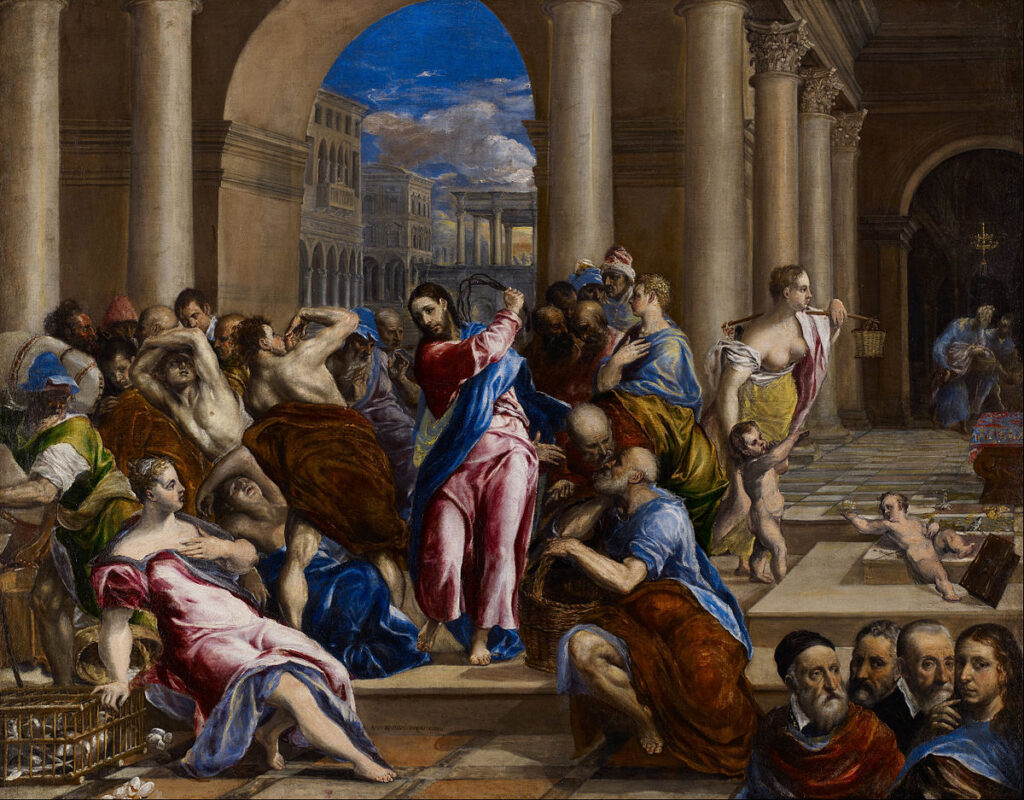
When Jesus fashioned a whip and drove the merchants from the temple, He was not losing His temper. He was exercising the divine prerogative that Malachi had prophesied: “The Lord, whom you seek, will suddenly come to His temple… He is like a refiner’s fire” (Malachi 3:1-3). As MacArthur observes, “He unapologetically invoked His Father’s name and authority, and He issued curt commands with emphatic finality that discouraged any comeback. He was not making suggestions or requests, much less asking for friendly dialogue” (The Jesus You Can’t Ignore, p.26). His anger was:
Deliberate, not impulsive. He took time to fashion a whip (John 2:15). This was not a man snapping under pressure. This was a judge entering a courtroom. The preparation was part of the message.
God-centered, not self-centered. His words were “Do not make My Father’s house a house of merchandise” (2:16). The offense was not against Jesus personally but against the Father’s honor and the purity of worship. He was angry on behalf of God, not on behalf of Himself.
Proportionate, not excessive. He drove out the animals with the whip and overturned the money changers’ tables, but He spoke gently to the dove sellers — the merchants who served the poor (2:16). Even in judgment, He calibrated His response to the situation.
Restorative, not destructive. The goal was not to destroy the temple but to cleanse it. He wanted worship to be what it was supposed to be. His anger aimed at restoration, not revenge.
Temporary, not habitual. Jesus did not live in a state of perpetual rage. He wept at Lazarus’ tomb. He blessed children. He ate with sinners. His anger was an episode within a life of extraordinary compassion and patience. It blazed when the situation demanded it and subsided when the work was done.
This is what Ephesians 4:26 means when it commands, “Be angry, and do not sin.” The verse does not say, “Never be angry.” It says, “Be angry in the right way.” There is an anger that is not merely permitted but required — an anger that would be sinful to suppress. To see the worship of God corrupted and feel nothing is not holiness. It is apathy.
What the Reformers Knew About Zeal
The Reformers understood this. They were men of extraordinary zeal — zeal that was frequently mistaken for arrogance by those who preferred comfortable religion.
Luther, standing before the Diet of Worms with his life on the line, declared: “My conscience is captive to the Word of God. I cannot and I will not recant anything, for to go against conscience is neither right nor safe. Here I stand. I can do no other. God help me.”9 That is zeal. Not self-aggrandizement. Not stubbornness. A man who has seen the truth of God and refuses to deny it even at the cost of his life.
Calvin wrote with equal fire: “A dog barks when his master is attacked. I would be a coward if I saw that God’s truth is attacked and yet would remain silent, without giving any sound.”10 Calvin’s entire ministry in Geneva was an exercise in holy zeal — an insistence that worship, doctrine, and Christian living must conform to Scripture regardless of popular opinion.
Edwards, in his sermon “The Distinguishing Marks of a Work of the Spirit of God,” argued that genuine revival always produces both joy and holy indignation — joy at the beauty of Christ and indignation at everything that obscures, corrupts, or counterfeits that beauty.11
How to Distinguish Holy Zeal from Self-Righteous Anger
This is the practical question, and it demands honest self-examination. Here are five tests:
The Object Test: Am I angry because God has been dishonored, or because I have been disrespected? Holy zeal grieves over offenses against God. Self-righteous anger grieves over offenses against self.
The Knowledge Test: Is my anger informed by Scripture, or fueled by preference? Jesus quoted Psalm 69. He acted on the basis of the Father’s revealed will regarding His house. Much of what passes for righteous anger in the church is actually indignation over violated cultural preferences — music styles, political positions, personality clashes — wearing theological clothing.
The Control Test: Does my anger control me, or do I control it? Jesus fashioned a whip with deliberation. He spoke clearly. He was never “out of control.” If your anger leaves you saying things you later regret, it is not the Holy Spirit’s zeal. It is the flesh’s tantrum.
The Compassion Test: Does my anger coexist with compassion for the people involved? Jesus drove out the animals but spoke gently to the dove sellers. He was angry at the system while remaining tender toward the vulnerable. Self-righteous anger delights in the suffering of its targets. Holy zeal aches for them.
The Fruit Test: Does my anger produce restoration or destruction? Jesus cleansed the temple so that worship could resume. Self-righteous anger burns relationships, splits churches, and leaves nothing but scorched earth.
Jesus’ temple cleansing was not a loss of temper but an expression of holy zeal — God-centered, deliberate, proportionate, and restorative anger at the corruption of worship. Scripture commands this kind of anger (Ephesians 4:26) while condemning its self-centered counterfeit. The Reformers exemplified it. The modern church has largely lost it, confusing niceness with holiness and apathy with meekness.
4. The Divine Knowledge of Jesus: He Knew What Was in Man (2:24-25)
Omniscience Walking in Sandals
John 2 closes with one of the most theologically dense — and pastorally devastating — statements in the New Testament:
“But Jesus did not commit Himself to them, because He knew all men, and had no need that anyone should testify of man, for He knew what was in man.” (John 2:24-25, NKJV)
The verbs are present tense in the Greek: He was knowing (“ginōskōn”Greek“γινώσκων”“ginōskōn”“verb,“knowing,) all men. This was not occasional insight. It was continuous, comprehensive, penetrating knowledge — the kind of knowledge that only God possesses.
The TDNT notes that in the Synoptics, Jesus’ mother appears only in the infancy narratives and a handful of later incidents, but in John she appears at two critical hinge points – the first sign at Cana and the cross – framing the entire public ministry with the hora (“hour”) motif (Kittel and Friedrich, Theological Dictionary of the New Testament, Abridged, p.338). Jesus’ knowledge of all people, then, must be read alongside this sovereign timing: He knows what is in man, and He knows when the hour will come.
The Old Testament reserves this capacity exclusively for deity:
- “I, the LORD, search the heart, I test the mind, even to give every man according to his ways, according to the fruit of his doings.” (Jeremiah 17:10)
- “The LORD does not see as man sees; for man looks at the outward appearance, but the LORD looks at the heart.” (1 Samuel 16:7)
- “O LORD, You have searched me and known me. You know my sitting down and my rising up; You understand my thought afar off… Such knowledge is too wonderful for me; it is high, I cannot attain it.” (Psalm 139:1-2, 6)
By attributing this same kind of heart-penetrating knowledge to Jesus, John is making a claim about His divine nature. Jesus does not merely know facts about people — the way a good psychologist might observe behavior patterns and make inferences. He knows what is in man — the depths of the heart, the hidden motivations, the self-deceptions, the things people will not admit even to themselves.
A Pattern Across John’s Gospel
This supernatural knowledge of human hearts is not an isolated instance. It appears throughout John’s narrative like a recurring signature:
Nathanael (1:47-48): Before they had ever met, Jesus told Nathanael, “Before Philip called you, when you were under the fig tree, I saw you.” Nathanael was so shaken that he confessed, “Rabbi, You are the Son of God! You are the King of Israel!” Whatever Nathanael was doing under that fig tree — likely studying Torah in a private moment of devotion — Jesus knew it without being told.
The Samaritan Woman (4:17-18): “You have had five husbands, and the one whom you now have is not your husband.” Jesus narrated the private history of a woman He had never met. Her response: “Sir, I perceive that You are a prophet” (4:19). She was understating the case.
Judas (6:64, 70-71): “Jesus knew from the beginning who they were who did not believe, and who would betray Him.” Long before the last supper, long before the garden, Jesus knew what Judas would do. He chose him anyway. He washed his feet anyway. He offered him the bread anyway. This is not ignorance overcome by betrayal. This is omniscience that embraces the full weight of what is coming.
Peter (13:38; 21:17): Jesus predicted Peter’s denial with devastating specificity — three times, before the rooster crowed. And after the resurrection, He restored Peter with three questions that corresponded to the three denials: “Do you love Me?” Jesus knew what Peter would do before Peter did. And He knew who Peter would become after the Spirit had done His work.
What Jesus Knew: Total Depravity and the Need for Regeneration
“He knew what was in man.” What did He see?
Jeremiah had answered the question seven hundred years earlier: “The heart is deceitful above all things, and desperately wicked; who can know it?” (Jeremiah 17:9). The Hebrew word for “deceitful” is “aqov”Hebrew“עָקֹב”“aqov”“adjective”“deceitful, — the same root as the name “Jacob” — the trickster, the heel-grabber. The human heart is not merely weak. It is actively self-deceiving. It constructs elaborate justifications for its sins. It genuinely believes its own lies.
The Reformed doctrine of total depravity does not mean that every human being is as wicked as possible. It means that every faculty of human nature — mind, will, emotions, desires — has been corrupted by the fall. There is no island of untouched goodness in the human soul from which the sinner can mount a rescue operation. As Paul writes, quoting Psalm 14: “There is none righteous, no, not one; there is none who understands; there is none who seeks after God” (Romans 3:10-11).
This is what Jesus saw when He looked at the Passover crowds. He saw people who were impressed by signs but untouched in their hearts. He saw religious enthusiasm that would evaporate the moment the cost of discipleship became clear. He saw profession without possession — the name of faith without the nature of faith.
R.C. Sproul described this with characteristic bluntness: “We are not sinners because we sin. We sin because we are sinners. The problem is not behavior. The problem is nature. And nature cannot be changed by spectacle, by enthusiasm, or by good intentions. Only God can change nature.”12
The Bridge to John 3
This is why John 2:25 is the perfect setup for John 3:1. After telling us that Jesus “knew what was in man,” John immediately introduces us to a man — Nicodemus, a Pharisee, a ruler of the Jews, a teacher of Israel. The best man available. The most educated, most moral, most religiously serious human specimen the Jewish system could produce.
And Jesus tells him: “You must be born again” (3:7).
The word “must” (“dei”Greek“δεῖ”“dei”“verb,“it) signals divine necessity, not optional suggestion. This is not self-improvement advice. It is a diagnosis. You are dead in your trespasses and sins (Ephesians 2:1). Dead people do not need inspiration. They need resurrection. They need a new nature, a new heart, a new birth “from above” (“anōthen”Greek“ἄνωθεν”“anōthen”“adverb”“from) — and only the sovereign Spirit can provide it.
Everything in John 2:23-25 leads to this conclusion. The crowds believed on the basis of signs, but their faith was insufficient because their hearts were unchanged. Nicodemus came to Jesus with impressive credentials, but credentials do not save. Only the new birth saves. And the new birth is not a human achievement. It is a divine miracle — as mysterious and sovereign as the wind: “The wind blows where it wishes, and you hear the sound of it, but cannot tell where it comes from and where it goes. So is everyone who is born of the Spirit” (John 3:8).
Jesus’ knowledge of the human heart (2:24-25) is a divine attribute exercised throughout John’s Gospel — with Nathanael, the Samaritan woman, Judas, and Peter. What He saw in the Passover crowds was the universal human condition: total depravity, self-deception, and the inability of sign-faith to save. This sets up John 3 and the necessity of the new birth — not moral improvement but supernatural regeneration by the sovereign Spirit.
5. The Theology of the Hour (Hora): God’s Timetable Over All Things
A Phrase That Spans the Entire Gospel
When Mary told Jesus that the wine had run out, He responded with one of the most theologically significant phrases in the New Testament: “My hour has not yet come” (2:4).
“hēGreek“ἡ“hē“noun“my — “My hour.” Two words in Greek. And they control the entire narrative of John’s Gospel like an invisible hand on the wheel.
John deploys this phrase at critical junctures throughout his account, creating a theological framework that reveals Jesus’ entire ministry as operating within a divinely predetermined timetable:
- 2:4 — “My hour has not yet come.” (At the wedding in Cana)
- 7:6 — “My time has not yet come.” (When His brothers urge Him to go publicly to Jerusalem)
- 7:8 — “My time has not yet fully come.” (Same conversation)
- 7:30 — “They sought to take Him; but no one laid a hand on Him, because His hour had not yet come.” (Attempted arrest in the temple)
- 8:20 — “No one laid hands on Him, for His hour had not yet come.” (Teaching in the temple treasury)
- 12:23 — “The hour has come that the Son of Man should be glorified.” (After the triumphal entry — the first time the hour has “come”)
- 12:27 — “Now My soul is troubled, and what shall I say? ‘Father, save Me from this hour’? But for this purpose I came to this hour.”
- 13:1 — “Jesus knew that His hour had come that He should depart from this world to the Father.”
- 17:1 — “Father, the hour has come. Glorify Your Son, that Your Son also may glorify You.”
The pattern is unmistakable. For the first eleven chapters of John’s Gospel, the hour has “not yet come.” No matter what opposition arises — no matter who wants to arrest Him, stone Him, or push Him into premature action — Jesus is untouchable because the Father’s schedule has not reached its appointed moment. Then in chapter 12, the hour arrives. And once it arrives, nothing can stop it.
What Is “The Hour”?
Jesus’ “hour” in John’s Gospel is not a sixty-minute window. It is the complex of events that constitute the climax of His earthly mission: His suffering, death, resurrection, and glorification. It is the cross viewed from heaven — not as a Roman execution but as the moment when the Son of God accomplishes the eternal purpose for which the Father sent Him. It is simultaneously the hour of deepest humiliation (crucifixion) and highest glorification (the achievement of redemption). John holds these together without tension because, in the Father’s plan, they are the same event.
This is why John 12:23 uses the language of glory, not tragedy: “The hour has come that the Son of Man should be glorified.” The cross is glory. The suffering is the exaltation. The death is the victory. This paradox runs throughout John and finds its fullest expression in the “hour” theology.
Why Jesus Acts Anyway (2:4-11)
Here is the puzzle of John 2:4. Jesus says, “My hour has not yet come” — and then He performs the miracle anyway. Was He being inconsistent? Was Mary’s influence stronger than His stated principle?
Neither. The statement “My hour has not yet come” was not a refusal to act. It was a clarification of authority. Jesus was not saying, “I will not do anything.” He was saying, “I do not take My orders from you. I operate on the Father’s timetable, not on human pressure.” The miracle at Cana happened because the Father willed it — not because Mary requested it. Jesus’ obedience was to the Father, and in the Father’s plan, the first sign at Cana was precisely on schedule.
This distinction matters immensely. Jesus was not a puppet responding to whoever pulled His strings. He was not at the mercy of circumstances, popular demand, family expectations, or hostile opposition. He moved through His ministry with sovereign composure because every step was governed by the Father’s sovereign plan.
The Westminster Confession of Faith expresses this with precision: “God from all eternity did, by the most wise and holy counsel of His own will, freely and unchangeably ordain whatsoever comes to pass” (WCF 3.1).13 Jesus’ entire life was the supreme demonstration of this truth. The Father ordained the hour. The Son freely embraced it. And nothing — not the Pharisees, not Herod, not Pilate, not the Roman army — could hasten or delay it by a single moment.
Pastoral Application: Trusting God’s Timing
If the Son of God operated within the Father’s sovereign timetable — never rushing, never panicking, never acting prematurely — what does that say to believers who are anxious about their own circumstances?
It says that your life has an “hour” too. Not the cosmic hour of redemption, but the personal hours of God’s providential plan for your sanctification, your service, and your glorification. The job that has not materialized. The healing that has not come. The marriage that has not appeared. The ministry that has not opened. The suffering that has not ended. These are not evidence that God has forgotten you. They are evidence that your hour has not yet come — and the God who timed the crucifixion to the Passover, who orchestrated every event of Jesus’ life with meticulous precision, is the same God who governs your story.
Edwards wrote, in his treatise on divine providence: “God’s timing is never late. It is never early. It arrives at the precise moment that accomplishes the maximum glory for His name and the maximum good for His people.”14
If that was true for the Son of God at a wedding in Cana, it is true for you in whatever wilderness you inhabit right now.
Every reference to Jesus’ “hour” in John points to the cross, resurrection, and glorification — the climax of His mission. For twelve chapters, the hour “has not yet come,” making Jesus untouchable by His enemies. Then it arrives, and nothing can stop it. Jesus’ response to Mary in 2:4 clarifies that He operates on the Father’s timetable, not human pressure. This sovereign timing extends to the believer: God’s schedule for your life is governed by the same meticulous providence.
6. Old Covenant to New: The Transformation Motif
A Chapter Built on Contrast
John 2 is not merely telling two stories. It is staging a theological argument about the transition from the old covenant to the new — and every detail serves that argument. The chapter is saturated with transformation imagery: old things being replaced by new things, shadows giving way to substance, the provisional yielding to the permanent.
This is not incidental. It is John’s central thesis in chapter 2, and once you see it, you cannot unsee it.
Water of Purification Becomes Wine of Celebration
The six stone jars at Cana were not random containers. John specifies that they were “set there according to the manner of purification of the Jews” (2:6). These were vessels of the old covenant ceremonial system — the ritual washings that the law required and the Pharisees had elaborated into an intricate system of external cleanliness. Archaeological evidence reinforces the point. Meyers and Chancey note that “the use of stone vessels to protect liquids from ritual impurity is an element of Jewish culture that is much better understood after the uncovering of stone vessels at so many sites in Palestine,” confirming John’s detail as historically precise and theologically loaded (Archaeology of the Land of the Bible, vol. III, p.192).
Jesus took the water of ceremonial purification and transformed it into the wine of messianic celebration. The old covenant said, “Wash yourself clean.” The new covenant says, “Drink deeply — the celebration has begun.”
The prophets had specifically associated abundant wine with the messianic age:
- “On this mountain the LORD of hosts will make for all peoples a feast of rich food, a feast of well-aged wine” (Isaiah 25:6, ESV).
- “The mountains shall drip with sweet wine, and all the hills shall flow with it” (Amos 9:13).
- “The mountains shall drip with new wine, the hills shall flow with milk” (Joel 3:18).
When Jesus produced 120 to 180 gallons of wine — vastly more than anyone could drink — He was enacting a prophetic sign. The messianic age has arrived. The feast has begun. And its quality exceeds everything that came before: “You have kept the good wine until now” (2:10). Robin Margaret Jensen notes that early church writers consistently understood this sign as bearing sacramental significance: “Most early Christian writers saw this story as having eucharistic, rather than baptismal, symbolism,” with Cyprian interpreting the mingling of wine and water as representing the inseparable union of Christ’s blood with His people (Baptismal Imagery in Early Christianity, p.221).
The contrast is stark: the old covenant gave water for washing. The new covenant gives wine for feasting. The old covenant addressed external impurity. The new covenant provides internal transformation and overflowing joy. Not incremental improvement. Total transformation.
Stone Temple Becomes Living Temple
The second scene repeats the pattern at a larger scale. The stone temple — impressive, massive, forty-six years in construction — is declared obsolete by Jesus’ words: “Destroy this temple, and in three days I will raise it up” (2:19). The building made of dead stone will be replaced by a temple of living flesh — and eventually by a temple of living stones (1 Peter 2:5).
Everything the stone temple was designed to accomplish — providing a meeting place between God and humanity, a locus for sacrifice, a center for worship, a symbol of God’s dwelling among His people — will now be accomplished in and through the person of Jesus Christ and, derivatively, through His body the church.
The shadow becomes the reality. The type becomes the antitype. The model becomes the finished product.
Moses and Law Give Way to Jesus and Grace
John had already laid this groundwork in 1:17: “For the law was given through Moses, but grace and truth came through Jesus Christ.” The entire Cana narrative dramatizes this verse. The ceremonial law — symbolized by the stone purification jars — was given through Moses. It was good. It was genuinely from God. But it was preparatory, not final.
Grace and truth came through Jesus Christ. Not as a negation of Moses but as a fulfillment — the completion of what the law pointed toward but could never provide. The law demanded purity. Grace provides it. The law exposed sin. Grace atones for it. The law said, “You must.” Grace says, “It is finished.”
Calvin captured this dynamic with his characteristic balance: “The Law is not contrary to grace, but it is insufficient without it. Moses was the servant who laid the table; Christ is the Master who provides the feast.”15
The Passover Lamb Becomes the Lamb of God
The chronological setting of the temple cleansing is “the Passover of the Jews” (2:13). This is no accident. Walvoord and Zuck note that “as was the custom for the Jewish people (Ex. 12:14-20, 43-49; Deut. 16:1-8) Jesus went up to Jerusalem to celebrate the Passover,” and that “it was a fitting time for His ministry” – the annual feast of deliverance became the stage for the Deliverer’s self-revelation (The Bible Knowledge Commentary: Gospels, p.233). John has already identified Jesus as “the Lamb of God who takes away the sin of the world” (1:29). Now the Lamb walks into the Passover — the very feast that commemorated God’s deliverance of Israel through the blood of a lamb on the doorposts.
The old Passover lamb was a shadow. It pointed forward to something — to Someone — who would provide not temporary national deliverance but permanent, cosmic redemption. As Paul declares: “Christ, our Passover, was sacrificed for us” (1 Corinthians 5:7).
By placing the temple cleansing at Passover, John is layering his symbolism: the Lamb has come to the place of sacrifice, during the feast of sacrifice, and He is the one true sacrifice to which all others pointed. The entire sacrificial system — the oxen, sheep, and doves being sold in the temple courts — is about to be rendered obsolete by the one sacrifice that actually takes away sin.
The author of Hebrews provides the theological commentary: “For it is not possible that the blood of bulls and goats could take away sins” (Hebrews 10:4). They never could. They were always placeholders — divinely appointed placeholders, yes, but placeholders nonetheless. The Lamb of God standing in the temple among the livestock is the reality standing among the shadows, and He is about to clear the room.
The Comprehensive Transformation
Taken together, these parallel transformations form a unified theological statement about the entire covenant transition:
| Old Covenant Element | New Covenant Reality | John 2 Reference |
|---|---|---|
| Water of purification | Wine of celebration | 2:6-10 |
| Stone temple | Living body/church | 2:19-21 |
| Law through Moses | Grace through Christ | 1:17 → 2:1-11 |
| Passover lamb (shadow) | Lamb of God (reality) | 1:29 → 2:13-22 |
| Ceremonial cleanness | Heart transformation | 2:6 → 3:3-5 |
| Six jars (incomplete) | Good wine (abundance) | 2:6, 10 |
John 2 is not two isolated stories. It is a comprehensive declaration that the old order has given way to the new. Every element of the old covenant — its rituals, its building, its sacrificial system, its mediator — finds its fulfillment and replacement in Jesus Christ. The good wine has been kept until now. The master of the feast is astonished. The old was good. The new is better. Infinitely, gloriously, permanently better.
John 2 systematically stages the transition from old covenant to new: purification water becomes celebration wine, the stone temple gives way to the living body of Christ, the Mosaic law is fulfilled by grace, and the Passover lamb is replaced by the Lamb of God. Every transformation follows the same pattern: the old was good (genuinely from God), but the new is better — not incrementally, but categorically.
Conclusion: The Chapter That Changes How You Worship
John 2 is only twenty-five verses. But it carries enough theology to sustain a lifetime of study.
It teaches you how to read Jesus’ miracles — not as spectacles to applaud but as signs to follow, arrows pointing past the event to the person. It warns you that sign-based faith is insufficient, that enthusiasm is not the same as regeneration, and that Jesus sees through every superficial profession.
It teaches you where God lives — not in a building, no matter how beautiful, but in the body of His Son and, by the Spirit, in His people. The entire temple system, with its centuries of sacrifice and ritual, was a shadow cast by the approaching reality. When the reality arrived, the shadow became unnecessary.
It teaches you that anger can be holy — that there is a zeal born not of ego but of love for God, and that the absence of such zeal is not meekness but apathy. It challenges you to examine every flash of anger and ask: Is this about God’s honor or mine?
It teaches you that Jesus knows your heart — not the version you present on Sunday morning, not the curated social media version, not the version you have convinced yourself is the real one. He knows what is in man. And knowing what is in you, He still came to the wedding. He still turned the water into wine. He still offered His body as the true temple, to be destroyed and raised for people He knew would fail Him.
And it teaches you that God’s timing is sovereign. The hour comes when the Father determines. Not when you demand it. Not when circumstances seem favorable. Not when your patience runs out. The same providence that governed every moment of Jesus’ ministry governs every moment of yours.
The six stone jars of the old covenant are empty now. The good wine has been poured. The temple of stone has fallen, but the temple of the risen Christ endures forever. The question John 2 presses on every reader is not “Do you understand these doctrines?” but “Have you tasted the wine? Have you entered the temple? Do you know the One who knew what was in you and came anyway?”
Because Jesus is still turning water into wine. He is still cleansing temples. He is still seeing through sign-faith to the heart beneath.
And He is still saying what Mary said to the servants, the finest summary of discipleship ever spoken: Whatever He says to you, do it.
Sources Cited
- Beale, G.K. The Temple and the Church’s Mission: A Biblical Theology of the Dwelling Place of God. Downers Grove: IVP Academic, 2004.
- Calvin, John. Commentary on the Gospel According to John. Translated by William Pringle. Grand Rapids: Baker, 2003.
- Calvin, John. Institutes of the Christian Religion.
- Clines, David J. A. and David M. Gunn, eds. Art and Meaning: Rhetoric in Biblical Literature. JSOT Supplement. Sheffield: JSOT Press, 1982.
- Edwards, Jonathan. A Treatise Concerning Religious Affections. 1746.
- Edwards, Jonathan. The End for Which God Created the World. 1765. In The Works of Jonathan Edwards, vol. 8. New Haven: Yale University Press, 1989.
- Freedman, David Noel, ed. The Anchor Bible Dictionary. 6 vols. New York: Doubleday, 1992.
- Jensen, Robin Margaret. Baptismal Imagery in Early Christianity. Grand Rapids: Baker Academic, 2012.
- Kittel, Gerhard, and Gerhard Friedrich, eds. Theological Dictionary of the New Testament. Abridged in One Volume by Geoffrey W. Bromiley. Grand Rapids: Eerdmans, 1985.
- MacArthur, John. The Gospel According to Jesus. Grand Rapids: Zondervan, 1988.
- MacArthur, John. The Jesus You Can’t Ignore. Nashville: Thomas Nelson, 2008.
- Meyers, Eric M., and Mark A. Chancey. Alexander to Constantine: Archaeology of the Land of the Bible, vol. III. New Haven: Yale University Press, 2012.
- Owen, John. An Exposition of the Epistle to the Hebrews. Vol. 3. Edinburgh: Banner of Truth, 1991 reprint.
- Rydelnik, Michael, ed. The Moody Handbook of Messianic Prophecy. Chicago: Moody Publishers, 2019.
- Sproul, R.C. The Holiness of God. Carol Stream: Tyndale, 1985.
- Sproul, R.C. John. St. Andrew’s Expositional Commentary. Orlando: Reformation Trust, 2009.
- Walvoord, John F., and Roy B. Zuck. The Bible Knowledge Commentary: Gospels. Colorado Springs: David C Cook, 1983.
- Westminster Confession of Faith. 1646.
- Wiersbe, Warren W. The Wiersbe Bible Commentary: New Testament. Colorado Springs: David C Cook, 2007.
This article is part of the John Deep Dive Series. For related studies, see: – John 2 Commentary: Water, Wine, and the Wrath of Holy Love — Verse-by-verse pillar deep dive – Greek Words That Unlock John 2 — Key terms the English hides – The World Behind John 2 — First-century weddings, Herod’s temple, and the Passover economy – God Pitched His Tent: What John 1:14 Actually Says About the Incarnation — The theology of John 1