
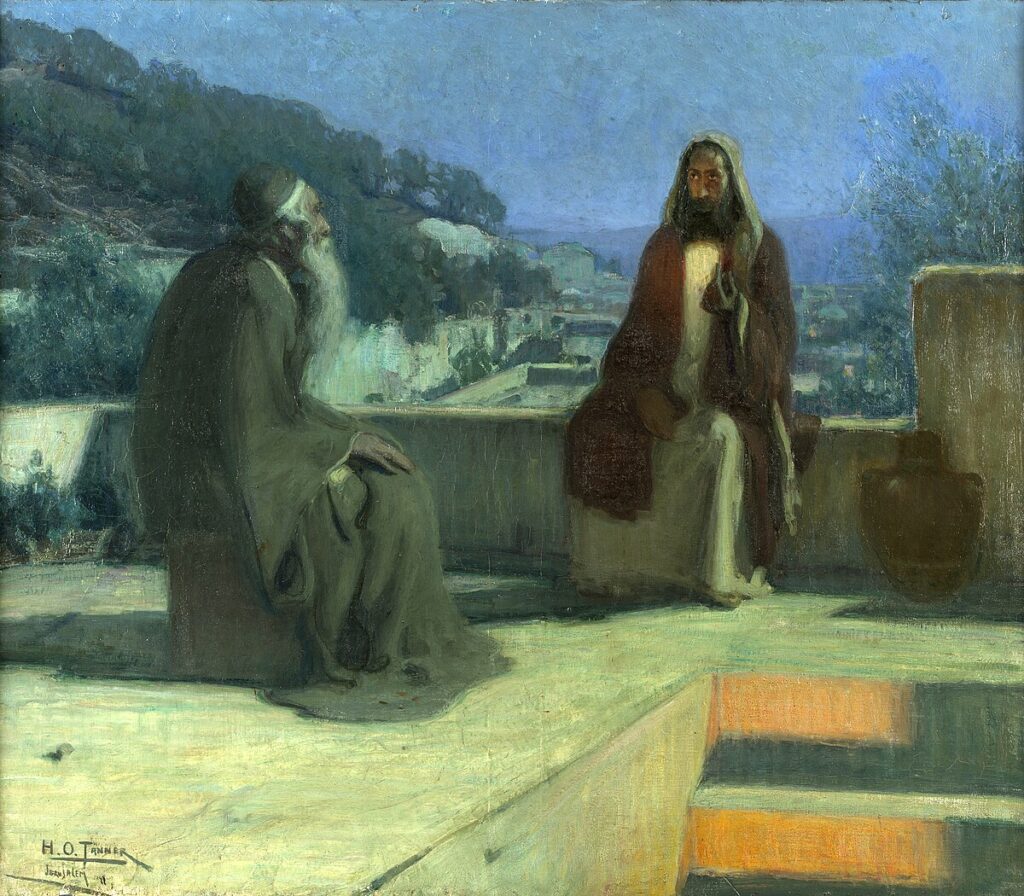
John 3 Commentary: Born from Above, Lifted on a Cross, Loved Beyond Reason
Introduction: A Conversation That Changed Everything
John 2 ended with a sentence that should make every religious person uneasy: “Jesus did not commit Himself to them, because He knew all men, and had no need that anyone should testify of man, for He knew what was in man” (2:24–25).
He knew what was in man. He saw past every profession, every prayer, every raised hand and walked aisle. He knew the difference between those who believed in His signs and those who believed in Him. And then, without missing a beat, John writes the most devastating transition in the Gospel: “There was a man of the Pharisees named Nicodemus” (3:1).
There was a man. After telling us that Jesus knew what was in man, John introduces us to a specific man — not a tax collector or a prostitute or a Roman soldier, but the best man Judaism could produce. A Pharisee. A member of the Sanhedrin. A teacher of Israel. A man of impeccable religious credentials, theological education, and moral uprightness. If anyone could enter the kingdom of God on his own merits, it would be this man.
And Jesus tells him he cannot see the kingdom of God unless he is born all over again.
John 3 is the most theologically important conversation in the Bible. It contains the most famous verse in Scripture (3:16), the most controversial doctrine in Christian theology (regeneration), and the most clarifying statement about the nature of saving faith ever recorded. As Millard J. Erickson observes, “Although the literal term palingenesia is not found elsewhere in the New Testament, the idea is most certainly prominent. The best-known and most extensive exposition of the concept of the new birth is found in Jesus’s conversation with Nicodemus in John 3” (Christian Theology, p.428). It also contains, in the second half, the Baptist’s final testimony — one of the most humble and beautiful statements any human being has ever made about another.
The chapter divides into three movements:
- The New Birth (3:1–15) — Jesus’ private nighttime conversation with Nicodemus about the absolute necessity of supernatural regeneration, culminating in the bronze serpent typology pointing to the cross.
- The Gospel in a Sentence (3:16–21) — The summary statement about God’s love, the Son’s mission, and the condemnation that falls on those who refuse the light. (Most commentators believe this is John’s editorial reflection, not Jesus’ continued speech to Nicodemus.)
- The Baptist’s Last Testimony (3:22–36) — John the Baptist’s disciples grow jealous of Jesus’ growing following. The Baptist responds with the most selfless declaration in Scripture: “He must increase, but I must decrease.”
Every verse. Every word that matters. Let’s begin where Nicodemus begins — in the dark.
The New Birth: Night School with Jesus (3:1–15)
Verses 1–2: The Visitor in the Dark
“There was a man of the Pharisees named Nicodemus, a ruler of the Jews. This man came to Jesus by night and said to Him, ‘Rabbi, we know that You are a teacher come from God; for no one can do these signs that You do unless God is with him.’” — John 3:1–2 (NKJV)
“A man of the Pharisees” — the Pharisees were the most religiously serious party in first-century Judaism. The name likely derives from the Hebrew “pĕrûshîm”Hebrew“פְּרוּשִׁים”“pĕrûshîm”“separated, reflecting their commitment to separation from ritual impurity and strict observance of the Torah and oral tradition. As MacArthur notes, “The word Pharisee most likely comes from a Hebrew word meaning ‘to separate’ and therefore probably means ‘separated ones.’ They were not separatists in the sense of isolationists but in the puritanical sense, i.e., they were highly zealous for ritual and religious purity according to the Mosaic law as well as their own traditions that they added to the OT legislation… They seem to have arisen as an offshoot from the ‘Hasidim’ or ‘pious ones’ during the Maccabean era” (One Perfect Life, p.70). Josephus estimates their number at approximately 6,000 (Antiquities 17.42). They believed in the resurrection of the dead, the authority of oral tradition alongside written Scripture, and meticulous obedience to all 613 commandments of the Torah. In terms of personal holiness and theological knowledge, they were the elite of Israel. MacArthur’s description is blunt: “The Pharisees were hyperlegalists who externalized religion. They were the very epitome of all who pursue a form of godliness with no reality (2 Tim. 3:5). Although they were fanatically religious, they were no nearer the kingdom of God than a prostitute” (The Gospel According to Jesus, p.21).
“Named Nicodemus” — the name is Greek (“Nikodēmos”Greek“Νικόδημος”“Nikodēmos”“proper“conqueror), from nikē (victory) and dēmos (people). It was common among Hellenized Jews. The Talmud mentions a wealthy Jerusalemite named Nakdimon ben Gurion who may be the same individual, though this identification is debated.1
“A ruler of the Jews” — Nicodemus was a member of the Sanhedrin, the supreme governing council of the Jewish nation, consisting of seventy-one members presided over by the high priest. This was the body that would later condemn Jesus to death. Nicodemus held, in effect, the equivalent of a senate seat combined with a supreme court position combined with a chair in the faculty of theology. He was the establishment.
“This man came to Jesus by night.” John does not explain why. Perhaps Nicodemus feared the disapproval of his colleagues. Perhaps he was simply too busy during the day. Perhaps he wanted an uninterrupted private conversation. But John is a master of symbolic detail, and throughout his Gospel, “night” and “darkness” carry moral and spiritual weight. Judas goes out to betray Jesus “and it was night” (13:30). The disciples fish all night and catch nothing until Jesus appears at dawn (21:3–6). Nicodemus comes in the dark — physically, yes, but the reader is meant to sense that he also comes in spiritual darkness, groping toward a light he does not yet understand.
“Rabbi, we know that You are a teacher come from God.” Several things are significant here. First, the address “Rabbi” — a term of respect that Nicodemus, as a member of the ruling class, would not normally offer to an unaccredited itinerant preacher from Galilee. Second, the plural “we know” — Nicodemus speaks not only for himself but for at least some of his colleagues. There was a faction within the establishment that recognized something genuine in Jesus.
Third — and this is theologically important — the basis for their knowledge: “for no one can do these signs that You do unless God is with him.” This is sound reasoning. Nicodemus recognizes that authentic miracles authenticate a divine messenger. The function of biblical miracles is not entertainment but attestation — God certifying that His agent speaks His word.2
But notice what Nicodemus does not say. He does not say “You are the Messiah.” He does not say “You are the Son of God.” He says “a teacher come from God.” It is a respectful, cautious, hedged affirmation. He is willing to welcome Jesus into the club — but on the club’s terms.
Verses 3–4: The Scandal of Starting Over
“Jesus answered and said to him, ‘Most assuredly, I say to you, unless one is born again, he cannot see the kingdom of God.’ Nicodemus said to Him, ‘How can a man be born when he is old? Can he enter a second time into his mother’s womb and be born?’” — John 3:3–4 (NKJV)
“Most assuredly” — the Greek is “amēnGreek“ἀμὴν“amēn“double“truly,. The double amēn formula appears twenty-five times in John’s Gospel, always on the lips of Jesus, and always introducing a statement of supreme importance. It functions as a divine oath — the equivalent of “I swear by My own being that what follows is absolutely certain.” No prophet in the Old Testament spoke this way. Only God can swear by Himself (Hebrews 6:13). That Jesus habitually uses this formula is an implicit claim to divine authority.
“Unless one is born again” — the word “anōthen”Greek“ἄνωθεν”“anōthen”“adverb”“again; is deliberately ambiguous. It can mean “again” (a second time) or “from above” (from a higher place). Both meanings are theologically correct, and John almost certainly intends both simultaneously — this is the kind of layered language he favors throughout his Gospel. Erickson confirms that “the Greek word used here, anothen, can also be rendered ‘from above.’ That ‘again’ or ‘anew’ is the correct rendering” is widely recognized, though the theological weight of both senses is essential to grasp what Jesus demands (Christian Theology, p.428). To be born again means to start over completely; to be born from above means the initiative and power come from God, not from human effort.
“He cannot see the kingdom of God.” The word “see” (“idein”Greek“ἰδεῖν”“idein”“verb,“to) means more than visual perception — it means to perceive, to experience, to participate in. Without the new birth, a person cannot even see the kingdom, let alone enter it. The kingdom is invisible to unregenerate eyes. This explains why Jesus’ teaching sounded like nonsense to the religious leaders: they were spiritually blind. They could not see what was standing right in front of them.
The word “unless” (“eanGreek“ἐὰν“ean“conditional“unless,) introduces a sine qua non — a necessary condition without which the consequence is impossible. This is not a suggestion. It is not one option among several. It is the absolute, non-negotiable prerequisite for entering God’s kingdom. No new birth, no kingdom. No exceptions.
Nicodemus’ response — “How can a man be born when he is old? Can he enter a second time into his mother’s womb?” — has puzzled commentators. Was Nicodemus being deliberately obtuse? Sarcastic? Simply confused? R.C. Sproul noted that Nicodemus was neither stupid nor uneducated: “He’s a doctor of the church… And yet he asks a question that is as crass as a man can be.” The response reeks of cynicism — the defensive posture of a man whose entire theological framework has just been demolished. If Nicodemus needs to be born again, then everything he has built his life on — his Pharisaic rigor, his Sanhedrin status, his theological mastery — counts for nothing.
Verses 5–8: Water, Spirit, Wind
“Jesus answered, ‘Most assuredly, I say to you, unless one is born of water and the Spirit, he cannot enter the kingdom of God. That which is born of the flesh is flesh, and that which is born of the Spirit is spirit. Do not marvel that I said to you, “You must be born again.” The wind blows where it wishes, and you hear the sound of it, but cannot tell where it comes from and where it goes. So is everyone who is born of the Spirit.’” — John 3:5–8 (NKJV)
“Born of water and the Spirit” — this phrase has generated centuries of debate. The major interpretations:
Baptismal interpretation: Some see “water” as a reference to Christian baptism, making this a statement about baptismal regeneration. But Jesus is speaking to Nicodemus before Christian baptism existed. Why would He expect a teacher of Israel to understand a reference to a ritual not yet instituted?
Natural birth interpretation: “Water” refers to the amniotic fluid of natural birth, while “Spirit” refers to supernatural birth. You need both: physical birth (water) and spiritual birth (Spirit).
Old Testament purification interpretation: This is the view most Reformed commentators favor, and the one R.C. Sproul taught. In the Old Testament prophets, particularly Ezekiel 36:25–27, God promises: “I will sprinkle clean water on you, and you shall be clean… I will give you a new heart and put a new spirit within you.” Water represents purification; Spirit represents the life-giving power of God. Jesus is telling Nicodemus: you need to be cleansed and made alive — purified from sin’s defilement and raised from spiritual death. Walvoord and Zuck catalog the full range of interpretive options, noting that “the ‘water’ refers to baptism as an essential part of regeneration” is a view that “contradicts other Bible verses that make it clear that salvation is by faith alone (e.g., John 3:16, 36; Eph. 2:8-9; Titus 3:5),” and that the Old Testament purification view best accounts for the context (The Bible Knowledge Commentary, p.236). Everett Ferguson concurs that “the verbal parallels equate the birth of water and the Spirit (3:5) with the birth from above (3:3) and contrast it with the natural birth that Nicodemus mentions (3:4). The one begetting is derived from two elements – water and Spirit… Only the Spirit of God can give a new birth, that is, impart new spiritual life” (Baptism in the Early Church, p.96).3
The strength of this interpretation is that it explains Jesus’ rebuke in verse 10: “Are you the teacher of Israel, and do not know these things?” If “water and Spirit” echoes Ezekiel 36–37, then yes, the foremost theologian in Israel absolutely should have understood. This was not new teaching. It was the prophets’ own message.
“That which is born of the flesh is flesh.” Natural birth produces natural life — nothing more. Biological descent does not produce spiritual life, whether the descent is from Abraham, from a Christian family, or from a line of pastors. “Flesh” (“sarx”Greek“σάρξ”“sarx”“noun,“flesh,) in John’s usage denotes humanity apart from divine intervention — not inherently evil (as in Gnostic thought) but powerless to produce spiritual life. The flesh can produce religion, morality, education, philanthropy, and impressive spiritual performance. What it cannot produce is regeneration.
“The wind blows where it wishes.” Jesus makes a wordplay that works in both Greek and Hebrew. The Greek “pneuma”Greek“πνεῦμα”“pneuma”“noun,“wind, means wind, breath, and spirit — the same triple meaning carried by the Hebrew “ruach”Hebrew“רוּחַ”“ruach”“wind,. The Holman Illustrated Bible Dictionary notes that “metaphorically speaking, pneuma could be extended to mean a kind of breath that blew from the invisible realms; thus, it could designate spirit, a sign of the influence of the gods upon persons, and the source of a relationship between mankind and the divine… When we come to the Judeo-Christian understanding, however, the concept and terms retain their dynamic characteristics but rise from cosmic power to personal being” (Charles W. Draper, Holman Illustrated Bible Dictionary, p.1695). Gerhard Kittel adds that “since the Holy Spirit affects the whole person and cannot be explained psychologically,” the term pneuma in the New Testament carries far greater theological weight than its secular parallels (Theological Dictionary of the New Testament, p.512). The Spirit, like the wind, is sovereign — He blows where He wishes. You cannot control Him, schedule Him, or manufacture His effects. You can see His results but you cannot see Him at work. Regeneration is God’s initiative from start to finish.
Robin Margaret Jensen observes that the early church understood this baptismal imagery in deeply personal terms, describing how candidates understood their submersion as “the death and burial of Christ our Lord,” professing faith in “his resurrection when I come up out of the water – this is a sign that I believe that I am already risen” (Baptismal Imagery in Early Christianity, p.162). The connection between water, Spirit, death, and rebirth was not an abstraction for the first Christians – it was enacted liturgically.
This is the heart of Reformed soteriology. Regeneration precedes faith. The new birth is not the product of human decision — it is the cause of it. Just as you did not choose to be born physically, you do not choose to be born spiritually. God the Holy Spirit, in His sovereign mercy, quickens dead souls and gives them the capacity to see, believe, and enter the kingdom. Apart from this supernatural work, no amount of religious effort, moral striving, or theological education will suffice. Nicodemus had all three. Jesus told him it was not enough.
Regeneration is the non-negotiable prerequisite for seeing and entering God’s kingdom. It cannot be produced by human effort — neither religious performance, moral excellence, nor theological education. The Spirit, like the wind, moves sovereignly where He wishes. Those who are born of the flesh have only flesh; those who are born of the Spirit have life from above. Nicodemus had everything religion could offer. Jesus told him he needed to start over.
Verses 9–13: The Teacher Who Did Not Know
“Nicodemus answered and said to Him, ‘How can these things be?’ Jesus answered and said to him, ‘Are you the teacher of Israel, and do not know these things? Most assuredly, I say to you, We speak what We know and testify what We have seen, and you do not receive Our witness. If I have told you earthly things and you do not believe, how will you believe if I tell you heavenly things? No one has ascended to heaven but He who came down from heaven, that is, the Son of Man who is in heaven.’” — John 3:9–13 (NKJV)
“How can these things be?” — Nicodemus is still stuck. His question is no longer sarcastic; it sounds genuinely bewildered. Three times Jesus has told him about the new birth, and Nicodemus still cannot grasp it. This is precisely Jesus’ point — the natural man cannot understand spiritual things (1 Corinthians 2:14). Nicodemus’ confusion is the proof of his need for the very thing Jesus is describing.
“Are you THE teacher of Israel?” — the Greek has the definite article: not “a teacher” but “hoGreek“ὁ“ho“noun“THE. Nicodemus was apparently the preeminent theological authority in Israel — the most respected scholar, the professor’s professor. And he did not understand the most basic truth about how a person enters into right relationship with God. R.C. Sproul captured Jesus’ tone perfectly: “How did you pass your orals? How did you make it through graduate school?”
The rebuke is devastating because it implies that what Jesus teaches is not esoteric or novel. Regeneration by the Spirit is not a mystery religion reserved for initiates. It is embedded in the Old Testament prophets — Ezekiel 36–37, Deuteronomy 30:6 (“The LORD your God will circumcise your heart”), Jeremiah 31:33 (“I will put My law in their minds”). As the Anchor Bible Dictionary observes, “Though the word palingenesia does not occur in the LXX, the concept of regeneration is central to the OT, as circumcision of the heart (Deut 30:6), in Ezekiel’s restoration of dead bones (Ezek 37:1-14), and in God’s promise to raise Israel from spiritual death (Jer 24:7; Ezek 11:19; 36:26-27)” (David Noel Freedman, The Anchor Bible Dictionary, p.7378). The Holman Illustrated Bible Dictionary likewise notes that “Jesus indicated that the idea of the new birth is rooted in the OT when He chastised Nicodemus for his dismay at this teaching: ‘Are you a teacher of Israel and don’t know these things?’ (v. 10; cp. Ezek. 36:26-27). The new birth is caused by the gracious and sovereign act of God apart from man’s cooperation (John 1:13; Eph. 2:4-5)” (Charles W. Draper, Holman Illustrated Bible Dictionary, p.1206). A teacher of Israel who did not understand these things had missed the entire point of the Scriptures he had spent his life studying.
“No one has ascended to heaven but He who came down from heaven, that is, the Son of Man who is in heaven.” Jesus’ self-identification as the “Son of Man” (“huiosGreek“υἱὸς“huios“noun“the) draws on Daniel 7:13–14, where “one like a Son of Man” approaches the Ancient of Days and receives an everlasting dominion, glory, and kingdom. This is not merely an expression of humility or identification with humanity — it is a claim to the heavenly figure who shares the throne of God. Jesus is telling Nicodemus: you are talking to the One who came down from heaven. You are not talking to a teacher. You are talking to the Son of Man.
Verses 14–15: The Serpent and the Cross
“And as Moses lifted up the serpent in the wilderness, even so must the Son of Man be lifted up, that whoever believes in Him should not perish but have eternal life.” — John 3:14–15 (NKJV)
This is the hinge of the entire conversation. Nicodemus has asked three times: How? How can a man be born again? How can these things be? And now Jesus gives the answer — not by explaining the mechanism of regeneration but by pointing to the means: the cross.
The background is Numbers 21:4–9. Israel grumbled against God in the wilderness. God sent fiery serpents whose venom was lethal. The people repented and cried out to Moses. God instructed Moses to fashion a bronze serpent and mount it on a pole. Anyone bitten who looked at the bronze serpent would live. As the Dictionary of Biblical Imagery notes, “The story of the bronze serpent in Numbers 21:4-9 plays upon common ancient Near Eastern associations with the snake or serpent as a symbol of evil power and chaos from the underworld as well as a symbol of fertility, healing and life… This image of Moses lifting up the serpent in the wilderness is used by the NT text of John 3:14-15 as a precursor of Jesus who was ‘lifted up’ on the cross, signifying both his crucifixion and his exaltation” (Leland Ryken, Dictionary of Biblical Imagery, p.699). The remedy was absurdly simple — just look. No ritual, no payment, no pilgrimage. Just look at what God has lifted up, and live.
The rabbinic tradition also reflected on this passage. Hermann Strack’s Commentary on the New Testament From the Talmud and Midrash records the midrashic explanation that God punished Israel with serpents because “even if the serpent eats all the delicacies of the world, they turn into dust in his mouth” – a contrast to Israel’s complaint about the manna, which “turns into any desired taste” (Strack, Commentary on the New Testament From the Talmud and Midrash, p.294). The rabbinic literature thus recognized both the severity and the mercy embedded in the serpent narrative.
The typology is precise:
| Numbers 21 | John 3 |
|---|---|
| Israel bitten by serpents | Humanity bitten by sin |
| Venom bringing death | Sin bringing eternal perishing |
| Bronze serpent lifted on a pole | Son of Man lifted on a cross |
| Look and live | Believe and have eternal life |
“Even so MUST the Son of Man be lifted up” — the word “dei”Greek“δεῖ”“dei”“verb,“it expresses divine necessity. The cross is not Plan B. It is not an unfortunate accident that God turned into good. It is the eternal, predetermined, necessary plan of God for the redemption of His people. The Son of Man must be lifted up. There is no other way.
The verb “lifted up” (“hypsōthēnai”Greek“ὑψωθῆναι”“hypsōthēnai”“verb,“to) carries a deliberate double meaning in John’s Gospel. It means both physical elevation (being raised on a cross) and spiritual exaltation (being glorified). The cross is not defeat followed later by victory — it is the victory. The lifting up on the cross and the lifting up in glory are, in John’s theology, the same event viewed from different angles.
“That whoever believes in Him should not perish but have eternal life.” The structure mirrors the Numbers 21 pattern: the negative precedes the positive. First: you will not perish. Then: you will have eternal life. The remedy addresses the mortal danger before it bestows the positive gift. And the condition is the same as it was in the wilderness: look. Believe. Turn your eyes to the one God has lifted up, and you will live.
Jesus answers Nicodemus’ “How?” by pointing to the cross. Just as the dying Israelites looked at the bronze serpent and lived, so those who believe in the crucified Son of Man will not perish but have eternal life. The cross is not an accident redeemed — it is a divine necessity (dei). And “lifted up” means both crucified and glorified: in John’s theology, the cross IS the exaltation.
The Gospel in a Sentence (3:16–21)
Verse 16: The Most Famous Verse in the World
“For God so loved the world that He gave His only begotten Son, that whoever believes in Him should not perish but have everlasting life.” — John 3:16 (NKJV)
Most commentators believe that Jesus’ direct speech to Nicodemus ends at verse 15, and that verses 16–21 are John’s theological reflection on the conversation.4
This is the most famous verse in the Bible, and possibly the most distorted. People invoke it to argue for universalism (God loves everyone, therefore everyone is saved), for moral sentimentality (a loving God would never judge), or against the exclusivity of Christ (a God of love wouldn’t provide only one way). None of these conclusions follow from the text.
“For God so loved the world” — the adverb “houtōs”Greek“οὕτως”“houtōs”“adverb”“in does not primarily mean “so much” (as in quantity) but “in this way” or “to this extent.” The emphasis is not on the quantity of God’s love but on its manner and demonstration. How did God love the world? Like this: He gave His Son. The proof of God’s love is not a feeling or a sentiment — it is a historical act. The cross is what God’s love looks like when it meets a world that hates Him.
“The world” (“kosmos”Greek“κόσμος”“kosmos”“noun,“world,) in John’s Gospel is a complex term. Sometimes it refers to the created order (1:10a). Sometimes it refers to humanity in general (1:10b). Sometimes it refers to the world system opposed to God (15:18–19). Here it emphasizes the unworthiness of the object of God’s love. God did not love a world that loved Him back. He loved a world in rebellion against Him — a world that would crucify His Son. That is what makes the love astonishing. The wonder of John 3:16 is not that God loves, but that He loves this.
R.C. Sproul’s challenge is worth quoting at length: “Consider this scenario. Suppose God created the whole world and gave the most exalted position to human beings, and fifteen minutes later they revolted against Him. And then He provided a way of escape, and they killed His prophets. And then He sent His own Son, and they crucified Him. And yet God loves them enough to transfer the sins of His people to the death of His own Son. Would you have the guts to come to God and say, ‘You haven’t done enough for this world that hates you?’”
“That He gave His only begotten Son” — the word “monogenēs”Greek“μονογενής”“monogenēs”“adjective,“one does not mean “only begotten” in the biological sense (as if the Son were generated or created) but “one of a kind, unique, only.” The Evangelical Dictionary of Theology clarifies that “monogenes occurs nine times in the NT… In the LXX it renders yahid, meaning ‘only one’ (e.g., Judg. 11:34). Wisdom is monogenes (Wis. Sol. 7:22), having no peer, unique. The word’s second half is not derived from gennan (to beget), but is an adjectival form derived from genos (origin, race)” (Daniel J. Treier, Evangelical Dictionary of Theology, p.618). The Theological Dictionary of the New Testament confirms that “monogenes is used for the only child. More generally it means ‘unique’ or ‘incomparable,’” and notes that “agapetos occurs in Gen. 22:2, 12 where monogenes might have been used (cf. Mk. 1:11), but while the only child may be ‘beloved,’ the terms are not synonymous” (Gerhard Kittel, TDNT, p.346). God’s act of love was to give what was most precious to Him — not an angel, not a prophet, not a created being of any kind, but His one-and-only, unique, eternally beloved Son.
“That whoever believes in Him should not perish but have everlasting life.” The universality is in the offer — whoever. The particularity is in the condition — believes. And both the negative (not perish) and the positive (everlasting life) are secured by the same act of faith. This verse does not teach universal salvation; it teaches universal availability conditioned on personal faith. And that faith, as Jesus has just told Nicodemus, is itself a gift of the Spirit who blows where He wishes.
Verses 17–18: Salvation and Condemnation
“For God did not send His Son into the world to condemn the world, but that the world through Him might be saved. He who believes in Him is not condemned; but he who does not believe is condemned already, because he has not believed in the name of the only begotten Son of God.” — John 3:17–18 (NKJV)
“Not to condemn the world” — the verb “krinē”Greek“κρίνῃ”“krinē”“verb,“to means to judge or condemn. The Theological Dictionary of the New Testament traces the word’s semantic range: “krino means ‘to sunder,’ then ‘to select,’ ‘to decide,’ ‘to judge,’ ‘to assess,’ ‘to go to law,’ ‘to seek justice’… The LXX mostly has krino for legal terms, though it may also denote deliverance for the oppressed (Ps. 72:2). The NT sense is usually ‘to judge’ with God or man as subject” (Gerhard Kittel, TDNT, p.266). The incarnation was a rescue mission, not a judgment raid. The Son came to save, not to destroy. But — and this is the turn that verse 18 provides — the very fact of His coming creates a judgment. Those who believe are not condemned. Those who refuse to believe are “condemned already” (“ēdēGreek“ἤδη“ēdē“perfect“has).
The perfect tense is devastating: has already been judged. The verdict is not pending. It is not future. It has already been rendered. The unbeliever does not become condemned at some future judgment day — he is condemned, right now, in his current state of unbelief. The judgment is not a sentence imposed from without but a condition that already exists. Refusing Christ does not create condemnation; it reveals the condemnation that was already there.
Verses 19–21: The Love of Darkness
“And this is the condemnation, that the light has come into the world, and men loved darkness rather than light, because their deeds were evil. For everyone practicing evil hates the light and does not come to the light, lest his deeds should be exposed. But he who does the truth comes to the light, that his deeds may be clearly seen, that they have been done in God.” — John 3:19–21 (NKJV)
“Men loved darkness rather than light.” The verb “ēgapēsan”Greek“ἠγάπησαν”“ēgapēsan”“verb,“loved” is the same word used of God’s love in verse 16 — agapaō. Men loved the darkness. This is not indifference or ignorance; it is active preference. Given the choice between light and darkness, between truth and self-deception, between Christ and sin — fallen humanity consistently, deliberately, passionately chooses darkness.
This is the doctrine of total depravity stated in its starkest terms. The problem is not that people lack information. The light has come. The problem is not intellectual — it is volitional and moral. People love darkness because their deeds are evil, and the light exposes what they want to keep hidden. No one runs from the light because it is too bright; they run because they are afraid of what it reveals.
“He who does the truth comes to the light.” Notice the phrase: not “believes the truth” but “does the truth” (“poiōnGreek“ποιῶν“poiōn“present“doing). In John’s vocabulary, truth is not merely intellectual assent but lived reality. Those who practice truth are drawn to the light, not repelled by it. Their deeds are “done in God” — performed in dependence on God, empowered by God, and directed toward God’s glory. This is the fruit that evidences genuine regeneration.
God’s love is demonstrated not by sentiment but by sacrifice — He gave His one-and-only Son. The offer is universal: whoever believes. The condition is particular: genuine faith. Those who refuse are not awaiting future judgment — they are condemned already. The root problem is not ignorance but love of darkness. People flee the light not because it is too bright but because it exposes what they want hidden.
The Baptist’s Final Testimony (3:22–36)
Verses 22–26: The Jealousy Question
“After these things Jesus and His disciples came into the land of Judea, and there He remained with them and baptized. Now John also was baptizing in Aenon near Salim, because there was much water there. And they came and were baptized. For John had not yet been thrown into prison. Then there arose a dispute between some of John’s disciples and the Jews about purification. And they came to John and said to him, ‘Rabbi, He who was with you beyond the Jordan, to whom you have testified — behold, He is baptizing, and all are coming to Him!’” — John 3:22–26 (NKJV)
John the Evangelist provides a historical note that frames what follows: Jesus and the Baptist are now conducting parallel ministries in the same region. Both are baptizing. Both are gathering followers. And the Baptist’s disciples are getting nervous — Jesus’ crowds are growing while theirs are shrinking.
The question the disciples bring to John drips with competitive anxiety: “Rabbi, He who was with you beyond the Jordan, to whom you have testified — behold, He is baptizing, and all are coming to Him!” The emphasis on “you” and “all” reveals the wound. You made Him famous. You pointed people to Him. And now all of them are leaving us for Him. Where is the gratitude?
This is the spirit of competitive ministry — the jealousy that infects every human institution, including the church. When another pastor’s church grows larger, when another ministry attracts more followers, when someone we mentored surpasses us — the flesh recoils. We want credit. We want loyalty. We want the numbers to validate our importance.
Verses 27–30: He Must Increase
“John answered and said, ‘A man can receive nothing unless it has been given to him from heaven. You yourselves bear me witness, that I said, “I am not the Christ,” but, “I have been sent before Him.” He who has the bride is the bridegroom; but the friend of the bridegroom, who stands and hears him, rejoices greatly because of the bridegroom’s voice. Therefore this joy of mine is fulfilled. He must increase, but I must decrease.’” — John 3:27–30 (NKJV)
“A man can receive nothing unless it has been given to him from heaven.” The Baptist begins with a theological principle that demolishes all competitive anxiety in one sentence. Every gift, every talent, every position, every opportunity is a gift from God. What do we have that we did not receive? (1 Corinthians 4:7). If Christ’s ministry is growing, it is because God is granting it. To resent Christ’s increase is to resent God’s gift.
“He who has the bride is the bridegroom.” The metaphor is drawn from Jewish wedding custom. Matthew Henry’s commentary captures the force of this image: “He compares himself to the friend of the bridegroom, who attends upon him, to do him honour and service, assists him in prosecuting the match, speaks a good word for him, uses his interest on his behalf, rejoices when the match goes on, and most of all when the point is gained, and he has the bride” (Unabridged Matthew Henry’s Commentary, p.15208). The Baptist casts himself as the “philosGreek“φίλος“philos“noun“friend — the best man, whose role was to arrange the wedding, prepare the bride, and then step aside once the bridegroom arrived. The best man’s joy is not diminished when the groom takes the bride — it is fulfilled. His entire purpose was to bring the two together. Once that happens, his job is done, and he rejoices.
This is the healthiest understanding of Christian ministry ever articulated. The minister is not the bridegroom. The church is not his bride. He is the friend of the bridegroom, and his joy consists in bringing people to Christ, not in gathering a following for himself.
“He must increase, but I must decrease.” — “dei”Greek“δεῖ”“dei”“verb,“it appears again — the same word of divine necessity used in verse 14 about the cross. This is not a strategy John has devised. It is not an optional attitude of humility. It is a divine imperative. The increase of Christ is necessary. The decrease of the Baptist is necessary. This is the will of God, and John embraces it not with resignation but with fulfilled joy.
Verses 31–36: The One from Above
“He who comes from above is above all; he who is of the earth is earthly and speaks of the earth. He who comes from heaven is above all. And what He has seen and heard, that He testifies; and no one receives His testimony. He who has received His testimony has certified that God is true. For He whom God has sent speaks the words of God, for God does not give the Spirit by measure. The Father loves the Son, and has given all things into His hand. He who believes in the Son has everlasting life; and he who does not believe the Son shall not see life, but the wrath of God abides on him.” — John 3:31–36 (NKJV)
Whether these are the Baptist’s continued words or John the Evangelist’s commentary is debated. The theological content mirrors the prologue (1:1–18) and the conversation with Nicodemus, creating a symphonic structure where the same themes recur from different voices.
“He who comes from above is above all.” The Baptist draws the fundamental distinction: Jesus is not merely a better teacher, a more successful minister, or a more gifted preacher. He is from a different category entirely. He comes from above. Everything and everyone else is “of the earth.” The comparison between Jesus and any human being — including the Baptist — is not a comparison between better and worse. It is a comparison between heaven and earth, Creator and creature, infinite and finite.
“For God does not give the Spirit by measure.” The anointing of the Spirit upon Jesus was not partial, not measured, not rationed. The prophets received the Spirit in measure — for specific tasks, at specific times. Jesus received the Spirit without limit. The fullness of the Spirit’s power, wisdom, and presence rested on Him permanently and completely (Isaiah 11:2; 61:1).
“The Father loves the Son, and has given all things into His hand.” This is the ground of everything — the love of the Father for the Son. Before creation, before the incarnation, before the cross, before any human was loved by God, the Father loved the Son. And our election, our adoption, our salvation — all of it flows from the Father’s love for the Son. We are loved because we are in the Beloved One (Ephesians 1:6). Sproul emphasized this: “Even our election must always be understood to be in the Son. It’s because of the Father’s love for the Son that we can be here at all.”
“He who believes in the Son has everlasting life; and he who does not believe the Son shall not see life, but the wrath of God abides on him.” The chapter ends where it must — with the starkest possible declaration of the two options available to every human being. Belief in the Son: everlasting life. Refusal of the Son: the wrath of God abiding — present tense, continuous, unending.
The word “abides” (“menei”Greek“μένει”“menei”“verb,“remains,) is one of John’s favorite words. He uses it of believers abiding in Christ (15:4–7) and of Christ abiding in believers. Here it describes something far more terrifying: the wrath of God abiding on the unbeliever. It does not come and go. It does not fluctuate. It stays. It remains settled, permanent, immovable — until and unless the person believes.
John the Baptist models the posture every minister should have: he is the friend of the bridegroom, not the bridegroom himself. His joy is fulfilled when people go to Christ, not when they stay with him. The chapter closes with the sharpest possible contrast: belief in the Son brings everlasting life; refusal brings the settled, abiding wrath of God. There is no third option.
Conclusion: What Is in Man, and What God Does About It
John 3 answers the question that John 2 raised. Chapter 2 ended with Jesus knowing “what was in man.” Chapter 3 tells us what is in man: darkness, spiritual death, love of evil, inability to see the kingdom of God, and the settled wrath of God abiding on us. That is what is in man. All of us. Pharisee and tax collector, senator and slave, the best humanity can produce and the worst.
But John 3 also tells us what God has done about what is in man. He has sent His Spirit to blow where He wishes, bringing life to the dead. He has sent His Son to be lifted up on a cross, so that anyone who looks in faith — like the dying Israelites looking at the bronze serpent — will not perish but live. He has loved the world with a love so deep that it sacrificed what was most precious to Him for people who were in active rebellion against Him.
Nicodemus came in the dark. He came with credentials, questions, and a cautious compliment. He left with the most devastating and liberating truth in human history: you must be born again, and that birth comes not from your effort but from the sovereign mercy of the God who loved you before you loved Him.
He appears twice more in John’s Gospel — once defending Jesus before the Sanhedrin (7:50–51) and once bringing seventy-five pounds of burial spices to anoint Jesus’ body (19:39). Tradition holds that he eventually became a believer. If so, the wind blew where it wished. It blew into a Pharisee’s study on a dark night in Jerusalem, and it brought him, slowly, from the shadows into the light.
Sources Cited
- Draper, Charles W. Holman Illustrated Bible Dictionary. Nashville: Holman Bible Publishers, 2003.
- Erickson, Millard J. Christian Theology. 3rd ed. Grand Rapids: Baker Academic, 2013.
- Ferguson, Everett. Baptism in the Early Church: History, Theology, and Liturgy in the First Five Centuries. Grand Rapids: Eerdmans, 2009.
- Freedman, David Noel, ed. The Anchor Bible Dictionary. 6 vols. New York: Doubleday, 1992.
- Henry, Matthew. Unabridged Matthew Henry’s Commentary on the Whole Bible. Peabody, MA: Hendrickson, 1991.
- Jensen, Robin Margaret. Baptismal Imagery in Early Christianity. Grand Rapids: Baker Academic, 2012.
- Kittel, Gerhard, and Gerhard Friedrich, eds. Theological Dictionary of the New Testament. Abridged in one volume by Geoffrey W. Bromiley. Grand Rapids: Eerdmans, 1985.
- MacArthur, John. The Gospel According to Jesus. Grand Rapids: Zondervan, 2008.
- MacArthur, John. One Perfect Life. Nashville: Thomas Nelson, 2012.
- Ryken, Leland, James C. Wilhoit, and Tremper Longman III, eds. Dictionary of Biblical Imagery. Downers Grove, IL: InterVarsity Press, 1998.
- Strack, Hermann L., and Paul Billerbeck. Commentary on the New Testament From the Talmud and Midrash. German original; various editions.
- Treier, Daniel J., and Walter A. Elwell, eds. Evangelical Dictionary of Theology. 3rd ed. Grand Rapids: Baker Academic, 2017.
- Walvoord, John F., and Roy B. Zuck, eds. The Bible Knowledge Commentary: New Testament. Colorado Springs: David C. Cook, 1983.
This article is part of the John Deep Dive Series. For related studies, see: – Greek Words That Unlock John 3 — Anōthen, pneuma, monogenēs, and the language behind the new birth – The World Behind John 3 — Pharisees, the Sanhedrin, and what Nicodemus risked by coming to Jesus – Born from Above: The Theology of John 3 — Regeneration, sovereignty, and the most important doctrine you’ve never heard preached