
Dead Men Cannot Decide: The Theology of Regeneration, Atonement, and Judgment in John 3
Introduction: The Chapter That Contains Everything
There are chapters in the Bible that teach a doctrine. John 3 teaches all of them.
Within thirty-six verses, this single chapter contains the most comprehensive statement on regeneration in the New Testament, the clearest typological anticipation of the atonement, the most famous declaration of divine love in human history, the starkest description of condemnation in the Gospels, and one of the most profound statements on the preeminence of Christ ever recorded. It is, by any measure, the most theologically dense chapter in John’s Gospel – and arguably in the entire New Testament.
And yet it is routinely sentimentalized. John 3:16 appears on bumper stickers, foam fingers, and eye-black strips at sporting events. It is quoted at funerals by people who have never read verse 18. It is invoked to prove that God is too loving to judge – by people who have not read verse 36. The most theologically explosive chapter in the Bible has been domesticated into a greeting card.
This article is an attempt at dedomestication.
We are going to trace six major theological doctrines that run through John 3 like load-bearing pillars through a cathedral: the doctrine of regeneration, the doctrine of the atonement, the theology of divine love, the doctrine of condemnation and judgment, the preeminence of Christ, and the practical demands these doctrines make on every reader. We will draw extensively on the Reformed theological tradition – Calvin, Edwards, Owen, Sproul, Packer, Piper – not because they invented these doctrines but because they recovered them from the text after centuries of ecclesiastical sentimentality had buried them under layers of human preference.
This is not a verse-by-verse commentary. For that, see the John 3 pillar deep dive. This is a theological excavation – digging beneath the narrative surface to expose the doctrinal bedrock on which the entire chapter rests.
Let us begin with the doctrine that makes all the others necessary.
1. The Doctrine of Regeneration: The New Birth
What Regeneration Is
The single most important theological claim in John 3 is not John 3:16. It is John 3:3: “Unless one is born again, he cannot see the kingdom of God.”
Before the love, before the atonement, before the famous verse – Jesus tells the most religious man in Israel that he needs to start over. Not improve. Not try harder. Not add Jesus to his existing religious portfolio. Start over. From scratch. From above.
The doctrine of regeneration – the new birth – is the claim that entrance into the kingdom of God requires not moral reformation but supernatural re-creation. It is the assertion that the human problem is not ignorance, not poor environment, not insufficient motivation, but spiritual death. And dead men cannot reform themselves any more than Lazarus could have rolled his own stone away. As the Anchor Bible Dictionary notes in its entry on regeneration, “Though the word palingenesia does not occur in the LXX, the concept of regeneration is central to the OT, as circumcision of the heart (Deut 30:6), in Ezekiel’s restoration of dead bones (Ezek 37:1-14), and in God’s promise to raise Israel from spiritual death (Jer 24:7; Ezek 11:19; 36:26-27)” (David Noel Freedman, ed., The Anchor Bible Dictionary, vol. 5, p. 7378). The new birth Jesus demands of Nicodemus is not a New Testament novelty – it is the culmination of a motif woven through the entire Old Testament.
“gennēthēGreek“γεννηθῇ“gennēthē“verb,“born – the phrase is deliberately ambiguous. It means both “born again” (a second time) and “born from above” (from a higher origin). As Millard Erickson observes, “The Greek word used here, anothen, can also be rendered ‘from above.’ That ‘again’ or ‘anew’ is the correct rendering” is confirmed by Nicodemus’s confusion about a second physical birth – yet the Fourth Gospel consistently uses anothen with the spatial sense of “from above” (Millard J. Erickson, Christian Theology, p. 428). Both meanings are theologically essential. To be born again means the old life is insufficient; something entirely new is required. To be born from above means the initiative and power come from God, not from the one being born. You did not cooperate in your first birth. You will not cooperate in your second.
This is what theologians call regeneration: the sovereign, supernatural, immediate act of God the Holy Spirit by which He creates new spiritual life in a soul that was previously dead in trespasses and sins. It is not assistance. It is resurrection. The Holman Illustrated Bible Dictionary summarizes the doctrine with precision: “The new birth is caused by the gracious and sovereign act of God apart from man’s cooperation (John 1:13; Eph. 2:4-5). God brings the new birth about through the preaching of the word of God (1 Pet. 1:23; James 1:18). The result of the new birth is a changed life (2 Cor. 5:17) which includes saving faith” (Charles W. Draper, ed., Holman Illustrated Bible Dictionary, p. 1206).
Why Regeneration Is Necessary: Total Depravity as the Backdrop
Jesus’ demand for the new birth is unintelligible apart from the doctrine of total depravity. If human beings are basically good – if they are spiritually alive but merely misdirected, if they have the inherent capacity to turn toward God whenever they choose – then the new birth is unnecessary. A nudge would suffice. A better argument. A more compelling presentation.
But that is not John’s anthropology. John 2:24-25 has just told us that Jesus “knew what was in man.” What He knew was what Jeremiah had articulated seven centuries earlier: “The heart is deceitful above all things, and desperately wicked” (Jeremiah 17:9). What He knew was what Paul would later systematize: “There is none righteous, no, not one; there is none who understands; there is none who seeks after God” (Romans 3:10-11). What He knew was the universal human condition: not weakness but death, not sickness but spiritual rigor mortis.1
R.C. Sproul stated this with characteristic bluntness: “We are not sinners because we sin. We sin because we are sinners. The problem is not behavior. The problem is nature. And nature cannot be changed by spectacle, by enthusiasm, or by good intentions. Only God can change nature.”2
This is why Jesus’ statement is so devastating to Nicodemus. The Pharisee had spent his entire life addressing the symptoms. He tithed his mint and cumin. He fasted twice a week. He memorized Scripture. He observed the ceremonial washings. He sat on the Sanhedrin. He was, by any external metric, the most righteous man in the room. And Jesus told him none of it mattered – not because it was insincere but because it was flesh. “That which is born of the flesh is flesh” (3:6). Flesh producing more flesh. Death producing more death. The most rigorous religious effort of the most dedicated religious man in the most religious nation on earth, and it could not produce a single heartbeat of spiritual life.
The Reformed Position: Regeneration Precedes Faith
Here is where John 3 wades into one of the most consequential debates in the history of Christian theology. The question is this: In the order of salvation, which comes first – faith or regeneration? Does a person believe and then receive new life? Or does God first give new life, and the person then believes as a result?
The Arminian position holds that faith precedes regeneration. God offers grace to all people, enabling them to choose or reject Christ. Regeneration follows upon the person’s decision to believe. The human will, assisted by prevenient grace, makes the decisive choice.
The Reformed position – grounded in Augustine, articulated by Calvin, defended by Edwards, Owen, Sproul, and Packer – holds that regeneration precedes faith. As Robert Letham explains, “Usually effectual calling and regeneration are placed first. Calling is the powerful action of the Father drawing us from death to life in Christ, embracing the whole process of what popularly is called ‘conversion.’ Regeneration is the hidden action of the Holy Spirit in renewing us, making us a new creation (2 Cor. 5:17), and giving us faith” (Robert Letham, Systematic Theology, p. 299). The unregenerate person is dead in sin (Ephesians 2:1), unable to understand spiritual things (1 Corinthians 2:14), and unwilling to come to Christ (John 6:44). Faith is not the cause of the new birth but its first fruit. God must first make the dead soul alive before that soul can exercise faith – just as Lazarus had to be raised before he could walk out of the tomb.
John 3 is the primary battleground for this debate, and the text leans decisively in the Reformed direction. Consider the evidence:
The analogy to physical birth. Jesus compares spiritual birth to physical birth. In physical birth, the one being born is entirely passive. No infant decides to be born. No fetus cooperates in its own conception. Birth happens to you, not by you. The passive voice in “gennēthē”Greek“γεννηθῇ”“gennēthē”“verb,“be reinforces this: one must be born, not birth oneself. John 1:13 makes this explicit: believers are those “who were born, not of blood, nor of the will of the flesh, nor of the will of man, but of God.” The new birth is God’s act, not ours.
The wind metaphor. “The wind blows where it wishes, and you hear the sound of it, but cannot tell where it comes from and where it goes. So is everyone who is born of the Spirit” (3:8). The Holman Illustrated Bible Dictionary notes that “metaphorically speaking, pneuma could be extended to mean a kind of breath that blew from the invisible realms; thus, it could designate spirit, a sign of the influence of the gods upon persons, and the source of a relationship between mankind and the divine” (Charles W. Draper, ed., Holman Illustrated Bible Dictionary, p. 1695). In the Old Testament, the Hebrew ruach carried the same semantic range – wind, breath, spirit – and John exploits this deliberate polyvalence. The wind – “pneuma”Greek“πνεῦμα”“pneuma”“noun,“wind, – is sovereign. It blows where it wishes, not where you wish. You cannot summon it, schedule it, or redirect it. You can only observe its effects after it has acted. Jesus says the Spirit works the same way: sovereignly, invisibly, according to His own will, not according to human decision. This is not the language of human cooperation. This is the language of divine initiative.
The “must” of divine necessity. “You must be born again” (3:7). The word “dei”Greek“δεῖ”“dei”“verb,“it signals divine necessity – the same word used in 3:14 of the cross (“the Son of Man must be lifted up”). The new birth is not a recommendation. It is a divine imperative, and the imperative is directed at what God must do, not at what Nicodemus must accomplish.
John Calvin wrote with precision on this point: “The Spirit of God does not find in man any capacity which deserves to be adorned, but rather renews him wholly. It is not true that we are drawn by Him because our hearts are prepared to follow Him. Rather, our hearts are made new so that we may follow.”3
Jonathan Edwards, in his masterful treatise Religious Affections, pressed the point further: “The Spirit of God does not merely assist the natural powers of the soul to do that which they could do before, but gives them a new supernatural principle of action.”4 Regeneration does not improve the existing machinery. It installs new machinery entirely.
Common Misunderstandings of “Born Again”
The phrase “born again” has become so common in American culture that its meaning has been almost entirely obscured. Three misunderstandings deserve correction:
Misunderstanding #1: Born again as moral self-improvement. Many people treat “born again” as a metaphor for turning over a new leaf – deciding to live a better life, cleaning up one’s act, joining a church. But this is precisely what Jesus is denying. Nicodemus had the best moral life in Israel. Self-improvement was his specialty. Jesus did not say “improve yourself.” He said “you must be born from above” – a category so different from self-improvement that Nicodemus could not even comprehend it.
Misunderstanding #2: Born again as a decision. The popular evangelical formulation – “I decided to accept Christ” or “I gave my heart to Jesus” – places the decisive act with the human being. But Jesus’ analogy runs in the opposite direction. Birth is something that happens to you. The wind blows where it wishes. The Spirit gives life to whom He will. Sproul was fond of saying: “A dead man cannot make himself alive. That is not a limitation of his will. That is a limitation of his condition.”5
Misunderstanding #3: Born again as an emotional experience. Some treat the new birth as an identifiable emotional event – a moment of overwhelming feeling, a spiritual high, a dramatic conversion experience. While regeneration may be accompanied by emotion, the two are not identical. Edwards spent much of Religious Affections distinguishing genuine spiritual experience from mere emotional excitement. Many people have powerful emotional experiences in religious settings without ever being regenerated. Conversely, some genuinely regenerate people cannot point to a single dramatic moment – the wind blew, and they became aware of its effects gradually. The evidence of regeneration is not the intensity of the experience but the presence of its fruit: faith, repentance, love for Christ, and hatred of sin.
Regeneration is not moral improvement, a human decision, or an emotional experience. It is the sovereign, supernatural act of God the Holy Spirit creating new spiritual life in a soul that was previously dead. The Reformed tradition, grounded in John 3, holds that regeneration precedes faith: God must first make the dead alive before they can believe. The wind blows where it wishes. You cannot control, schedule, or manufacture the new birth. You can only receive it – as passively and gratefully as you received your first birth.
2. The Doctrine of the Atonement: The Lifted-Up Son
The Bronze Serpent Typology
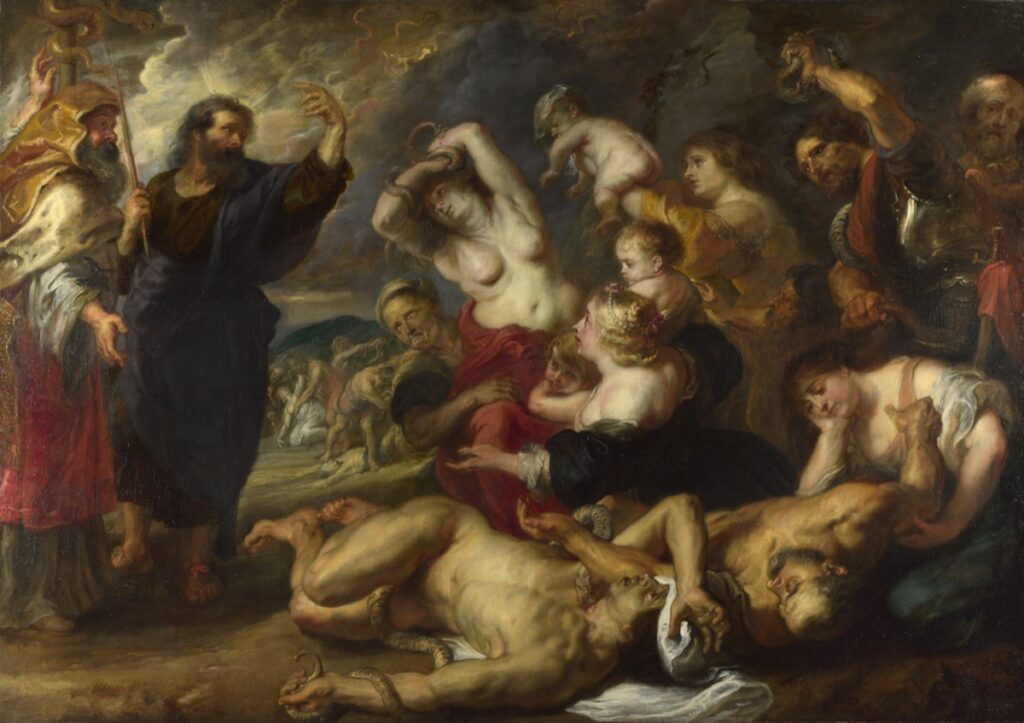
When Nicodemus asks “How can these things be?” – how can a dead soul be made alive, how can the Spirit accomplish this impossible thing – Jesus does not give a theological lecture on the mechanics of regeneration. He tells a story. And the story is about a snake on a stick.
“As Moses lifted up the serpent in the wilderness, even so must the Son of Man be lifted up, that whoever believes in Him should not perish but have eternal life” (3:14-15).
As the Dictionary of Biblical Imagery observes, “The story of the bronze serpent in Numbers 21:4-9 plays upon common ancient Near Eastern associations with the snake or serpent as a symbol of evil power and chaos from the underworld as well as a symbol of fertility, healing and life. This image of Moses lifting up the serpent in the wilderness is used by the NT text of John 3:14-15 as a precursor of Jesus who was ‘lifted up’ on the cross, signifying both his crucifixion and exaltation” (Leland Ryken et al., Dictionary of Biblical Imagery, p. 699). The background is Numbers 21:4-9. Israel, delivered from Egypt, provided with manna, guided by a pillar of cloud and fire, responds to God’s lavish provision with bitter complaint: “Why have you brought us out of Egypt to die in the wilderness? There is no food and no water, and our soul loathes this worthless bread” (Numbers 21:5). God responds with fiery serpents – venomous snakes whose bite brought agonizing death. The people repent. Moses prays. And God gives a remedy so strange that it almost sounds like a prank: make a bronze serpent, put it on a pole, and lift it up. Anyone who has been bitten – anyone who is dying from the venom – need only look at the bronze serpent and live.
R.C. Sproul painted the scene vividly: “I can’t think of few things worse than imagining being just thrown into a pit of vipers where all around me are these fiery serpents, one bite of which can be fatal. It’s something out of the temple of doom… And God said simply, if anyone wants healing, if anyone wants redemption from this plague, if anyone wants rescue from my judgment – let them simply look at this and they will be healed.”6
The typology between Numbers 21 and John 3 is precise, and Jesus Himself draws it:
| Numbers 21 | John 3 |
|---|---|
| Israel bitten by fiery serpents | Humanity poisoned by sin |
| Serpent venom bringing physical death | Sin bringing eternal perishing |
| Bronze serpent lifted on a pole | Son of Man lifted on a cross |
| Looking at the serpent in faith | Believing in Christ |
| Physical life preserved | Eternal life received |
But there is a layer of the typology that deserves deeper exploration. The bronze serpent was an image of the very thing that was killing them. It was a serpent – fashioned in the likeness of the instrument of death. Paul captures this dimension when he writes of Christ: “God made Him who had no sin to be sin for us” (2 Corinthians 5:21). Christ on the cross bore the likeness of the curse. He became what was destroying us – not by becoming sinful, but by bearing the penalty of sin in His own body. The one lifted up on the pole took upon Himself the venom that was killing the world.
The Necessity of the Cross
“Even so must the Son of Man be lifted up” (3:14). There is that word again – “dei”Greek“δεῖ”“dei”“verb,“it. The same divine necessity that governs the new birth governs the cross. The crucifixion was not a contingency plan. It was not God scrambling to recover from an unexpected human rebellion. It was the eternal, predetermined, necessary plan decreed before the foundation of the world.
The word dei appears at the most critical junctures in the Gospels. The Son of Man must suffer (Mark 8:31). The Scriptures must be fulfilled (Luke 24:44). The Christ must be lifted up (John 3:14). At every turn, the divine “must” overrides human autonomy, political circumstance, and historical contingency. The cross is Plan A from eternity – not a reaction to history but the event toward which all of history was being directed.
John Owen, the greatest Puritan theologian, argued this with relentless logic in The Death of Death in the Death of Christ: “The death of Christ was not the discovery of a remedy after the disease was found, but the provision of a remedy before the disease was contracted. The Lamb was slain from the foundation of the world – not as an afterthought but as the foremost thought of God.”7
The Double Meaning of “Lifted Up”
The verb “hypsōthēnai”Greek“ὑψωθῆναι”“hypsōthēnai”“verb,“to carries a deliberate double meaning in John’s Gospel. It refers simultaneously to crucifixion (being physically elevated on a cross) and to exaltation (being glorified). This is not merely clever wordplay. It is John’s deepest theological conviction about the cross: the crucifixion is the glorification. The cross is not a humiliation followed by an exaltation – it is the exaltation itself, viewed from the angle of divine purpose rather than human perception.
This double meaning appears three times in John:
- 3:14 – “The Son of Man must be lifted up”
- 8:28 – “When you lift up the Son of Man, then you will know that I am He”
- 12:32-33 – “And I, if I am lifted up from the earth, will draw all peoples to Myself.” John adds: “This He said, signifying by what death He would die.”
The connection to Isaiah 52:13 is almost certainly intentional: “Behold, My Servant shall deal prudently; He shall be exalted and extolled and be very high.” The Hebrew verb “yarum”Hebrew“יָרוּם”“yarum”“verb,“shall in Isaiah 52:13 introduces the Suffering Servant passage that culminates in Isaiah 53 – the most detailed prophecy of substitutionary atonement in the Old Testament. When John uses “hypsoō”Greek“ὑψόω”“hypsoō”“verb”“to of Jesus, he is connecting the crucifixion to the Servant who was “wounded for our transgressions” and “bruised for our iniquities” (Isaiah 53:5). The lifting up on the cross and the lifting up in glory are one act, seen from two perspectives. The shame is the glory. The death is the victory. The curse is the cure.
Substitutionary Atonement in John 3
John 3:14-15 does not merely illustrate the atonement – it establishes its substitutionary character. Consider the logic:
The Israelites were dying of serpent venom. The bronze serpent, bearing the image of what was killing them, was lifted up in their place. Those who looked in faith at the substitute were healed. The venom remained lethal; the serpent on the pole absorbed the curse. The rabbinic tradition itself grappled with this strange remedy. Strack and Billerbeck record the midrashic commentary: “Why did he punish them with serpents? Even if the serpent eats all the delicacies of the world, they turn into dust in his mouth… And these eat the manna that turns into any desired taste” – the serpent, cursed to eat dust, became the instrument of judgment against a people who despised heavenly bread (Hermann L. Strack and Paul Billerbeck, Commentary on the New Testament from the Talmud and Midrash, vol. 2, p. 294).
Similarly, humanity is dying of sin. The Son of Man, who “had no sin” but was “made sin for us” (2 Corinthians 5:21), was lifted up on a cross. Those who look in faith at the crucified Christ will not perish. The sin remains lethal; the one on the cross absorbed the condemnation.
Verse 18 completes the picture: “He who does not believe is condemned already.” The word “kekritai”Greek“κέκριται”“kekritai”“verb,“has is in the perfect tense – the judgment has already been rendered and its effects persist. Condemnation is not a future possibility; it is the present reality of every person outside of Christ. The cross addresses this existing condemnation by transferring it to the one lifted up. This is the heart of substitutionary atonement: Christ bears the condemnation that was already ours so that we might receive the life that was always His.
The cross is not Plan B. The Son of Man “must” be lifted up – the same divine necessity that governs regeneration governs Calvary. The bronze serpent typology reveals the substitutionary nature of the atonement: Christ bears the image of the curse, absorbs the venom of sin, and gives life to all who look in faith. The double meaning of “lifted up” – crucifixion and exaltation – reveals John’s deepest conviction: the cross is not humiliation followed by glory. The cross IS the glory.
3. The Love of God: What John 3:16 Actually Claims
What “God So Loved” Means
“For God so loved the world that He gave His only begotten Son, that whoever believes in Him should not perish but have everlasting life” (3:16).
It is the most quoted verse in the Bible. It is also the most misunderstood. And the misunderstanding begins with a single word: “so.”
The adverb “houtōs”Greek“οὕτως”“houtōs”“adverb”“in does not primarily mean “so much” – as though the verse were quantifying the volume of God’s love. It means “in this way” or “to this extent.” The emphasis falls not on the amount of divine affection but on its manner and demonstration. How did God love the world? Like this: He gave His Son. The cross is not the result of God’s love; it is the definition of God’s love. Apart from the cross, the statement “God loves you” is an abstraction with no content. The cross gives it content. It tells you what divine love looks like when it collides with a world in rebellion.
This is not sentimental love. Sentimentality is emotion divorced from action, feeling without cost. God’s love in John 3:16 is the most costly action ever taken – the giving of the eternal, beloved, one-and-only Son to die under divine wrath for creatures who were His enemies. This love is not warm and fuzzy. It is warm and bloody. It is a love that leads to Gethsemane, to the scourging post, to the cross.
J.I. Packer, in Knowing God, drew this distinction with devastating clarity: “The love of God is not a vague, diffused goodwill that smiles indulgently at everything. It is a love that costs. It cost the Father the life of His Son. It cost the Son the death of His body. And it cost both of them the eternal rupture of a fellowship that had never, in all of infinite eternity, been interrupted.”8
The Object of Divine Love: “The World”
“God so loved the world” – “tonGreek“τὸν“ton“noun,“the. In John’s Gospel, kosmos is a complex, multivalent term. It can refer to the created order (1:10a), to humanity in general (1:10b), or to the world system in active rebellion against God (15:18-19). Here, the emphasis falls on the unworthiness of the object. God did not love a world that was lovely, lovable, or loving toward Him. He loved a world that hated Him, killed His prophets, and would shortly crucify His Son.
This is what makes the verse astonishing – not that God loves, but that He loves this. As Sproul pressed in his sermon: “Can anybody read the story of Christ against the background of fallen humanity, against the constant opposition to God that is raised by fallen creatures in His world? I say to people, consider this scenario… Suppose He sends His own Son, and the people rise up against His Son and crucify Him. And yet God loves them enough that while they’re in the act of killing Him, God takes the sins of His people and transfers them to the death of His own Son… Would you have the guts to come up to God and say, ‘God, You haven’t done enough for this world that hates You?’”9
“Gave His Only Son”: The Sacrifice as Evidence
“That He gave His only begotten Son” – the verb “edōken”Greek“ἔδωκεν”“edōken”“verb,“gave” is an aorist, marking a specific historical act: the giving of the Son at the incarnation and the cross. And the object given is described as “monogenēs”Greek“μονογενής”“monogenēs”“adjective”“one – the one-of-a-kind, unique, eternally beloved Son. The Theological Dictionary of the New Testament clarifies the precise semantic range: “In compounds with genes, adverbs describe the nature rather than the source of derivation. Hence monogenes is used for the only child. More generally it means ‘unique’ or ‘incomparable’” (Gerhard Kittel and Gerhard Friedrich, eds., Theological Dictionary of the New Testament, abridged ed., p. 346). The Evangelical Dictionary of Theology further notes that “the word’s second half is not derived from gennan (to beget), but is an adjectival form derived from genos (origin, race)” – making “one and only” or “unique” a more precise rendering than the traditional “only begotten” (Daniel J. Treier, ed., Evangelical Dictionary of Theology, p. 618).
The sacrifice is the evidence of the love, not vice versa. We do not first perceive God’s love abstractly and then notice the cross as a secondary confirmation. Rather, we know that God loves because He gave His Son. The giving is the loving. Without the giving, the love would be invisible, unfelt, and – for all practical purposes – nonexistent. The cross is not one expression of divine love among many. It is the supreme, definitive, unrepeatable act that defines the word “love” for all eternity.
This has profound implications for how we read John 3:16. The verse is not a warm blanket assuring us that everything will be fine. It is a war report from the front lines of the cosmic conflict between holiness and sin, telling us that God Himself has entered the battle at infinite personal cost. The love of John 3:16 is not the love of a greeting card. It is the love of a Father watching His Son die – and willing it, because there was no other way to rescue the world that had turned against Him.
The Reformed Reading vs. the Popular Reading
The popular reading of John 3:16 draws two conclusions the text does not support.
First, that God’s love cancels His judgment. “God so loved the world” – therefore God would never condemn anyone, would never send anyone to hell, would never allow anyone to perish. But read two verses further: “He who does not believe is condemned already” (3:18). And read to the end of the chapter: “The wrath of God abides on him” (3:36). God’s love does not cancel His holiness. It satisfies it. The cross is the place where love and justice meet – where God’s refusal to let sin go unpunished (justice) and His refusal to let sinners go unredeemed (love) are both fully expressed in a single act. As Packer wrote: “The cross does not make God loving. God is eternally, inherently loving. The cross is the outworking of that love in a world where justice also demands satisfaction.”10
Second, that God’s love is so broad that it renders the exclusivity of Christ unnecessary. “God loved the world” – therefore all religions lead to God, and insisting on faith in Christ alone is narrow-minded and unloving. But the verse itself specifies the mechanism: “whoever believes in Him.” The universality is in the offer; the particularity is in the condition. God’s love is wide enough to encompass the world. The way of salvation is narrow enough to require faith in the one and only Son.
Sproul was characteristically direct: “He doesn’t love the world enough to say you can ignore the only one. We need to understand that because everything out there in that culture says, if God only provides one way of salvation, one savior, then God doesn’t really love the world.”11
Perish vs. Eternal Life: The Binary of John’s Gospel
“Should not perish but have everlasting life.” The structure presents two options. Not three. Not a spectrum. Two: perish or live. There is no middle ground in John’s theology. No neutral zone. No comfortable agnosticism. You are either believing or not believing, alive or dead, in the light or in the darkness, under grace or under wrath.
The verb “apolētai”Greek“ἀπόληται”“apolētai”“verb,“perish, does not mean annihilation. It means ruin, loss, destruction – the forfeiture of everything for which a human being was created. To perish is to lose God, lose meaning, lose hope, lose joy, lose self – eternally. The alternative – “zōēnGreek“ζωὴν“zōēn“noun“eternal – is not merely endless duration but a quality of existence: the life of the coming age, the life of God Himself shared with redeemed humanity.
John’s Gospel offers no middle category. You are either perishing or living. And the hinge between the two is faith in the crucified and risen Son.
God’s love in John 3:16 is not sentiment but sacrifice – demonstrated by the giving of His only Son. The cross does not cancel God’s justice; it satisfies it. The offer is universal (“whoever”), the condition particular (“believes in Him”), and the binary absolute: perish or live. The proper response to the exclusivity of Christ is not resentment at one way but astonishment at any way at all.
4. The Doctrine of Condemnation and Judgment
“Condemned Already”: Judgment as Present Reality
If John 3:16 is the most famous verse in the chapter, John 3:18 is the most neglected. And it is the verse that completes the picture.
“He who believes in Him is not condemned; but he who does not believe is condemned already, because he has not believed in the name of the only begotten Son of God.”
“ēdēGreek“ἤδη“ēdē“adverb“has. The adverb ēdē means “already.” The verb is in the perfect tense – an action completed in the past with effects continuing into the present. The TDNT entry on krino provides essential background: “The word krino means ‘to sunder,’ then ‘to select,’ ‘to decide,’ ‘to judge,’ ‘to assess’… The NT sense is usually ‘to judge’ with God or man as subject” (Gerhard Kittel and Gerhard Friedrich, eds., Theological Dictionary of the New Testament, abridged ed., p. 266). John’s use of the perfect tense transforms judgment from a future event into a present condition – the verdict has already been rendered. The unbeliever has already been judged. The verdict is not pending. The trial is not upcoming. The sentence has been pronounced. The person who does not believe in the Son is not awaiting condemnation at some future judgment day. He is living under condemnation right now, at this moment, as surely as a man who has been bitten by a venomous serpent is already dying whether he feels the symptoms yet or not.
This demolishes one of the most common objections to the gospel: “How could a loving God condemn people?” The answer is that God does not need to condemn them. They are condemned already. The default state of humanity after the fall is condemnation. It is not a sentence imposed on reluctant innocents. It is a condition that already exists. Christ does not come to condemn – “God did not send His Son into the world to condemn the world” (3:17). He comes to rescue people who are already condemned. The condemnation precedes the remedy. The disease precedes the cure. The venom precedes the bronze serpent.
Self-Condemnation: The Moral Nature of Unbelief
“And this is the condemnation, that the light has come into the world, and men loved darkness rather than light, because their deeds were evil” (3:19).
The early church father Irenaeus recognized the weight of this passage, writing: “He that believes not is condemned already, because he has not believed in the name of the only-begotten Son of God; that is, he separated himself from God of his own accord. For this is the condemnation, that light has come into this world, and men have loved darkness rather than light” (Irenaeus, Against Heresies, Book V, ch. 27, p. 322). This verse is a devastating indictment of the claim that unbelief is merely an intellectual problem – that people reject Christ because they lack sufficient evidence, haven’t heard a compelling enough argument, or simply find the historical claims implausible. John says otherwise. The problem is not insufficient evidence. The light has come. The problem is not intellectual but moral: “men loved darkness rather than light, because their deeds were evil.”
The verb “ēgapēsan”Greek“ἠγάπησαν”“ēgapēsan”“verb,“loved” is the same verb used of God’s love in verse 16. God loved the world; men loved the darkness. The parallel is intentional and devastating. The love of darkness is not a passive drift but an active preference – the same kind of deep, volitional commitment that characterizes God’s love for the world. People do not stumble into unbelief. They choose it. They prefer it. They love it. And they love it because the alternative – the light – would expose what they desperately want to keep hidden.
“For everyone practicing evil hates the light and does not come to the light, lest his deeds should be exposed” (3:20). The word “misei”Greek“μισεῖ”“misei”“verb,“hates” is present tense – a continuous, ongoing hatred. And the reason is not that the light is too bright for honest seekers. It is that the light is an exposure. It reveals what people want concealed. The cockroach does not flee the kitchen light because it has philosophical objections to illumination. It flees because the light reveals its presence in a place it should not be.
This means that unbelief is morally culpable. It is not an innocent mistake. It is not a respectable intellectual position. It is a love of darkness – a preference for hiding over being known, for self-deception over truth, for autonomy over surrender. Sproul was right: “Men love the darkness rather than the light because their deeds are evil. That’s our nature. We are by nature children of darkness. It is against the nature of a child of darkness to come to the light because we know what the light represents. It represents exposure.”12
The Urgency of the Gospel
The combination of “condemned already” and “men loved darkness” creates an urgent pastoral situation. The unconverted are not in a neutral holding pattern, waiting to make up their minds. They are already under judgment, already loving the very darkness that is destroying them, and already incapable of rescuing themselves. This is not a theoretical danger. It is a present condition.
This is why the gospel is urgent. Not because condemnation is a future risk that might possibly arrive someday if certain conditions are met. But because condemnation is the current address of every person outside of Christ. The fire is not approaching. The house is already burning. And the residents have locked the doors from the inside because they prefer the dark.
John Piper captures this urgency: “The wrath of God is not merely a future threat. It is a present reality from which Christ has come to deliver us. The rescue mission is not for people who might someday face danger. It is for people who are drowning now.”13
Condemnation is not a future sentence for the unconverted – it is a present reality. “He who does not believe is condemned already.” The root of unbelief is not intellectual but moral: people love darkness because it conceals what the light would expose. Unbelief is not innocent uncertainty; it is a culpable preference for hiding over being known. This makes the gospel urgently necessary, not optionally helpful.
5. The Doctrine of Christ’s Preeminence
“He Must Increase, I Must Decrease”
The second half of John 3 records the Baptist’s final public testimony, and it contains one of the most selfless – and most theologically precise – statements any human being has ever made about another.
John’s disciples come to him with competitive anxiety. Jesus is baptizing nearby, and the crowds are migrating. “Rabbi, He who was with you beyond the Jordan, to whom you have testified – behold, He is baptizing, and all are coming to Him!” (3:26). The subtext is unmistakable: You made Him famous. You pointed everyone to Him. And now He’s taking your followers. Aren’t you angry?
The Baptist’s response demolishes competitive ministry in a single sentence: “A man can receive nothing unless it has been given to him from heaven” (3:27). Every gift, every calling, every platform, every follower is a gift from God. To resent another person’s success is to resent God’s distribution of His own gifts. Sproul noted the parallel to Paul: “What do you have that you did not receive? And if you received it, why do you boast as though you did not?” (1 Corinthians 4:7).14
Then comes the declaration: “ekeinonGreek“ἐκεῖνον“ekeinon“pronoun“He. “He must increase, but I must decrease” (3:30).
Notice the dei – it is necessary. This is not a strategy John has devised. It is not a posture of false humility. It is not optional. The increase of Christ is a divine necessity. And the decrease of everyone and everything else is the inevitable corollary. Sproul emphasized this: “John is not suggesting a strategy that he has devised… He has his marching orders. He is called to go before Christ and once he announces Christ then John is to go back into the background. It’s necessary. It’s not optional. This has to happen.”15
The bridegroom metaphor is perfect. The “philosGreek“φίλος“philos“noun“friend does not compete with the groom for the bride. His joy is fulfilled when the groom arrives and the wedding proceeds. The best man who covets the bride has betrayed his entire role. And the Baptist says: “This joy of mine is fulfilled” (3:29). Not diminished. Not reluctantly accepted. Fulfilled. The decrease is the joy.
“He Who Comes from Above Is Above All”
The Baptist grounds Christ’s preeminence not in comparative achievement but in ontological category: “He who comes from above is above all; he who is of the earth is earthly and speaks of the earth. He who comes from heaven is above all” (3:31).
This is not a comparison between a better teacher and a good teacher, between a more successful ministry and a less successful one. It is a distinction between heaven and earth, Creator and creature, infinite and finite. Jesus is not comparatively superior to John. He is categorically other. He is “from above” – “anōthen”Greek“ἄνωθεν”“anōthen”“adverb”“from, the same word used in 3:3 of the new birth. The one who must be born from above is the one who has come from above. The origin determines the authority.
The Spirit “Without Measure”
“For He whom God has sent speaks the words of God, for God does not give the Spirit by measure” (3:34).
The Old Testament prophets received the Spirit in measure – for specific tasks, at specific times, for limited durations. The Spirit came upon Samson for feats of strength. The Spirit came upon David at his anointing. The Spirit came upon Isaiah for prophetic utterance. In each case, the anointing was partial, temporary, and task-specific. The TDNT entry on pneuma explains this broader theological framework: “Since the Holy Spirit affects the whole person and cannot be explained psychologically, Paul adopts popular anthropological ideas quite freely… In the last resort, however, the pneuma is for Paul the God-given pneuma that is alien to us” (Gerhard Kittel and Gerhard Friedrich, eds., Theological Dictionary of the New Testament, abridged ed., p. 512). The Spirit is not a natural human faculty but a divine gift – and in Jesus, that gift is given without measure.
Jesus received the Spirit “ouGreek“οὐ“ou“negative“not – without measure, without limit, without rationing. The fullness of the Spirit’s power, wisdom, presence, and authority rested on Him permanently and completely. This is why His words are not merely inspired (as the prophets’ words were inspired) but are the very words of God spoken without any mediation, distortion, or limitation. When Jesus speaks, God speaks – not approximately, not partially, but fully and directly.
The Wrath That “Abides”
The chapter closes with the starkest possible contrast: “He who believes in the Son has everlasting life; and he who does not believe the Son shall not see life, but the wrath of God abides on him” (3:36).
The word “menei”Greek“μένει”“menei”“verb,“remains, is one of John’s signature words. He uses it of believers abiding in Christ (15:4-7), of Christ’s words abiding in believers (15:7), of the Father’s love abiding (15:10). It describes a permanent, settled, ongoing condition. Here it describes the wrath of God abiding on the unbeliever.
This is not wrath that flares and subsides. It is not anger that ebbs and flows with God’s mood. It is settled, permanent, immovable wrath – the holy response of a righteous God to unrepentant rebellion. And it abides. Present tense. Continuous action. It remains on the unbeliever right now, at this moment, and will remain forever unless and until that person believes in the Son.
The conjunction of “everlasting life” and “wrath abides” in the same verse is not an accident. It is a mirror held up to the reader: which condition describes you? There is no third option. No abstention. No “I’ll think about it.” You are either under grace or under wrath. You either have eternal life or the wrath of God is settled upon you like a weight from which you cannot free yourself.
The Baptist’s “He must increase, I must decrease” is not a strategy but a divine imperative. Christ’s superiority is not comparative but categorical – He is from above; everyone else is from the earth. He receives the Spirit without measure. The Father has given all things into His hand. And the chapter closes with an absolute binary: everlasting life for those who believe, and the settled, abiding wrath of God for those who refuse. There is no third category.
6. Practical Theology: What John 3 Demands
If Regeneration Is God’s Work, Is Human Responsibility Eliminated?
This is the question that every honest reader of John 3 must ask. If the new birth is entirely God’s work – if the Spirit blows where He wishes, if dead men cannot make themselves alive, if regeneration precedes and produces faith – then what is left for human beings to do? Is responsibility eliminated? Is the command to believe meaningless?
The answer, resoundingly, is no. The Reformed tradition has always insisted on the paradox: divine sovereignty and human responsibility are both true, both taught in Scripture, and both operative in salvation. God regenerates. Humans believe. The one makes the other possible, but neither cancels the other. The Evangelical Dictionary of Theology traces this historical balance: “The church fathers did not formulate the concept of regeneration precisely. They equated it, broadly speaking, with baptismal grace… Augustine realized, and vindicated against Pelagianism, the necessity for prevenient grace to make people trust and love God… The Reformers reaffirmed the substance of Augustine’s doctrine of prevenient grace, and Reformed theology still maintains it” (Daniel J. Treier, ed., Evangelical Dictionary of Theology, p. 730). The Reformed insistence on regeneration preceding faith was never intended to eliminate human responsibility but to locate its origin in divine grace.
The command to believe remains. “Whoever believes in Him should not perish” (3:16). “He who believes in the Son has everlasting life” (3:36). The imperative is real. The offer is genuine. The invitation is extended to all. And the fact that no one can believe apart from the Spirit’s work does not make the command to believe any less binding. A drowning man cannot save himself. That does not mean it is meaningless to throw him a rope. The rope is real. The command to grab it is real. But his ability to grab it depends on a power outside himself.
Calvin held these truths together with characteristic precision: “We are not to suppose that it is left to each man’s judgment to seek or reject God. The Spirit enlightens the minds of those whom He has chosen; but let no man on that account give way to sloth, as if he had nothing to do.”16
How to Preach John 3:16 Without Sentimentality
The pastoral challenge of John 3:16 is to proclaim it with both its warmth and its edge – to let the verse be as comforting as it is, without stripping away the judgment that surrounds it on every side.
John 3:16 cannot be preached honestly apart from 3:18 (“condemned already”), 3:19 (“men loved darkness”), and 3:36 (“the wrath of God abides”). The love of God in verse 16 is the love of a God who is rescuing people from a condemnation that is already in force. Strip away the condemnation and the love loses its urgency, its cost, and its glory. A love that rescues you from nothing is a love that costs nothing. And a love that costs nothing is not the love of John 3:16.
The cross is both love and judgment. It is love toward sinners – God giving His Son so that whoever believes will not perish. It is judgment against sin – God pouring out on His Son the wrath that sinners deserved. To preach the love without the judgment is to produce sentimentalists who think God is their therapist. To preach the judgment without the love is to produce terrified people who think God is their executioner. The gospel holds both together, and John 3 insists that we do the same.
What the Baptist Teaches About Christian Ministry
John the Baptist’s final testimony in John 3:27-30 is a masterclass in ministerial health. And it addresses a sickness that is epidemic in the modern church: the competitive, platform-driven, follower-counting, influence-obsessed ministry culture that measures success by the size of the audience rather than the faithfulness of the servant.
The Baptist teaches three principles:
First, every gift is from heaven. “A man can receive nothing unless it has been given to him from heaven” (3:27). If your ministry is fruitful, God made it so. If another’s ministry is more fruitful, God made it so. To resent another ministry’s success is to quarrel with divine providence. To boast in your own is to claim credit for a gift.
Second, the minister is not the bridegroom. “He who has the bride is the bridegroom; but the friend of the bridegroom rejoices greatly” (3:29). The church belongs to Christ, not to the pastor. The pastor’s role is to bring people to Christ, not to gather a following for himself. The moment a minister begins to feel proprietary about “his” people, “his” church, “his” platform, he has confused the best man with the groom.
Third, joy consists in someone else’s success. “This joy of mine is fulfilled” (3:29). The Baptist’s joy was not diminished by Christ’s increase. It was fulfilled by it. His entire purpose was to prepare the way, point to the Messiah, and then step aside. When the Messiah came, the mission was accomplished. The decrease was not a loss but a completion.
The Pastoral Challenge: What Do You Say to the Nicodemuses?
Every church has Nicodemuses. They are the faithful attendees, the generous givers, the Sunday school teachers, the committee members, the people who have been in the church for forty years. They know the Bible. They can recite the creeds. They have built their lives on religious performance. And they have never been born again.
How do you tell a moral, religious, churchgoing person that their religion is not enough?
You tell them what Jesus told Nicodemus: you must be born again. Not improved. Not educated. Not inspired. Born again. From above. By the Spirit. And you tell them that this is not an insult to their effort but a diagnosis of their condition. The problem is not that they have tried too little. The problem is that flesh produces flesh, and no amount of flesh can produce spirit.
You tell them that Nicodemus was the best man Israel had – Pharisee, Sanhedrin member, teacher of the nation – and Jesus told him he could not even see the kingdom without a birth he could not produce for himself. If Nicodemus’ credentials were insufficient, so are yours.
And you tell them the good news: the same wind that blew into a Pharisee’s study on a dark night in Jerusalem still blows. It blows where it wishes. It blows into committee meetings and hospital rooms and seminary classrooms and prison cells and kitchens and boardrooms. It blows into the lives of people who never expected it and had no idea they needed it. And when it blows, the dead come alive.
Nicodemus came in the dark. He appears twice more in John’s Gospel – once defending Jesus before the Sanhedrin (7:50-51) and once bringing seventy-five pounds of burial spices to anoint the body of the crucified Christ (19:39). Tradition holds that he became a believer. If so, then the wind blew. It blew through every layer of religious performance and theological sophistication and social respectability and personal pride. And it brought a dead man to life.
That is what John 3 teaches. That is what John 3 demands. And that is what John 3 offers – to everyone who has ears to hear the sound of the wind.
Divine sovereignty does not eliminate human responsibility – the command to believe remains real and binding. John 3:16 must be preached with both its warmth and its edge, inseparable from the condemnation of 3:18 and the wrath of 3:36. The Baptist models ministerial health: every gift is from heaven, the minister is not the bridegroom, and joy consists in someone else’s success. And the pastoral challenge remains: telling religious people that religion is not enough – that flesh produces flesh, and only the Spirit produces life.
Sources Cited
- Calvin, John. Commentary on the Gospel According to John. Various editions.
- Calvin, John. Institutes of the Christian Religion. Various editions.
- Draper, Charles W., ed. Holman Illustrated Bible Dictionary. Nashville: Holman, 2003.
- Edwards, Jonathan. A Treatise Concerning Religious Affections. 1746.
- Erickson, Millard J. Christian Theology. Grand Rapids: Baker, 1998.
- Ferguson, Everett. Baptism in the Early Church: History, Theology, and Liturgy in the First Five Centuries. Grand Rapids: Eerdmans, 2009.
- Freedman, David Noel, ed. The Anchor Bible Dictionary. 6 vols. New York: Doubleday, 1992.
- Irenaeus. Against Heresies. Various editions.
- Kittel, Gerhard, and Gerhard Friedrich, eds. Theological Dictionary of the New Testament. Abridged in one volume by Geoffrey W. Bromiley. Grand Rapids: Eerdmans, 1985.
- Letham, Robert. Systematic Theology. Wheaton: Crossway, 2019.
- Owen, John. The Death of Death in the Death of Christ. 1647.
- Packer, J.I. Knowing God. London: Hodder and Stoughton, 1973.
- Piper, John. The Pleasures of God. Portland: Multnomah, 1991.
- Ryken, Leland, et al., eds. Dictionary of Biblical Imagery. Downers Grove: InterVarsity, 1998.
- Sproul, R.C. Chosen by God. Carol Stream: Tyndale, 1986.
- Sproul, R.C. The Holiness of God. Carol Stream: Tyndale, 1985.
- Sproul, R.C. Sermons on John 3, St. Andrew’s Expositional Commentary series. 2002.
- Strack, Hermann L., and Paul Billerbeck. Commentary on the New Testament from the Talmud and Midrash. Munich: Beck, 1922-1961.
- Treier, Daniel J., ed. Evangelical Dictionary of Theology. 3rd ed. Grand Rapids: Baker Academic, 2017.
This article is part of the John Deep Dive Series. For related studies, see: – John 3 Commentary: Born from Above, Lifted on a Cross, Loved Beyond Reason – Verse-by-verse pillar deep dive – Greek Words That Unlock John 3 – Anothen, pneuma, monogenes, and the language behind the new birth – The World Behind John 3 – Pharisees, the Sanhedrin, and what Nicodemus risked by coming to Jesus