The protests didn’t end. They went underground.
If you followed the coverage in January and early February, you saw the fires, the body counts, the chanting from rooftops. You saw a regime that murdered tens of thousands of its own people and then celebrated its revolution anniversary like nothing happened.
Then the news cycle moved on. The cameras pointed somewhere else. And the Islamic Republic assumed the crisis was over.
It’s not over.
Across Iran, people are tearing down monuments to Ruhollah Khomeini — the architect of the 1979 revolution, the man whose face has loomed over this country for nearly half a century. They are burning banners of Supreme Leader Ali Khamenei in the streets. Not in isolated incidents. Not in a single city. Across the country, in acts of defiance so dangerous that each one could cost a life.
And while the people tear down the images of their oppressors, the regime is waging a quieter war — one fought in hospitals, morgues, and government offices. A war designed not to defeat the protesters but to erase them.
This is what the aftermath looks like.
Inside Iran: What the Regime Doesn’t Want You to See
The Islamic Republic has a problem. It killed too many people. And now it needs the evidence to disappear.
Start with the hospitals.
When the crackdown began in January, security forces fired pellet rounds into crowds. Not rubber bullets — metal pellets designed to embed in flesh, shatter bone, and blind. The wounds are distinctive. If you show up at a hospital with pellet injuries, you are a protester. And if you are a protester, you are a target.
This was by design. The pellet rounds serve a dual purpose: they maim in the moment, and they mark you for later. When wounded Iranians dragged themselves to hospitals seeking treatment, security forces were waiting. Thousands have been detained at medical facilities. Thousands more have refused to seek treatment entirely — choosing infection, permanent disability, or death over the certainty of arrest.
But the medical abuse doesn’t stop at the hospital doors.
Reports from multiple sources — corroborated by leaked testimony from medical staff — describe plainclothes government officers entering hospitals and injecting detained protesters, including children, in the aftermath of surgeries. The exact substances remain unconfirmed. What is confirmed is the pattern: young Iranians go in for treatment and come out changed — sedated, disoriented, or worse. Medical professionals who have spoken out describe it as systematic. Families who have tried to intervene have been threatened.
Let that register. A government is using its own hospitals as interrogation sites. Children who survived the bullets are being subjected to medical procedures they did not consent to, administered by men in plainclothes who answer to the intelligence services, not the Hippocratic oath.
And the dead? The regime doesn’t want them counted.
Hospitals across Iran have been ordered not to register the bodies of slain protesters. Families arriving to claim their loved ones are turned away or told no record exists. Bodies are moved to military facilities. In some cases, as we reported in our earlier coverage, those facilities are later set on fire — the regime’s preferred method of destroying evidence it cannot explain.
A government that controls the body count controls the narrative. And the Islamic Republic is determined to control both.
When the evidence cannot be hidden, the regime does what authoritarian governments have always done: it manufactures an alternative story. In recent weeks, Iranian state media has escalated its campaign to blame Israel for the protests. The framing is familiar: the demonstrations are not organic expressions of a population that has been crushed by inflation, humiliated by military defeat, and brutalized by its own security forces. No — they are a Zionist operation. A foreign plot. An Israeli intelligence campaign designed to destabilize the Islamic Republic.
This is not new rhetoric. But its escalation is deliberate. By casting the protests as an Israeli operation, the regime creates the legal and theological framework for unlimited suppression. These are not citizens exercising their rights. They are enemy agents. And enemy agents deserve whatever they get.
The Cost of Dissent
In any country, dissent has a price. In the Islamic Republic, the price is everything you have.
Consider the footballers.
Iran’s football stars are among the most visible public figures in the country — far more influential than politicians, and far more trusted. When prominent players expressed sympathy for the protesters, the regime moved swiftly. One famous footballer — well-known for his public support of the protest movement — had his assets seized. Bank accounts frozen. Properties confiscated. Another was detained outright.
The message was precise: fame will not protect you. Wealth will not protect you. Popularity will not protect you. If you stand with the people, you will lose everything. And if losing everything doesn’t silence you, we have prisons.
But the deepest cost is borne by those who never sought attention at all.
The funeral scenes emerging from Iran tell a story that statistics cannot. A widow weeping over a body bag — not a casket, because caskets require registration, and registration creates a record, and the regime does not want records. Body bags stacked in facilities that are not morgues but have become morgues because the actual morgues are full, or closed, or under military control.
Families searching for the missing. Mothers who last saw their sons being dragged into vans. Fathers who went to every hospital in the city and were told at each one: “No record of that name.” Bodies of protesters — identified by family members through leaked photographs on Telegram channels — that the government refuses to release.
This is what the cost of dissent looks like when the state has no limits: not just punishment, but erasure. The regime does not merely kill its opponents. It tries to make them disappear — from the hospitals, from the death records, from history itself.
And still, the monuments come down. And still, the banners burn.
The World Responds
The Iranian diaspora is not waiting for governments to act.
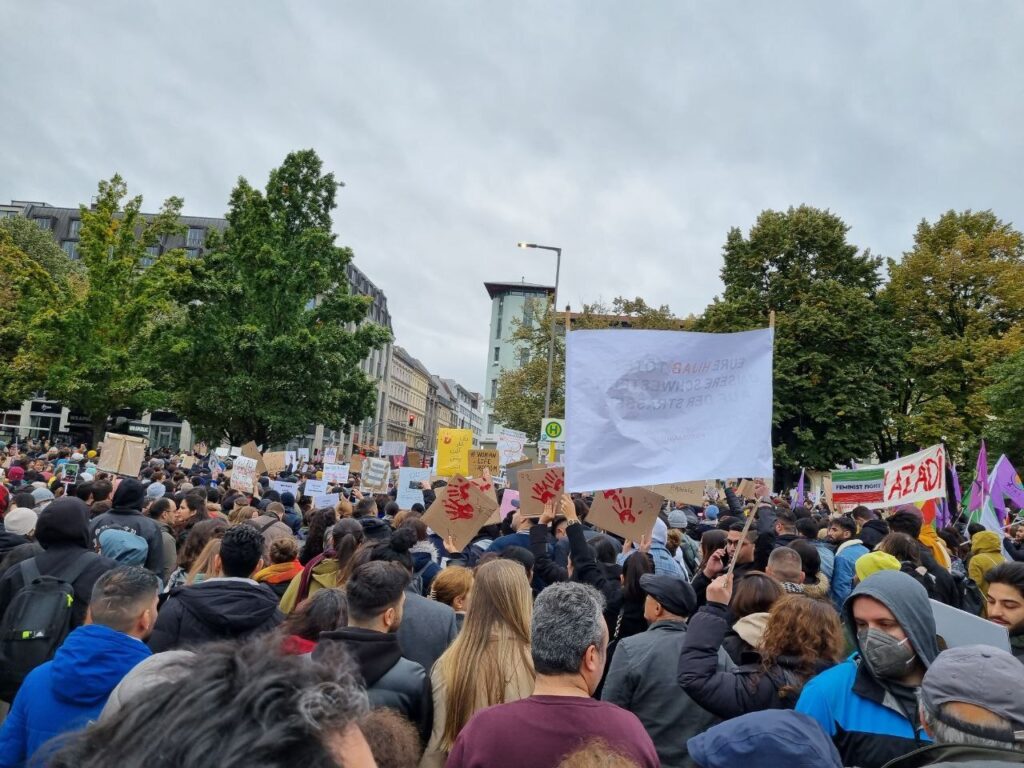
In February 2026, anti-regime protests erupted in cities across the globe — not as isolated vigils, but as coordinated declarations of solidarity with the people inside Iran. Munich. Warsaw. Toronto. Athens. Dublin. Madrid. Boston. Pretoria. Eight cities on four continents, united by a single demand: the world must not look away.
The Munich protests carried particular weight. Germany is home to one of the largest Iranian diaspora communities in Europe, and Munich became the focal point for a convergence of exile politics, human rights advocacy, and raw grief. Anti-ayatollah demonstrators filled the streets, their signs bearing the names of the dead, photographs of the missing, and a simple, devastating question: Where are they?
It was in Munich that Crown Prince Reza Pahlavi — the son of Iran’s last shah, and the most prominent figure in the Iranian opposition abroad — delivered a speech that electrified the diaspora. Pahlavi called for a secular, democratic Iran. He called for the international community to hold the regime accountable for its massacres. And he named what many Iranians already know: the Islamic Republic is not reformable. It must be replaced.
Whatever one makes of Pahlavi’s politics — and the Iranian diaspora is far from unified on the question of monarchy — his speech crystallized something that the protests inside Iran have been saying for months: this is not a demand for reform. This is a demand for a new beginning.
The global protests also served a practical function. In Warsaw, organizers collected testimony from families of the disappeared. In Toronto, legal advocates began compiling evidence for potential international criminal proceedings. In Boston, Iranian-American medical professionals organized to provide remote guidance to wounded protesters who cannot access hospitals safely.
The international community’s official response remains muted. The UN has issued statements. Some European governments have summoned Iranian ambassadors. But no new sanctions have been tied specifically to the January massacres. No international tribunal has been convened. The diplomatic machinery grinds slowly, when it grinds at all.
The diaspora is not waiting for the machinery. They are building their own.
What Scripture Says
There is a psalm that reads like it was written for this moment.
“Why, O LORD, do you stand far away? Why do you hide yourself in times of trouble? In arrogance the wicked hotly pursue the poor; let them be caught in the schemes that they have devised. For the wicked boasts of the desires of his soul, and the one greedy for gain curses and renounces the LORD. In the pride of his face the wicked does not seek him; all his thoughts are, ‘There is no God.'” (Psalm 10:1-4)
Read that and tell me the psalmist doesn’t know the Islamic Republic.
The arrogant pursue the poor. They boast. They scheme. They act as though there is no God who sees — or worse, they act as though God endorses their violence. The ayatollahs do not say “There is no God.” They say something more dangerous: “God is on our side.” They clothe mass murder in theological language. They call massacre purification. They call tyranny righteousness.
But the psalm doesn’t end with the wicked boasting. It ends with God rising.
“Arise, O LORD; O God, lift up your hand; forget not the afflicted. Why does the wicked renounce God and say in his heart, ‘You will not call to account’? But you do see, for you note mischief and vexation, that you may take it into your hands; to you the helpless commits himself; you have been the helper of the fatherless.” (Psalm 10:12-14)
But you do see.
God sees the pellet wounds. He sees the children in the hospitals. He sees the body bags and the widows and the fires set to destroy the evidence. He sees the unregistered dead. He sees the footballers stripped of everything for the crime of compassion. He sees the monuments coming down and the banners burning and the chanting in the dark.
And He notes it. The Hebrew is precise: God notes mischief and vexation. He is keeping a record. The regime may refuse to register the dead, but God has His own registry. And His books are meticulous.
The book of Revelation gives us the scene from the other side of history:
“When he opened the fifth seal, I saw under the altar the souls of those who had been slain for the word of God and for the witness they had borne. They cried out with a loud voice, ‘O Sovereign Lord, holy and true, how long before you will judge and avenge our blood on those who dwell on the earth?'” (Revelation 6:9-10)
How long?
That is the cry of every Iranian mother searching for her son’s body. Every widow weeping over a body bag. Every protester who risked everything and watched the world look away. How long will the wicked prosper? How long will the blood cry out from the ground?
Scripture does not give us a date. But it gives us a certainty. The souls under the altar are told to rest “a little longer” — and then justice comes. Not maybe. Not hopefully. It comes. The God who notes every act of mischief will settle every account. No regime is exempt. No dictator escapes the final audit.
The mills of God grind slowly. But they grind to powder.
How to Pray
Do not pray vaguely. Pray like a war correspondent filing a report to heaven. Here is what to bring before the throne:
- For the wounded hiding from hospitals. Pray for the thousands of Iranians who are treating their own injuries at home rather than risk arrest. Pray for infection to be held back. Pray for the underground medical networks providing remote care. Pray for courage for the doctors and nurses who are defying orders to report patients.
- For the families of the disappeared. Pray for the mothers and fathers who do not know if their children are alive or dead. Pray that the bodies withheld by the regime would be returned. Pray that the unregistered dead would be named — if not by the Islamic Republic, then by the international community.
- For the global solidarity movement. Pray for the diaspora communities in Munich, Toronto, Warsaw, and beyond. Pray that their documentation efforts would produce evidence that cannot be denied. Pray for legal advocates building cases for international accountability.
- For the underground church in Iran. Pray for the two million believers gathering in secret. Pray for the house church leaders who have been accused of fueling the protests. Pray that the gospel would advance precisely where the regime is trying to crush it.
- For cracks in the regime. Pray that security forces would refuse orders. Pray that leaked videos would continue to surface. Pray that the men who fire pellets into crowds would be haunted by what they have done. Pray for defections. Pray for conscience.
- For justice. Pray that the God who notes mischief and vexation would act. Pray Psalm 10 over Iran. Pray that the wicked would not prosper forever. Pray that the cry of “How long?” would be answered — in God’s timing, with God’s justice, which no human court can match.
The monuments are coming down. The banners are burning. The chanting hasn’t stopped. Inside Iran, the regime is doing everything it can to erase what happened — burning evidence, silencing witnesses, hunting the wounded in their hospital beds.
But you cannot erase what God has recorded. You cannot silence a cry that has reached the altar. And you cannot destroy a people whose suffering has been noted by the One who keeps the books.
“But you do see, for you note mischief and vexation, that you may take it into your hands.”
He sees. He notes. He acts.
The regime should be terrified.
This article is a companion piece to “47 Years of Iran’s Islamic Revolution” and “Iran: Protests, Persecution, and the God Who Sees.” For more on the persecuted church worldwide, see our Christian Persecution 2026 feature.
Sources: HRANA (Human Rights Activists News Agency); Behold Israel (Amir Tsarfati), Telegram; Babak Taghvaee, X (formerly Twitter); citizen documentation via Telegram channels. Global protest locations confirmed via diaspora media and on-the-ground reporting.